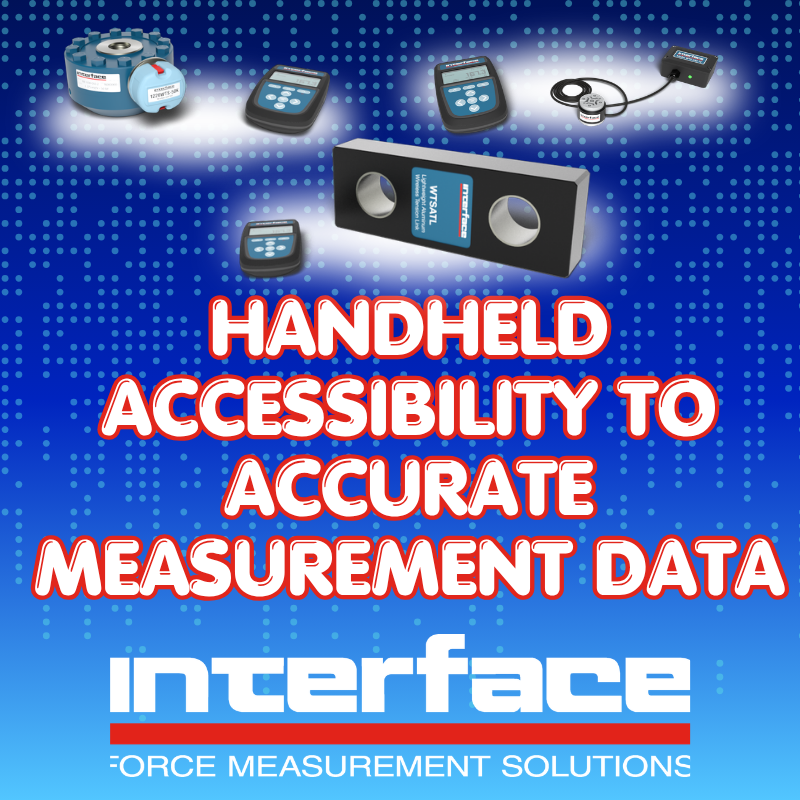
Handheld Accessibility to Accurate Measurement Data
 Combining sensors with portable, handheld instrumentation delivers lab-grade precision directly to field environments. When testing moves outside a traditional test lab, dragging power cords, desktop PCs, and bulky signal conditioners across a plant floor or job site creates safety hazards and limits mobility. This instrument class provides measurement accuracy without cable constraints.
Interface handheld indicators, multi-channel Bluetooth data loggers, and wireless telemetry receivers pair directly with Interface’s load cells, torque transducers, and multi-axis sensors. By handling excitation, bridge completion, analog-to-digital conversion, and direct engineering unit display in a compact package, these instruments deliver immediate verification, high-speed onboard logging, and untethered continuous data acquisition.
Interface Portable Indicator Configurations
Interface handheld instrumentation combines dedicated strain gage bridge conditioning, regulated excitation, and high-resolution analog-to-digital conversion into compact, battery-powered hardware. Rather than routing long sensor leads back to fixed data acquisition racks, technicians can connect load cells, torque transducers, or load pins directly to a handheld unit at the physical test point.
With pre-stored sensor calibrations, tare functions, and high-speed onboard data logging, handheld indicators let operators verify peak loads, track continuous force profiles, and diagnose mechanical setups in tight machine envelopes where benchtop instruments cannot fit. Whether performing routine field verification, structural proof tests, or active machinery troubleshooting, handheld devices deliver calibrated measurement data immediately without cumbersome configuration.

Built for direct sensor connection via standard industrial connectors. The 9325 Portable Sensor Display and 9325-NU Portable Sensor Display series provide immediate readout with dual-range calibration storage, gross/net tare functions, and battery operation. The 9330 Battery Powered High Speed Data Logging Indicator adds high-speed logging up to several thousand samples per second directly to an SD card for transient and dynamic load profiling.
Battery-powered units that accept 4 to 6 bridge inputs simultaneously include the 4850 Battery Powered Bluetooth Weight Indicator. They stream real-time load data directly to tablets, laptops, or mobile devices without external data cables, making them ideal for multi-axis monitoring and distributed force verification.
Handheld transceivers that communicate with Interface WTS wireless transmitters over license-free 2.4 GHz radio. Available for single-sensor direct readouts, cycling through multiple sensors, or summing outputs across an entire network of load cells. The most advanced portable option is the Interface WTS-HK-S Next-Generation Wireless Handheld and WTS-BS-1 Wireless Handheld Display for Unlimited Transmitters.
Interface Handheld Instrumentation Complete Systems
A precision load cell is only as dependable as the signal chain connected to it. To eliminate integration guesswork and signal mismatch, Interface provides fully integrated portable measurement systems pairing our high-accuracy sensors directly with handheld instrumentation and accessories. Every complete system undergoes factory system-level calibration, testing the sensor, cable assembly, and portable indicator together as a single, verified unit. This end-to-end matching ensures NIST-traceable accuracy out of the box, eliminates on-site scaling errors, and lets technicians deploy directly to the field with complete measurement confidence.

The 1200 Series Wireless Low Profile Load Cell and the WTS-HK-S Wireless Handheld are part of Interface’s Wireless Telemetry System, offering portable, real-time force measurement without cables. The load cell measures tension or compression and wirelessly transmits data to receivers. The WTS-HK-S acts as the receiver and display, showing live readings, monitoring multiple transmitters, and allowing configuration. Together, they provide a compact, wireless system ideal for field, test, or industrial use.

The LW General Purpose Load Washer Load Cell, combined with the WTS Wireless Telemetry System, includes the Interface Load Washer Load Cell, which detects tensile or compressive forces in bolted joints, fasteners, and structural assemblies. Its mV/V output connects to the WTS-AM-1E Wireless Strain Bridge Transmitter Module, transforming the sensor signals into wireless telemetry data. The WTS-HK-S Next Generation Wireless Handheld then receives and displays real-time force readings, forming a portable system suited for load verification, structural testing, and field measurements.

The BPL Pedal Load Cell, combined with the BTS Bluetooth® Telemetry System, provides accurate, wireless pedal-force measurement. The small load cell gathers high-precision data, which the BTS then transmits in real time to mobile devices, making it perfect for simulation, testing, and remote monitoring without any physical connections.
The MRT Miniature Flange Style Reaction Torque Transducer and WTS Wireless Telemetry System is an excellent pairing for torque measurement. The MRT Miniature Flange Style Reaction Torque Transducer accurately measures both static and dynamic reaction torque in small-scale applications. Its mV/V output interfaces with the WTS-AM-1E Wireless Strain Bridge Transmitter Module, which wirelessly sends data to the WTS-HK-S Next Generation Wireless Handheld for convenient, real-time torque monitoring, testing, and process control.

When you need instant measurement access with a load pin load cell, the ILPW Standard Wireless Load Measuring Pin and WTS-HK-S Next-Generation Wireless Handheld are an excellent choice. The ILPW Standard Wireless Load Measuring Pin transmits real‑time force data wirelessly to the WTS-HK-S Next-Generation Wireless Handheld, enabling seamless monitoring from multiple sensors on a compact, portable interface.
Practical Use Cases for Continuous Load Monitoring Using Handheld Instrumentation
Continuous load monitoring demands real-time data capture under operating conditions that rarely accommodate fixed acquisition racks, external power supplies, or delicate desktop PCs. Handheld instrumentation provides direct bridge excitation, high-speed onboard analog-to-digital conversion, and integrated data logging right at the sensor location, turning static inspection routines into active, continuous diagnostic streams. The following use cases demonstrate how handheld devices operate across production lines, aerospace facilities, and mobile calibration workflows. However, these applications represent only a baseline: the same core architecture supports continuous force profiling across robotics integration, crane overload prevention, dynamic web-tension regulation, subsea structural health monitoring, and any critical process where real-time mechanical feedback determines operational integrity.
In-Situ Press Machine Verification and Tooling Setups
- Environment: Metal stamping, powder compaction, and automotive assembly plants.
- The User: Manufacturing engineers, tooling specialists, and plant maintenance technicians.
- The Application: High-tonnage stamping presses and press-fit assembly stations experience mechanical drift, uneven die seating, and frame fatigue over time. Bolted-in machine sensors or machine PLC displays often lack the accuracy required to identify localized tool wear.
- How Portable Instrumentation Helps: Technicians place a low-profile load cell inside the die cavity and connect it to a high-speed logger like the 9330. Because the unit runs on battery power and logs locally, the technician can record peak impact forces, press curves, and continuous multi-point load profiles during dry runs and live part stamping. This verifies force symmetry across four-post presses without routing cables into the machine’s main electrical enclosure.
Aerospace Structural Proof Loading and Pre-Flight Ground Testing
- Environment: Aircraft hangars, flight lines, and launch pad staging facilities.
- The User: Flight test engineers and structural test technicians.
- The Application: Verifying structural tie-down tensions, crane hoist limits for rocket stages, and primary control surface actuation loads requires continuous load monitoring across widely separated points. Long sensor wire runs introduce signal noise, trip hazards, and routing bottlenecks around moving flight hardware.
- How Portable Instrumentation Helps: Pairing load cells and load shackles with wireless transmitters allows technicians to monitor mechanical load distributions using a WTS-BS-1-HA wireless handheld display. Technicians walk the perimeter of the airframe, read live tensions at each point, and monitor gross totals on a single screen to ensure no structural point exceeds proof-load limits during tensioning.
Heavy Equipment Assembly and Center-of-Gravity (CoG) Balancing
- Environment: Heavy machinery assembly lines, agricultural equipment manufacturing, and shipyard docks.
- The User: Rigging supervisors, manufacturing quality inspectors, and safety engineers.
- The Application: Large assemblies such as combine harvesters, tracked mining equipment, and subsea structures must be weighed and balanced before final assembly or transport. Uneven weight distribution leads to structural instability, bearing failure, or tipping hazards during lifting operations.
- How Portable Instrumentation Helps: Technicians position multi-point compression load cells under each jack or wheel hub, feeding into a WTS Next Generation Handheld. The portable unit displays individual corner loads alongside the cumulative sum in real time. Riggers adjust ballasts or shift components until the live balance indicators confirm that the center of gravity falls within design tolerances.
Cleanroom and Pharmaceutical Packaging Line Validation
- Environment: Medical device cleanrooms, aseptic blister packaging, and pharmaceutical vial-capping suites.
- The User: Validation engineers, packaging line technicians, and automation maintenance teams.
- The Application: Rotary vial-capping machines and blister-sealing heads apply specific vertical sealing forces to ensure sterile barrier integrity. In cleanroom environments, running temporary AC power lines or setting up external PCs inside the sterile envelope violates clean-air protocols and complicates sanitation routines.
- How Portable Instrumentation Helps: Technicians place a miniature or pancake load cell beneath sealing heads and connect it to a handheld 9325 or a wireless logger enclosed outside the barrier zone. The technician performs rapid mechanical adjustments on the line, verifying that each head applies the exact target force across continuous cycles before production batches begin.
Three Implementation Considerations
When selecting a portable instrument for continuous data collection, match the hardware to your operational constraints:
- Sampling Speed vs. Battery Runtime: Standard display indicators such as the 9325 prioritize long battery life for shift-long spot checks. If your process requires capturing rapid shock loads or brief press-fit peaks, select a high-speed logger like the 9330 that supports kilohertz-range acquisition.
- Channel Count and Synchronization: For single-point checks, dedicated handheld displays minimize setup time. When balancing platforms or evaluating multi-axis fixtures, multi-channel loggers ensure all load vectors are sampled at the same instant, eliminating phase-shift errors during dynamic tests.
- Environmental Sealing: Field use exposes instruments to dust, moisture, and temperature swings. Verify that enclosure ratings, cable boots, and connector interfaces meet your operating-environment requirements.
Key Takeaways in Moving to Handheld Instruments
Handheld and portable instrumentation replaces cumbersome benchtop setups with battery-operated displays, multi-channel loggers, and long-range wireless receivers that can condition signals directly at the bridge. Across industrial stamping lines, aircraft ground tests, field calibration jobs, equipment balancing, and regulated cleanrooms, these tools let technicians collect traceable, high-speed load cell data at the point of action. The right combination of sampling rate, channel capacity, and wireless telemetry eliminates cable-routing issues while protecting measurement integrity outside the laboratory.


