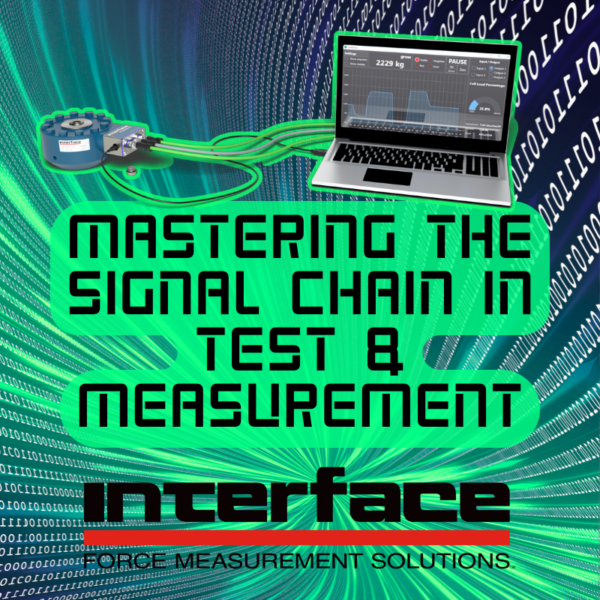
In test and measurement, Interface defines the signal chain as the interconnected hardware and software continuum that converts a physical event into validated engineering units. It encompasses the raw strain gage bridge from a load cell, regulated excitation sources, local analog conditioning, filtering, high-resolution digitization, network transmission, and the final analytical software interface. Learn engineering tips, application highlights, and why modern test and measurement requires planning for the entire signal chain to preserve data integrity.
https://www.interfaceforce.com/wp-content/uploads/signal-chain-in-test-and-measurement.png800800Jamie Glass/wp-content/uploads/Interface_White_Red.svgJamie Glass2026-08-20 08:08:122026-08-19 15:41:08Mastering The Signal Chain in Test and Measurement
Interface 101 series details high-fidelity (Hi-Fi), a term referencing how accurately a measurement system reproduces the characteristics of a physical input. Load cell users may require a high-fidelity system where the digital output precisely reflects the mechanical force applied to the sensor. This integrity must be maintained throughout the entire signal chain, from the physical deformation of the strain gage to the final data output. Hi-Fi is very important in aerospace, additive manufacturing, and product efficiency such as lightweighting.
Interface analog-to-digital converters (ADCs) are vital in advanced force measurement systems. These devices connect the analog output of force transducers to digital inputs for data acquisition and analysis. Interface load cells, torque transducers, and multi-axis sensors produce a small analog voltage proportional to the applied force. This signal needs careful conditioning and conversion before it can be used for logging, viewing, and analysis. The ADC carries out this important conversion, changing the continuous analog voltage into a discrete digital representation.
We use cookies to enhance your browsing experience, serve personalized content, and analyze our traffic. By clicking "Accept All Cookies", you consent to our use of cookies.
We may request cookies to be set on your device. We use cookies to let us know when you visit our websites, how you interact with us, to enrich your user experience, and to customize your relationship with our website.
Click on the different category headings to find out more. You can also change some of your preferences. Note that blocking some types of cookies may impact your experience on our websites and the services we are able to offer.
Essential Website Cookies
Essential Website Cookies
These cookies are strictly necessary to provide you with services available through our website and to use some of its features.
Because these cookies are strictly necessary to deliver the website, you cannot refuse them without impacting how our site functions. You can block or delete them by changing your browser settings and force blocking all cookies on this website.
Google Analytics Cookies
Google Analytics Cookies
These cookies collect information that is used either in aggregate form to help us understand how our website is being used or how effective our marketing campaigns are, or to help us customize our website and application for you in order to enhance your experience.
If you do not want us to track your visit to our site, you can disable tracking in your browser here:
Other external services
Other external services
We also use different external services like Google Webfonts, Google Maps and external Video providers. Since these providers may collect personal data like your IP address we allow you to block them here. Please be aware that this might heavily reduce the functionality and appearance of our site. Changes will take effect once you reload the page.
Google Webfont Settings:
Google Map Settings:
Privacy Policy
Privacy Policy
I agree to the terms and conditions laid out in the Privacy Policy
 https://www.interfaceforce.com/wp-content/uploads/signal-chain-in-test-and-measurement.png
800
800
Jamie Glass
/wp-content/uploads/Interface_White_Red.svg
Jamie Glass2026-08-20 08:08:122026-08-19 15:41:08Mastering The Signal Chain in Test and Measurement
https://www.interfaceforce.com/wp-content/uploads/signal-chain-in-test-and-measurement.png
800
800
Jamie Glass
/wp-content/uploads/Interface_White_Red.svg
Jamie Glass2026-08-20 08:08:122026-08-19 15:41:08Mastering The Signal Chain in Test and Measurement https://www.interfaceforce.com/wp-content/uploads/high-fidelity-101.png
800
800
Jamie Glass
/wp-content/uploads/Interface_White_Red.svg
Jamie Glass2026-03-17 08:08:122026-03-16 14:50:35High-Fidelity 101
https://www.interfaceforce.com/wp-content/uploads/high-fidelity-101.png
800
800
Jamie Glass
/wp-content/uploads/Interface_White_Red.svg
Jamie Glass2026-03-17 08:08:122026-03-16 14:50:35High-Fidelity 101 https://www.interfaceforce.com/wp-content/uploads/INTERFACE-101-ADC.png
800
800
Jamie Glass
/wp-content/uploads/Interface_White_Red.svg
Jamie Glass2025-02-11 08:08:242025-02-10 15:11:23Analog-to-Digital Converters 101
https://www.interfaceforce.com/wp-content/uploads/INTERFACE-101-ADC.png
800
800
Jamie Glass
/wp-content/uploads/Interface_White_Red.svg
Jamie Glass2025-02-11 08:08:242025-02-10 15:11:23Analog-to-Digital Converters 101