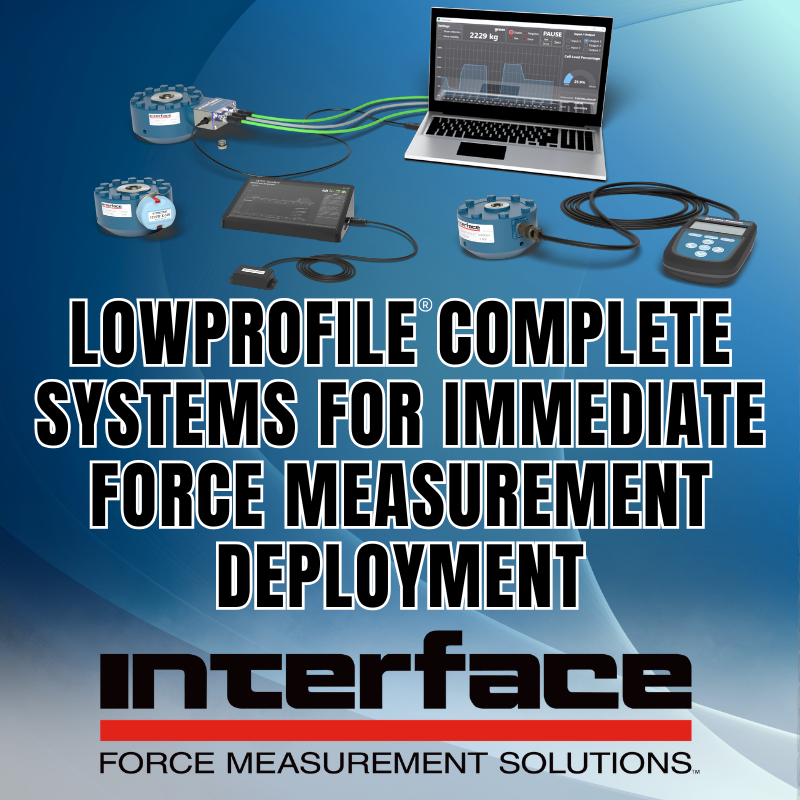
LowProfile Complete Systems for Immediate Force Measurement Deployment
 Precision force measurement requires more than simply selecting a load cell with the correct capacity. Reliable, repeatable data depends on how well every component in the measurement chain works together. When test engineers assemble systems from disparate manufacturers, subtle incompatibilities often arise between the sensor output, cable impedance, excitation voltage, and instrument signal conditioning.
An Interface Complete System addresses these challenges before installation begins. Pairing a LowProfile load cell with dedicated instrumentation and matched cables establishes a verified measurement chain. When the sensor, shielding, connectors, and digital indicator or signal conditioner are factory-configured and calibrated as a single assembly, the setup is ready for immediate deployment. The Interface LowProfile Load Cell Complete Systems are a pre-engineered approach that eliminates the trial-and-error often associated with scaling millivolt signals, setting shunt calibrations, and troubleshooting grounding or noise interference.
System level calibration provides documented traceability for the entire signal path. Rather than relying on theoretical calculations that combine individual component error budgets, the test engineer works from a verified system calibration certificate. This provides immediate confidence in the data, shortens commissioning time in the test cell, and ensures the LowProfile design mechanical performance is accurately represented in the digital output.

1200 Series Load Cell Universal Load Cell Digitizer EtherCAT Fieldbus System
The 1200 Series with integrated digitizer provides a direct fieldbus connection to PLCs, making it well-suited for industrial automation and connected plant architectures. The unit features an integrally mounted, factory-wired digitizer directly inside the LowProfile load cell body, eliminating external signal conditioning boxes and reducing line interference. Available in capacities from 300 lbf to 100K lbf (2 kN to 445 kN), the system includes an interface status LED and three M12 flying connectors. Setup and monitoring are managed directly through a micro USB service port using the free Instrument Manager PC software.

1000 Fatigue-Rated Universal LowProfile® Load Cell and 9325 Portable Sensor Display
Engineered for dynamic testing environments, the 1000 Fatigue-Rated Universal LowProfile Load Cell pairs with the 9325 Handheld Sensor Display to provide a portable, self-contained measurement solution. The 1000 Series spans capacities from 250 lbf to 50K lbf (1.11 kN to 222 kN) and utilizes proprietary temperature-compensated strain gages to achieve 0.03% performance. Built with eccentric load compensation, low deflection, and barometric compensation, the sensor delivers reliable tension and compression data. The paired 9325 handheld powers the cell, conditions the signal, and displays real-time readings, leveraging TEDS auto-calibration and USB data output for efficient lab and field testing.

1000 Fatigue-Rated Universal LowProfile® Load Cell and 9325 Portable Sensor Display Data AQ Pack
The Interface 1000 series has 300% safe overload, extremely low moment sensitivity of 0.1%/in, and a higher fatigue life. If you need to measure 1 pound (4.45N) or 1 million pounds (4500kN), Interface load cells can do it. The 9325 Portable Display Data AQ Pack is designed for use with Interface force and torque sensors, offering a convenient way to view test results from your load cell. It lets you set up, log, graph, and display data from your application, supporting all Interface load cells and torque transducers. The Pipo X15 combines a touchscreen display, mounting capability, and rich connectivity. The Interface 9325 Toolkit is a free Windows software application used to configure, calibrate, and manage Interface’s 9325 Portable Sensor Display.

WTS 1200 Standard Precision LowProfile Wireless Load Cell and WTS-HK-S Next-Generation Wireless Handheld
For test scenarios where physical cabling poses a snag hazard or installation hurdle, the WTS 1200 Series and WTS-HK-S Wireless Handheld offer a remote alternative. Covering capacities from 300 lbf to 100K lbf (1.5 kN to 450 kN), the load cell transmits tension and compression force data over a secure 2.4 GHz transceiver. The sensor maintains the mechanical integrity of the standard LowProfile line, including low deflection, barometric compensation, and resistance to eccentric loads. The WTS-HK-S handheld serves as the remote display and configuration tool, enabling operators to read live data, switch between transmitters, and manage settings remotely.

WTS Wireless 1200 Series Data AQ Pack
The WTS Wireless Data AQ Pack, featuring an on-cable or integrated wireless acquisition module, provides convenient wireless communication with speeds up to 200 samples per second when connected to your transducers. It offers powerful tools to set up, log, graph, and display data, including application mapping, and is compatible with all Interface force sensors. WTS 1200 Standard Precision LowProfile® Wireless Load Cells can transmit up to 2000 feet (610 meters) to various base stations, including a USB version and a handheld display. The WTS-BS-3E is one of several base stations used to configure and calibrate the WTS modular telemetry system. Base stations can also collect data by making WTS wireless transmitter data available over the USB interface. The Pipo X15 is a unique, multifunctional mini PC/tablet hybrid that blends portability with industrial-grade functionality. The WTS Toolkit is a free software suite provided by Interface, designed to configure, calibrate, test, and manage their full range of WTS wireless telemetry modules. It supports a variety of hardware, including transmitters, handheld displays, base stations, gateways, and LED displays.

1200 Series Universal Load Cell IO-Link Compatible System and 1201 Series Compression-Only Load Cell IO-Link Compatible System
Interface provides direct digital factory automation through the 1200 Universal and 1201 Compression-Only IO-Link load cells. Both designs leverage the open-standard IO-Link protocol to enable bidirectional communication between the sensor and industrial automation networks. By transmitting a robust 24V differential digital signal over standard M12 industrial cabling, these systems resist factory electrical noise while supporting real-time sensor health monitoring and onboard diagnostics. The 1200 version supports bidirectional tension and compression monitoring, while the 1201 delivers the same communication efficiency in a dedicated, compact compression package.
Test and Measurement Applications for LowProfile Load Cell Complete Systems
The mechanical stability, low deflection, and eccentric load compensation of LowProfile load cells make these complete systems practical across diverse test and measurement environments.
Aerospace Structural and Fatigue Testing – In multi-point airframe structural testing, engineers subject wings, fuselage sections, and landing gear to millions of loading cycles. Using pre-calibrated 1000 LowProfile Fatigue-Rated Complete Systems ensures the sensor withstands fully reversed tension and compression cycles without fatigue failure, while pre-matched instrumentation and cabling eliminate signal degradation across extended runs in large test cells.
Automotive Component and Chassis – Automotive test benches evaluate the strength and longevity of suspension components, engine mounts, and steering assemblies under simulated road conditions. Complete systems feature the 1200 Universal LowProfile Load Cell paired with high-speed digital indicators to capture rapid dynamic load changes, ensuring off-center forces from mechanical movement do not distort data accuracy.
Materials Testing Machines and Tensile Test Stands – Universal testing machines depend on consistent linearity and precise zero balance when conducting tensile, peel, or compression tests on metals, composites, and plastics. Complete LowProfile Systems provide a factory-verified measurement chain scaled to standard machine frames, allowing immediate calibration verification and direct digital communication with lab software.
Industrial Automation and Press Monitoring – Automated assembly processes, such as bearing insertions, metal stamping, and precision press-fit operations, demand real-time verification to prevent part damage. Integrating a 1200 or 1201 Series IO-Link or EtherCAT Complete System connects the load cell directly to factory programmable logic controllers, providing clean 24V differential digital signals and continuous sensor health diagnostics on active production lines.
Reference Standards for Calibration Laboratories – Metrology departments and field calibration technicians require highly repeatable force standards to verify in-plant testing machinery, hydraulic jacks, and working load cells. Combining a 1200 LowProfile with a portable, high-resolution digital display like the 9325 creates a self-contained reference standard that maintains documented NIST-traceable calibration without requiring manual parameter re-entry.
Heavy Equipment and Mobile Machinery Field Testing – Evaluating structural loads on agricultural implements, mining cranes, and construction excavators often introduces harsh electrical interference and physical routing constraints. Deploying a WTS 1200 LowProfile Wireless Complete System enables test crews to measure static and dynamic forces without running external cables, sending live force data straight to a handheld display or PC receiver positioned safely away from moving machinery.
Ready to Configure your LowProfile Complete System?
Selecting the components or a complete system changes how test facilities and engineers approach deployment. By integrating the LowProfile load cell, environmental cabling, and digital instrumentation into a unified package, engineers bypass the integration hurdles that often delay testing schedules. Every component is selected to preserve the sensor’s inherent accuracy, ensuring signal noise, improper excitation, or cable loss does not compromise the final result.
The true value of a complete system lies in immediate readiness and operational reliability through system level calibration. With calibrated system data documented prior to delivery, technicians can install hardware, connect instrumentation, and begin testing without secondary calibration steps. Whether supporting long-term structural evaluations, high-cycle component tests, or precision production monitoring, complete LowProfile systems provide a straightforward, dependable path to traceable force measurement.


