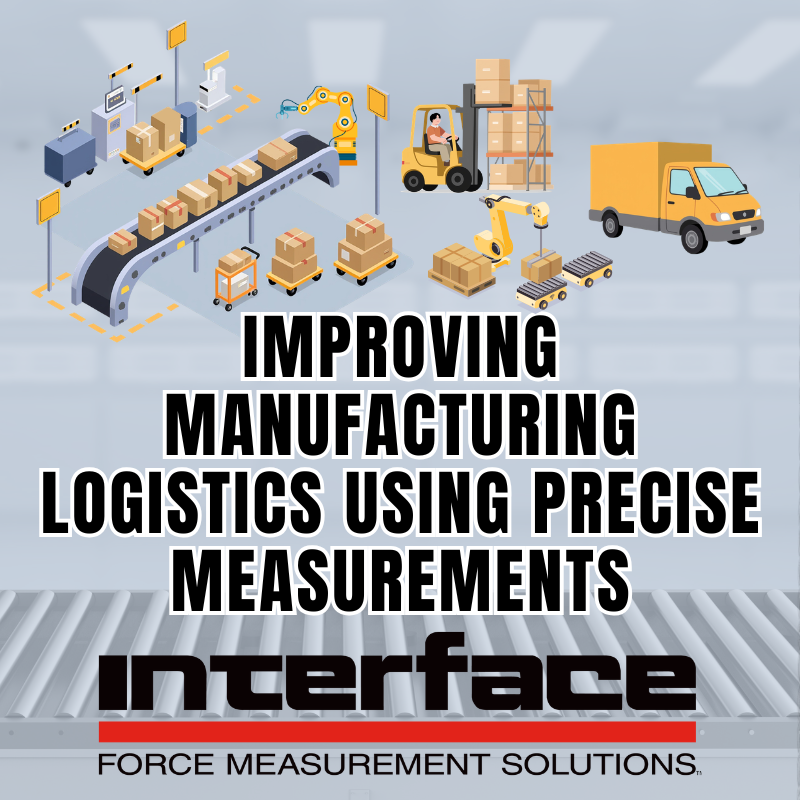
Improving Manufacturing Logistics Using Precise Measurements
 Manufacturing logistics automates the handling, sorting, transportation, warehousing, and distribution of raw materials and finished goods. Smart warehouses, lean supply chains, and manufacturing plants operate on razor-thin fulfillment schedules, where equipment uptime and material flow velocity directly drive operational profitability.
To maintain speed, high-production logistics facilities depend heavily on automated material-handling equipment (AMHE), including automated guided vehicles (AGVs), autonomous mobile robots (AMRs), high-speed sorters, and automated storage and retrieval systems (ASRS).
While these automated machines keep facilities moving, their real-time effectiveness depends on the physical feedback that drives their controls. Sensor-based measurements form the foundational data loop for automated logistics infrastructure, converting dynamic weight changes, pulling and lifting forces, and motor torques into actionable operational metrics.
Without accurate, continuous physical measurement, automated material handling lacks intelligence about the mechanical stress it endures and produces.
Monitoring Mechanical Loads in Logistics Equipment
Integrating precision sensors into overhead cranes, conveyor rollers, and storage systems enables engineering and maintenance teams to detect mechanical wear early, track inventory mass in motion, and protect equipment from structural overloads.
In high-speed distribution hubs and automated plants, this continuous physical monitoring establishes a reliable operational baseline, preventing costly machinery breakdowns and keeping material-handling assets running safely.
Beyond processing speed, logistics hardware routinely experiences complex, multidirectional stresses. Conveyor curves generate off-axis side forces, while robotic lifts and cranes face shifting, uneven weight distribution. Unmonitored load imbalances, conveyor jams, and structural overloads can lead to costly line stoppages, product damage, or safety hazards. Measuring true structural loads requires advanced sensors, such as load cells, torque transducers, and multi-axis sensors.
Handling High-Speed Measurement Challenges
The central challenge in manufacturing logistics testing and live operations is maintaining measurement stability during continuous, high-speed operation. Signal lag or sensor drift in dynamic checkweighing, sorting, or automated conveying lines directly leads to inaccurate inventory records, misrouted freight, and undetected machinery jams.
Capturing these rapid physical interactions safely requires high-speed, low-latency signal conditioning. By recording sudden load spikes, stopping forces, and dynamic accelerations in real time without data gaps, plant control systems can intervene before mechanical stress causes line downtime.
TIP: Read the Sensor-Driven Advancements Optimize Manufacturing case study to see how Interface measurement solutions meet this challenge.
Where Measurement Decisions and Monitoring Fit in the Facility
Mobile Equipment and Transport – Autonomous vehicles and yard equipment rely on weight checks to maintain stability and protect drive systems. Load cells integrated into AGVs and AMRs verify payload weight and balance before a vehicle accelerates or turns, preventing tip-overs. On industrial tow tractors and tuggers, load cells measure drawbar pull at the hitch to confirm towing capacity and prevent motor overloads. At the loading dock, pressure sensors and load cells monitor dock leveler hydraulic cylinders and deck stresses as heavy forklifts transition into trailers.

Vertical Hoists and Heavy Lifting – High-bay storage and vertical transfers place continuous tension on cables, chains, and hoists. Load pins installed directly into sheaves, along with tension load links and load shackles, monitor live line pull on ASRS cranes, overhead bridge hoists, and vertical reciprocating conveyors (VRCs). This measurement immediately detects slack cables, verifies cable tension calibration, and tracks the center of gravity across heavy-material spreader beams.
Conveyors and High-Speed Sorting – Dynamic checkweighing cells mounted under moving belts verify parcel weights at line speed, flagging out-of-spec packages before sorting errors happen. At transfer points, force sensors profile the actuation stroke of pneumatic and electric diverter arms, providing the data needed to clear packages quickly without denting products or damaging actuator mechanisms. These sensors also supply the stable weight baselines needed for automated parcel dimensioning and weighing stations.

Robotic Tooling and Storage Racks – In palletizing cells, miniature load cells and multi-axis sensors built directly into robotic end effectors measure gripper clamping force and placement in real time. This ensures items stay secure during high-speed moves without crushing packaging. Across high-bay storage areas, load cells and strain transducers placed under racking uprights map static weight distribution, alerting facility managers to dangerous localized overloads and structural settling.
Interface Sensor Hardware for Manufacturing Logistics
Interface provides comprehensive force and torque measurement solutions that help logistics engineers and automation equipment makers accurately track performance across all types of material-handling machinery, with advanced data management for logistics operations.
Sensors
Our comprehensive line of LowProfile and miniature load cells delivers high accuracy and superior resistance to extraneous side loads in both tension and compression. Reaction and rotary torque transducers monitor drive motors, gearboxes, and roller shafts. For equipment retrofits, load pins fit directly into existing clevis joints and sheaves, while load shackles, tension links, and through-hole load washers add measurement capabilities without requiring expensive structural redesigns.
Instrumentation and DAQ Systems
Interface sensors pair directly with digital instrumentation, portable indicators, and our extensive line of wireless telemetry system components. As demand for connected networks grows, Interface smart load cells with IO-Link and digital digitizers that connect straight to PLCs and industrial networks, reducing field wiring, speeding commissioning, and making smart sensor adoption seamless.
Precise measurements between mechanical equipment and digital warehouse controls drive efficiency and operational improvements across the factory. Integrating real-time force, weight, and torque data into daily logistics operations provides manufacturers with the visibility needed to eliminate bottlenecks, protect expensive handling machinery, and maintain the continuous throughput required in modern fulfillment.


