IO-Link Load Cells 101
 IO-Link is an open-standard serial communication protocol that’s changing the game for industrial automation, testing labs, and advanced force measurement programs. It enables the bi-directional exchange of data from sensors and devices, providing high-precision measurements with digital communication capabilities.
IO-Link enables intelligent connections in factories, labs, and facilities by providing a standardized, brand-agnostic communication protocol that simplifies wiring, reduces commissioning time, and allows for the collection of detailed, real-time data. This information enables predictive maintenance, process optimization, and data-driven decisions that improve operational efficiency and reduce costs.
The IO-Link technology is being used in test and measurement to streamline data collection and device configuration, reducing the need for additional electronics.
What is IO-Link?
IO-Link is a global, open-standard communication protocol that allows sensors and actuators to communicate with a master device. It’s an essential technology in industrial automation because it enables seamless bidirectional data exchange between devices and a controller. This means a controller can read data from a sensor and send commands and configuration parameters.
Unlike traditional analog or binary connections, which only provide a simple on/off signal or a voltage/current value, IO-Link provides a complete digital data channel. This enables advanced features like device identification, diagnostic information, and remote configuration.
How Does IO-Link Work?
IO-Link uses a simple, three-wire connection (or a five-wire connection for power-hungry devices) and operates on a standard M12 cable, which simplifies wiring and reduces installation costs. The system consists of two main components:
- IO-Link Master: The central hub that connects to the higher-level control system and manages all communication with the IO-Link devices.
- IO-Link Device: This is the sensor, actuator, or other field device that provides data or performs a function.
Communication is established using an IODD (I/O Device Description) file, a standardized file that contains all the necessary information about a device, including its parameters, functions, and communication capabilities. The IO-Link Master uses this file to correctly identify, configure, and communicate with the device.
IO-Link Enabled Load Cells in Test and Measurement
In recent years, the use of IO-Link has grown exponentially across a wide range of industries, from manufacturing and automotive to food and beverage. This is mainly because it serves as a foundational technology for Industry 4.0 and the Industrial Internet of Things (IIoT). Read more: Measurement Solutions Advance Industrial IoT Success.
In test and measurement environments, IO-Link replaces traditional analog interfaces, which are susceptible to electrical noise and signal degradation, with a robust digital communication link. This ensures measurement data integrity and accuracy. Key applications include:
- High-Precision Force and Weight Measurement: Load cells can send highly accurate force and weight measurements digitally, eliminating the need for separate analog-to-digital converters and reducing signal noise.
- Simplified Integration: IO-Link simplifies sensor integration into test setups. IODD files and standardized cables enable quick device swaps and configuration changes.
- Enhanced Diagnostics: IO-Link devices can provide detailed diagnostic information, such as temperature, peak values, and error codes. This is critical for preventative maintenance and troubleshooting.
Interface’s IO-Link Load Cells
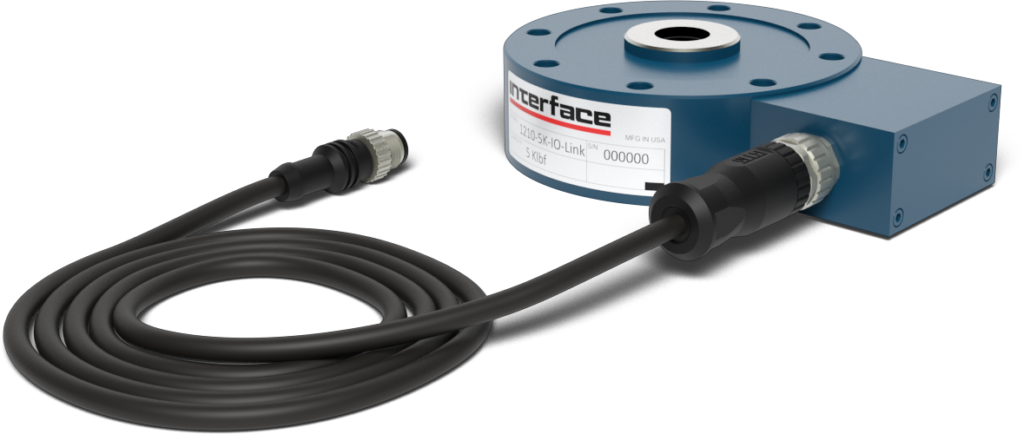
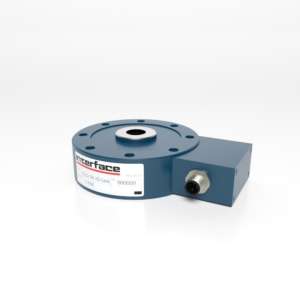 Our Model 1200 and Model 1201 Series IO-Link Universal and Compression-Only Load Cells are excellent examples of how this technology is being applied to test and measurement’s most popular “blue” load cell. These LowProfile, IO-Link compatible load cells offer a streamlined solution for highly accurate force measurement.
The Interface IO-Link Load Cells provide precision force measurements with the benefits of digital communication. They connect directly to an IO-Link Master without requiring any additional electronics. This simplifies installation and ensures a clean, noise-free digital signal.
Our IO-Link load cells stand out for several reasons:
- Proprietary, temperature-compensated strain gages for superior accuracy
- Design compensates for eccentric loads, ensuring consistent and reliable measurements
- Compact size makes them ideal for applications where space is a constraint
Review the Interface 1200 and 1201 IO-Link LowProfile data specifications, including drawings here.
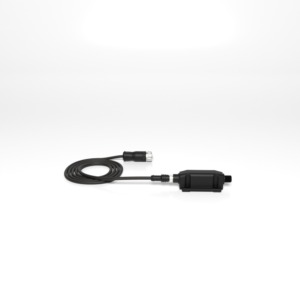 Interface’s new ILM In-Line IO-Link Amplifier is an instrumentation solution that enables digital point-to-point IO-Link connections, offering an independent communication technology. IO-Link enables intelligent connections between sensors and actuators and automation systems. The comprehensive, standardized communication with each IO-Link-capable sensor enables additional sensor data, transmission of measurement and switching signals without losses, and numerous independent diagnostic functions. Sensor-level IO-Link integration not only increases productivity and reduces machine costs, but also simplifies sensor replacement while preserving redundant parameter data. IO-Link-capable devices can significantly increase machine and system availability by reducing downtime and accelerating restarts during maintenance or repair.
Making the Connection to IO-Link Load Cells
To get started with an Interface IO-Link load cell, you’ll need to follow a few simple steps:
- Securely mount the load cell to a stable surface using the provided mounting holes.
- Connect the load cell to an IO-Link Master port using a standard M12 cable.
- Access the IO-Link Master’s configuration tool (typically software or a web interface) and upload the cell’s IODD file. The IODD file contains all the necessary information, including the manufacturer’s pre-configured settings, such as serial number, type, and measurement range.
- Use the Interface I-O Link Quick Start Guide for additional information.
Once configured, the load cell will provide cyclic process data, such as the force/weight applied, to the IO-Link Master. You can monitor this data in real time to verify the sensor’s load operation. The load cell can also provide cyclic diagnostic data such as temperature, peak values, and operating hours, which can be invaluable for monitoring system health.
IO-Link Load Cell Applications
Automated Filling and Dosing
An automated liquid filling machine needs to dispense a precise amount of a product into bottles or containers. The system requires high speed and accuracy to maintain production quotas and minimize waste. The IO-Link load cell is integrated into the weighing platform, providing real-time weight data directly to the PLC. IO-Link’s digital communication eliminates signal noise and drift, ensuring accurate and repeatable fills. The load cell can be remotely configured through the IO-Link master, allowing for quick “recipe” changes for different products and fill weights without manual intervention.
Checkweighing and Quality Control
A conveyor system in a packaging facility needs to verify that each package contains the correct number of items by weight. Overweight or underweight packages must be identified and diverted from the main line to prevent shipping errors. An IO-Link load cell is placed on a section of the conveyor to perform a high-speed checkweigh. The load cell sends digital data, including weight and pass/fail status, directly to the control system. The IO-Link Master can also trigger a sorting mechanism or an alarm based on pre-configured weight thresholds, ensuring that only correctly filled packages proceed.
Robotics and End-of-Arm Tooling
A robotic arm performs a press-fit assembly, where a component must be pressed into place with a specific force. The system must ensure the correct force is applied to prevent damage to the parts and verify successful assembly. An IO-Link force sensor is mounted on the robot’s end-of-arm tooling. The device provides real-time feedback to the robot controller via IO-Link. The bidirectional communication allows the controller to adjust the force applied during the process. The load cell can also send diagnostic information, such as peak force values and error codes, which can be used for quality control and to identify potential issues with the assembly process.
Continuous Condition Monitoring and Predictive Maintenance
Machines with multiple moving parts, such as a large mixer or a conveyor, use load cells to monitor bearing and motor loads. The operator needs to track machine health and anticipate potential failures before they occur. IO-Link load cells provide not only force data but also valuable diagnostic information, such as the load cell’s internal temperature and operating hours. This data can be collected and trended over time. By setting alarm thresholds for these parameters, the system can provide a “sensor health warning” when it detects an issue, such as a motor drawing more current than usual. This enables proactive maintenance, preventing unexpected machine downtime and costly repairs.
The Interface Advantage is Customization and Expertise
Interface stands out in the force measurement industry due to its commitment to innovation and customer-centric solutions. While our standard IO-Link load cells deliver exceptional performance, our true strength is our ability to provide customized IO-Link capabilities across a wide range of Interface force measurement devices.
Leveraging our decades of expertise and proprietary technology, we can integrate IO-Link into other load cell models and specialty force and torque sensors. This allows you to harness the benefits of digital communication with enhanced accuracy, simplified integration, and advanced diagnostics for even the most specific and demanding test and measurement applications.