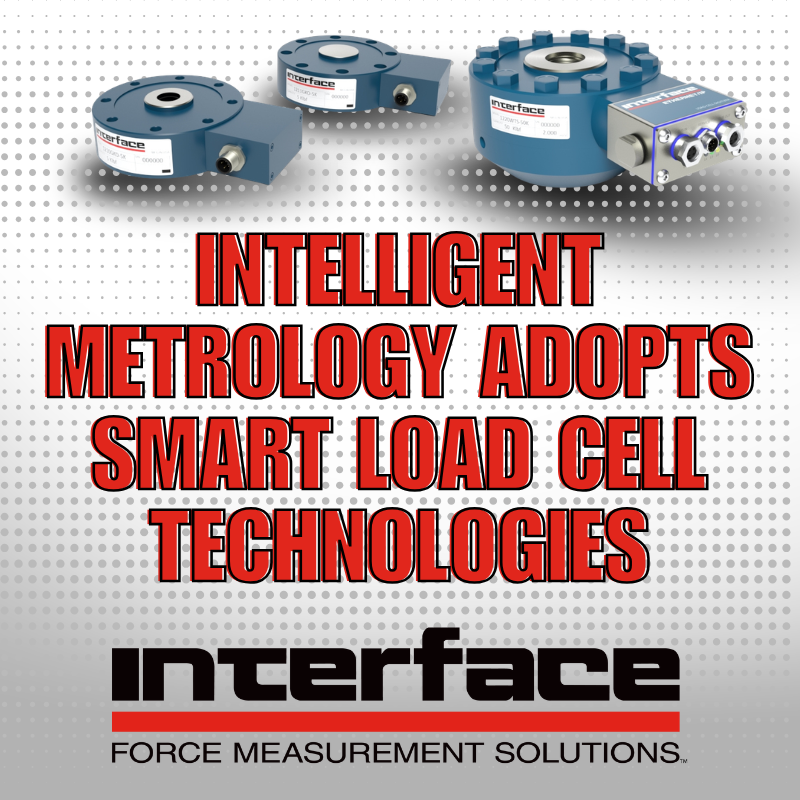
Intelligent Metrology Adopts Smart Load Cell Technologies
 Traditional test and measurement setups often rely on load cells that route analog millivolt (mV/V) signals over long cables to a centralized data acquisition (DAQ) system or a PLC cabinet. While highly accurate, this architecture can introduce vulnerability to electrical noise, thermal signal degradation, and complex calibration tracking without the right instrumentation.
The integration of internal or in-line digitizers, smart instrumentation, and IO-Link capabilities transforms sensors into active, digital devices for modern test environments. This shift alters how physical forces are quantified, transmitted, and analyzed.
Moving to Smart Load Cells
The transition to digital, IoT-enabled force measurement addresses several long-standing pain points on the factory floor and in testing labs. Here are three common factors accelerating the transformation.
#1 – Noise Immunity and Signal Integrity
Converting the analog mV/V signal to digital right at the sensor reduces the risk of electromagnetic interference (EMI) overriding long cable runs. It is one of the reasons Interface’s Wireless Telemetry Systems, including our wireless load cells, are one of our fastest-growing product lines.
#2 – Plug-and-Play Maintenance
Smart components allow configuration profiles to be stored digitally. If a sensor needs to be swapped out, the network can automatically push configuration parameters to the new hardware, cutting manual setup and reducing downtime.
#3 – Local Processing and Diagnostics
Smart-enabled devices paired with the right instrumentation can monitor internal metrics such as peak overloads, temperature cycles, and health indicators, alerting operators to potential maintenance needs before a component fails.
TIP: Learn more in our post, What are IO-Link Load Cells.

Technical Spotlight for Smart Force Measurement Hardware
Interface bridges the gap between traditional high-precision metrology and industrial automation networks with three core product solutions available today. Hardware available today includes:
- ILCB In-Line Load Cell Digitizer – Designed for versatile fieldbus communication (PROFINET, EtherCAT, EtherNet/IP, Modbus, RS485), the ILCB mounts directly in line with a load cell or via its standard ¼ GAS fitting. It features an onboard 24-bit A/D converter capable of up to 500 conversions per second and includes built-in batching logic for local process control.
- 1200 and 1201 Series IO-Link Load Cell Universal or Compression-Only – Interface 1200 and 1201 Series IO-Link Load Cell Universal or Compression-Only are LowProfile load cells that are IO-Link compatible and an open-standard serial communication protocol that allows for the bi-directional exchange of data from sensors and devices.
- 1200 and 1201 Series Load Cell Universal or Compression-Only with Load Cell Digitizer – The 1200 and 1201 Series Load Cell Universal or Compression-Only with Load Cell Digitizer is our LowProfile load cell featuring an integrally mounted and wired digitizer within the load cell body, enabling direct fieldbus connection to PLCs from leading international brands. Conceived for Internet of Things (IoT) applications, the instrument can be configured and managed using the free Instrument Manager PC software via the micro USB port. It includes a communication interface status LED and is supplied with three M12 mating connectors.
- ILM In-Line IO-Link Amplifier – A compact, in-line solution that converts any standard strain gage sensor into an intelligent IO-Link device. It provides an independent, cost-effective path to bring existing analog hardware into modern industrial networks.
ILM In-Line IO-Link Amplifier / #shorts
TIP: Explore more about IO-Link Load Cells 101
Interface Smart Complete Systems
Interface offers complete systems with our IO-Link functionality ready for smart plug-and-play. Engineered-to-order and custom solutions cover a wide range of our sensors. As a few examples, explore the systems to show the functionality.
Fully integrated smart sensors combining high accuracy, temperature compensation, and eccentric load compensation of standard Interface low-profile cells with a direct 24V IO-Link digital output via an IP67 M12 connector.
Applications for Smart Load Cell Solutions
Industrial Automation and Multi-Stage Batching
Integrating high-accuracy force measurement into industrial production lines often requires a direct connection to high-speed fieldbus networks.
The Challenge – A manufacturing facility needs to optimize a multi-product chemical batching and filling system. The existing architecture relies on standard analog load cells wired to a remote junction box. This setup experiences a slight measurement lag due to signal processing distances and requires manual recalibration whenever a sensor component is adjusted. The facility needs real-time weight tracking, local digital filtering to counteract mechanical vibration from mixers, and direct integration into an Ethernet/IP or PROFINET PLC network.
The Smart Solution – Existing analog load cells are retrofitted with the Interface ILCB In-Line Load Cell Digitizer. The ILCB immediately converts the analog mV/V output into a digital signal at the sensor, feeding data across the fieldbus network at maximum speed.
Result and Operational Benefit – The ILCB has a built-in single-product loading program with space for up to 99 formulas, featuring automatic fall calculation and precision batching control. Its local digital filter reduces the effects of weight oscillation caused by facility machinery before the data ever reaches the PLC, ensuring a clean signal and faster batch cycles.
Automated Assembly Verification with IO-Link
The factory floor relies heavily on standardized point-to-point communication to minimize cabling complexity and ensure continuous diagnostic tracking.
The Challenge – An automotive components manufacturer uses hydraulic press-fit cells to insert bearings into steering assemblies. The system must monitor insertion forces in real time to ensure part quality. Traditional analog systems require dedicated, shielded wiring and separate signal-conditioning modules inside the control cabinet. They cannot output internal diagnostics, such as sensor health monitoring or temperature tracking, directly to the master control network.
The Smart Solution – The facility deploys the Interface Model 1200 (Universal) or 1201 (Compression-Only) IO-Link LowProfile Load Cell System. For setups utilizing existing analog cells, they integrate the ILM In-Line IO-Link Amplifier. The hardware connects directly to an industrial IO-Link Master using standard, low-cost M12 unshielded cables.
Result and Operational Benefit – This setup enables bidirectional data exchange. The system transmits loss-free, high-resolution force measurements while simultaneously streaming sensor health monitoring and diagnostics. Because the configuration parameters are stored on the IO-Link Master, if a load cell must be replaced during scheduled maintenance, the master automatically clones the configuration profile to the new sensor, minimizing production line downtime.
Smart Load Cell Impact on the Future of Test and Measurement
The trajectory of smart load cells extends beyond simpler wiring configurations; it fundamentally changes data architecture in industrial environments.
Protocol Standardization
The adoption of open-standard industrial protocols such as IO-Link ensures that high-fidelity force measurement is no longer confined to a separate DAQ ecosystem. Force data becomes just another standard input on the main industrial network, alongside proximity switches, temperature probes, and vision systems.
Continuous Structural Health Monitoring
With smart digitizers, force measurement moves easily beyond the laboratory environment. Low-power, ruggedized modules can be permanently embedded into heavy machinery or infrastructure to continuously stream real-time load data, enabling true predictive maintenance models.
End-to-End Data Traceability
As data integrity requirements grow more stringent, the ability of a smart sensor to stamp its digital payload with a unique ID, calibration timestamp, and environmental data ensures absolute traceability from the moment a physical force is applied to the final quality report.
Driving the Future of Precision Metrology
The shift toward intelligent, networked force measurement highlights a fundamental truth in test and measurement: data is only as good as the sensor that captures it. While digitizers and IO-Link communication protocols provide the pipeline for modern data transmission, the ultimate accuracy of the system still depends on the physical integrity of the primary transducer.
We continue to lead the industry by combining these advanced communication technologies with our world-class, premium sensor designs. Rather than treating digital connectivity as an add-on, Interface treats it as a natural extension of the sensor itself. With high-resolution digitization and bidirectional fieldbus communication built into standard designs, Interface lets engineers keep data accuracy without sacrificing network convenience.
Whether you’re adapting legacy testing labs with in-line digitizers or building specialized, automated production networks from the ground up with IO-Link systems, Interface delivers the application solutions high-stakes engineering sectors need. As industrial automation and predictive maintenance evolve, we remain committed to delivering high-fidelity data, absolute traceability, and rugged reliability that engineers trust to build the future.


