Tag Archive for: Did You Know

How Do Universal Testing Machines Use Load Cells?

Universal testing machines (UTMs) are essential for material qualification, structural research, and quality assurance. Interface load cells sit directly in series with the moving crosshead and the upper specimen grip of a UTM. A machine controller reads the load cell continuously within a closed feedback loop to regulate crosshead travel, maintain constant loading rates, or hold targeted force thresholds during stress relaxation evaluations. The transducer measures the specimen resistance as it deforms. The data acquisition system pairs this instantaneous force data with displacement data to measure elasticity, yield point, and ultimate tensile strength.

Why Use a Single Load Cell for Platform Weighing?

Interface Tech Talk answers how a single point load cell measures the weight of objects placed anywhere on a weighing platform or scale. Interface Single Point Load Cells compensate for off-center (eccentric) loading, have high repeatability and linearity, and have fast response times. For weighing, the single point load cell is a cost-effective solution for OEMs and scale manufacturers. They are simple to install, have a long service life, and require low maintenance.

How Do Thermal Specifications Influence Sensor Selection?

Interface Tech Talk details the differences between compensated and operating temperature ranges in load cell specifications. Thermal variables influence sensor accuracy, the mechanics of static deflection. Thermal gradient, material, strain gages, and repeatability are important when selecting a sensor. Only using capacity ignores the realities of the test environment. A load cell's compensated temperature range is the zone where accuracy is maintained by design. The operating temperature range is the boundary for hardware survival.

Bridge Completion Considerations
Interface's use of the Wheatstone bridge is considered world-class in load cell design and for its ability to produce accurate measurements. Selecting the right instrumentation and ensuring proper bridge completion are technical necessities for maintaining the integrity of your force measurement data. Our bridge completion solutions simplify selecting the right instrumentation device to pair with your sensor, making it easier than ever to achieve high-quality measurements.

Why Do Torque Wrenches Use Transducers?

Interface's Tech Talk reviews torque wrenches, applications, and FAQs when combining wrenches with reaction torque transducers to validate the tightness of fasteners, bolts, screws, and other mechanical assembly tools used in aerospace, energy, automotive, and manufacturing. A torque wrench is only as reliable as the data supporting it. Combining a torque wrench with high-accuracy torque measurements from torque transducers and advanced instrumentation provides the validation necessary to protect machines, equipment, products, consumers, and workers.

The Testing Behind Your Favorite Gifts
Interface offers a range of sensors for precise testing and force measurement across popular products such as gaming equipment, sports gear, electronics, scooters, and smartwatches. We take pride in ensuring these favorite gifts are safe, reliable, and durable well beyond the holiday season.

IO-Link Load Cells 101
Interface 1200 and Model 1201 Series IO-Link Universal and Compression-Only Load Cells are IO-Link compatible load cells that offer precision force measurements with the benefits of digital communication. They connect directly to an IO-Link Master without requiring any additional electronics. This not only simplifies installation but also ensures a clean, noise-free digital signal. The digital point-to-point connection of IO-Link offers a manufacturer-independent, fieldbus-independent communication technology. IO-Link allows intelligent connection of sensors and actuators to automation systems. The comprehensive, standardized communication with each IO-Link capable sensor enables additional sensor data, transmission of measurement and switching signals without losses, and numerous independent diagnostic functions.

3-Axis Load Cells 101
Interface 3-Axis Load Cells measure forces along three mutually perpendicular axes: X, Y, and Z. Interface offers 3-axis load cells with varying capacities, dimensions, and specifications to measure force and torque. The multi-axis sensors require no mathematical manipulation for standard 3-axis force measurements as each signal directly correlates to a specific measurement direction. These advanced load cells are used in aerospace, medical, automotive, automation, robotics, manufacturing and product testing applications.

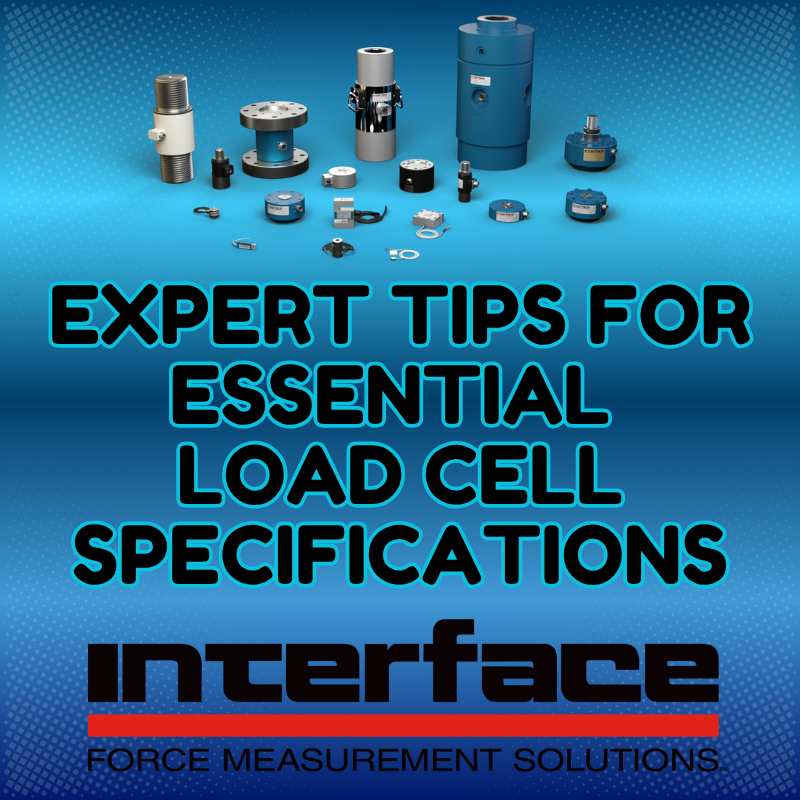
Expert Tips for Essential Load Cell Specifications
Interface force measurement experts share top load cell specification tips for capacity range, accuracy, temperature, calibration, and system-level considerations. Choosing a load cell requires an understanding of how the sensor will perform within your specific system. Get the tips, watch the video, and find a helpful glossary of specifications terms.