University of Waterloo Capstone Tackles Physical Strain in Medical Imaging
 Diagnostic medical ultrasound imaging requires sonographers to apply sustained pressure to a patient with an ultrasound probe. This hands-on imaging modality demands precise positioning and consistent image quality over long periods.
The Capstone Symposium Team at the University of Waterloo in Ontario, Canada, took on this problem for their year-end project. In their research, the students determined that, because of this highly repetitive and physically demanding workflow, a solution was needed to contribute to medical innovation. They noted that nearly ninety percent of sonographers experience work-related pain, with eighty-three percent of those surveyed identifying the application of force when using ultrasound equipment as the primary contributor to their discomfort.
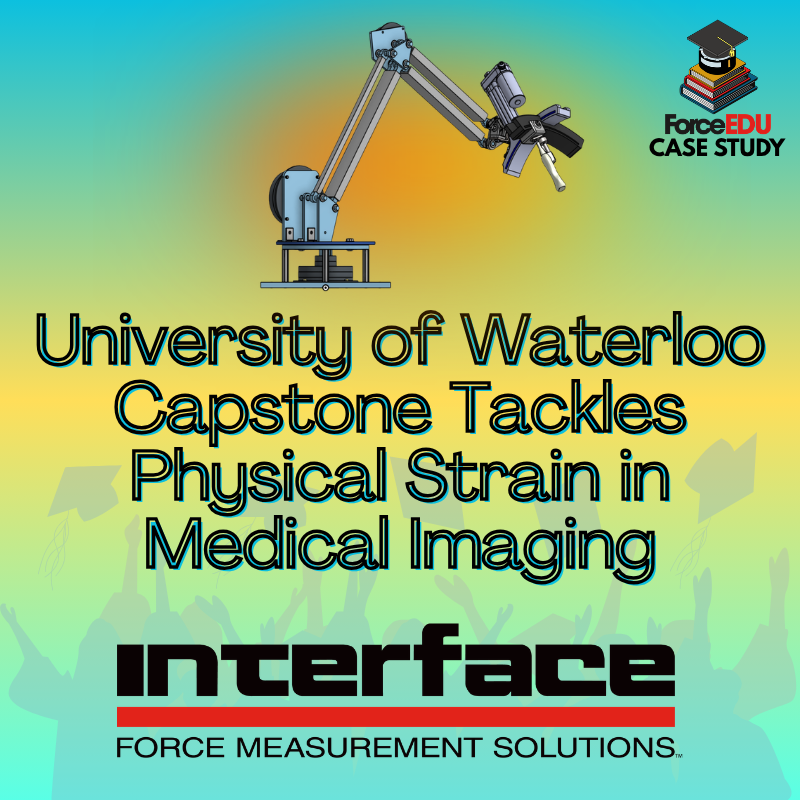
To solve this biomechanical clinical challenge, the student team developed Load Assistance for Reduced-Strain Sonography, known as the LARS system. LARS is a semi-robotic articulated arm engineered to aid with probe force application while keeping the sonographer fully in control of the procedure.

Unlike large and costly robotic alternatives, this system integrates directly into existing clinical workflows and provides assistive support without disrupting the established scanning methods of the medical professional. Watch a demonstration post of LARS by Progressive Automations on Instagram.
Medical Robot Force Sensing Integration
Developing a system that responds naturally to human interaction requires highly precise force feedback. The student team integrated Interface’s WMC-110 Sealed Stainless Steel Miniature Load Cell and a DMA2 DIN Rail Mount Signal Conditioner into the structural design. The miniature load cell is positioned directly above the ultrasound mounting mechanism to measure the real-time force applied to the patient.
How does it work? The sensor feeds data continuously into a closed-loop control system. This architecture relies on an outer admittance loop and an inner PID position loop. The outer loop serves as the primary force-sensing layer, where an admittance controller processes the error between the target force setpoint and the load cell’s measured force. This positional error is then sent to the inner PID controller, which evaluates the linear actuator’s feedback and adjusts the position accordingly. The signal conditioner converts the load cell output into a usable 0-3.3V signal for proper communication with the microcontroller unit.
TIP: Read the full Interface case study, University of Waterloo LARS Project Redefines Sonography Application.

LARS Project Outcomes and Academic Recognition
The integration of precise force feedback allowed the LARS system to achieve a fast response with a 0.12-second rise time and zero overshoot. This responsiveness ensures smooth, stable force application during a live scan. The system successfully maintains the exact force level selected by the operator while dynamically adapting to subtle movements, including the patient’s breathing or coughing.
The LARS capstone project achieved significant validation within the academic and engineering community, earning multiple honors for its technical execution and design fidelity:
- Norman Esch Entrepreneurship Award (2026): Granted for finding a clear market need and presenting a viable commercial pathway for clinical implementation.
- Biomedical Engineering Capstone Best Prototype Winner (2026): Awarded to the team for achieving the highest fidelity prototype within the department.
- Baylis Medical Capstone Design Award (2025): Recognized for providing an innovative and technically complex design with a distinct biomedical focus.
Project Contributors: The University of Waterloo Capstone Symposium Team consisting of Luke Coulter, Alexa Daly, Rylin Soto, and Serena Wittenberg (photo above). Visual materials and engineering assets are credited directly to the University of Waterloo.
Interface is Investing in Future Engineering Talent
The success of the LARS project underscores the vital relationship between academic institutions and precise metrology tools and resources. Providing foundational hardware support to engineering students enables the transition from theoretical design to high-fidelity, functional prototypes. This collaborative investment helps prepare the next generation of engineers to solve complex, real-world problems in biomedical, robotic, and industrial fields.
To ensure students and faculty members have access to the resources for advanced testing and capstone projects, academic programs can utilize dedicated research support structures. Interface offers educational support and discount programs to help university testing laboratories and student teams acquire high-precision instrumentation within their budgetary constraints.
We carry on our investment legacy in the science of measurement and education through our ForceEDU program, a focused online resource hub of materials and references that support learning about metrology, force measurement, and testing.

Beyond providing physical instrumentation, fostering STEM education requires comprehensive learning resources. The ForceEDU platform serves as an educational hub tailored specifically for students, researchers, and professors. It provides reference materials, technical documentation, and metrology principles to deepen understanding of force-measurement applications.
By supporting programs like ForceEDU, the goal remains centered on advancing technical education, validating structural testing methodologies, and equipping future engineers with the foundational knowledge required for professional success.
Read the full case study here:


