Raw Signals to Intelligent Force Sensing
 In the current landscape of test and measurement, reliance on data is expanding, and integration into systems requires reliable, accurate sensor output.
The goal is to feed high-fidelity data into predictive models that can learn, adapt, and respond. Based on a recent survey, 78% of Interface customers are now evaluating or using advanced analytics, AI, and machine learning, indicating the industry is moving toward a future in which the sensor is the system’s foundational intelligence.
New environments and applications that rely heavily on data analytics are finding new uses for high-accuracy sensor data. The quality of the sensor, which impacts data reliability, is a cornerstone of any adaptation of advanced analytics and AI-enabled test and measurement.
From Strain Gage to Advanced Analytics and AI
Load cells deliver raw analog signals that require external processing for use. The rapid adoption of advanced analytics requires a robust digital pipeline.
Let’s explore a popular pairing for advanced analytics and AI use of sensor data. Using Interface Multi-Axis Sensors with high-speed BX8 Digital Instrumentation, you create a seamless data flow that feeds directly into analytical engines. Here are the features of this type of complete system:
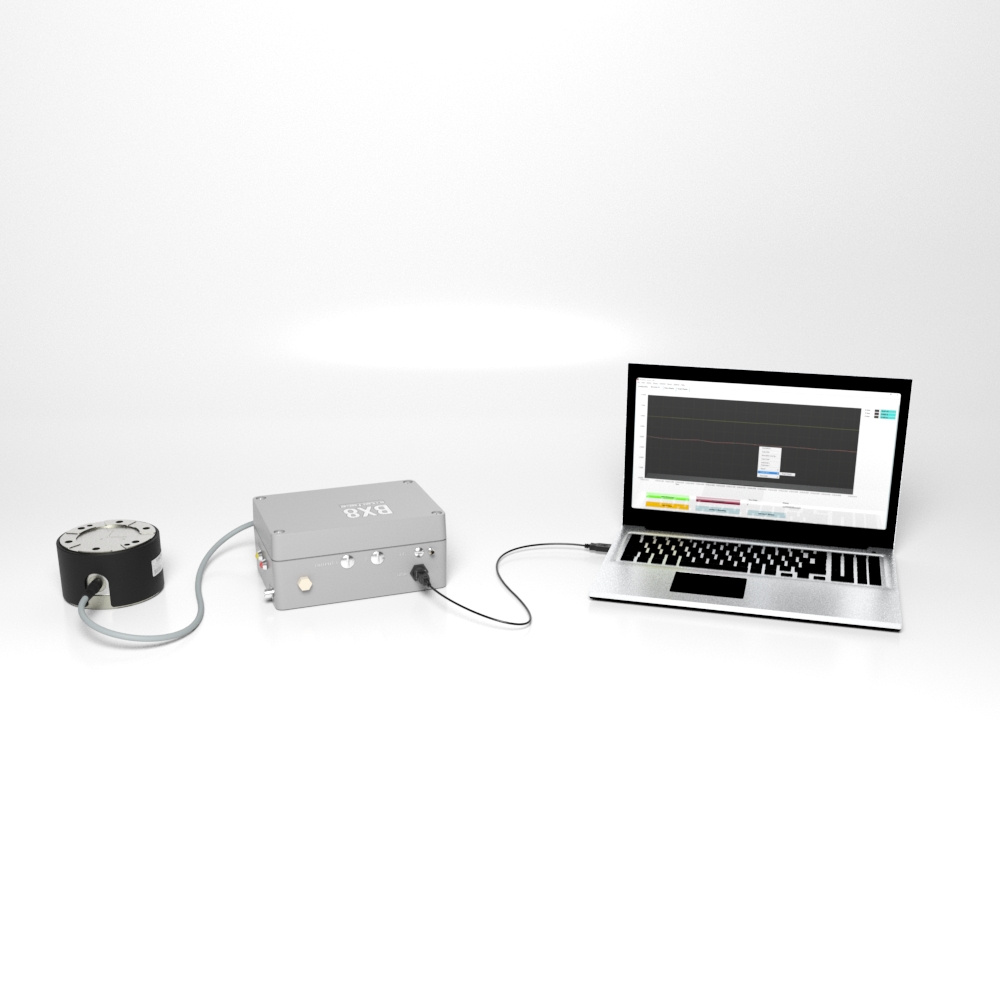
The Interface 6A Series 6-Axis Standard Capacity Load Cell and BX8-AS BlueDAQ Series Data Acquisition System uses the 6-axis load cell to capture forces (Fx, Fy, Fz) and torques (Mx, My, Mz) across six channels, while the BX8-AS BlueDAQ data acquisition system logs, graphs, and outputs all six measurements in real time creating a complete, high-resolution multi-axis measurement solution. Feeding the data from the BX8 into data storage for machine learning or AI use takes this system to the next level.
6-Axis Standard Capacity Load Cells force and moment values MUST be calculated using the supplied 36-term coefficient matrix. They offer low crosstalk and are temperature-compensated sensors. A BX8 amplifier and software can be used to calculate force and moment values. The BX8-AS BlueDAQ Series Data Acquisition System features 8-channel synchronized sampling, internal calculation of axis load values for 6-Axis sensors, and active scaling of analog outputs based on internal calculations. There are EtherCAT, CAN bus, and CANopen options.
Consider a 6-axis load cell integrated into a robotic assembly arm. In a traditional setup, the controller may only process static force thresholds. In an advanced analytics or AI-enabled environment, multi-axis sensor outputs are sent to our BX8 DAQ to synchronize data and provide a more complete view of performance.
If you then pair the DAQ output with an AI engine, it analyzes the data to identify subtle force signatures. This allows the system to distinguish between a successful assembly and a “near-miss” misalignment, compensating dynamically for variables like vibration or thermal expansion that would typically compromise measurement accuracy.

Moving Beyond Static
One of the most significant shifts for engineers is the move away from static measurement toward context-aware sensing. When precise Interface sensors are paired with machine learning, the system provides predictive maintenance with accuracy over time. Instead of relying on fixed compensation tables, AI models can filter out environmental noise and resonance at the edge, delivering immediate, actionable feedback. This is particularly critical in high-speed automation and aerospace testing, where waiting for downstream data processing is not an option.
Interface Precision Foundation
The success of these analytical capabilities depends entirely on the accuracy of the underlying hardware:
- LowProfile, Miniature, and Load Washer Load Cells
- Torque Transducers and Multi-Axis Sensors
- Digital Instrumentation and BX8 DAQ Systems
- IO-Link and Wireless Telemetry Systems
Impact Across the Engineering Lifecycle
Valuable data from load cells and multi-axis sensors are finding new use cases across product development, test evaluations, engineering design, and operations, with advanced analytics supporting these efforts. The integration of artificial intelligence into force measurement systems represents a significant leap forward in precision, responsiveness, and reliability for these data use cases.
This transformation is already being realized in complex sectors. In medical device design, predictive modeling simulates years of wear in a fraction of the time. In energy projects, force data is fed into equipment models to predict maintenance needs before a failure occurs.
Whether optimizing a manufacturing workflow or designing smart consumer products, the integration of Interface’s precision hardware with AI-driven analytics ensures that data is not only collected but also used to its full potential.
Ultimately, this is more than just measurement. It is intelligent force sensing. By providing the high-quality data foundation required for advanced analytics and AI, Interface helps engineers build smarter systems every day.
TIP: Learn more about DAQ solutions by viewing our Unlocking the Power of DAQ Webinar.