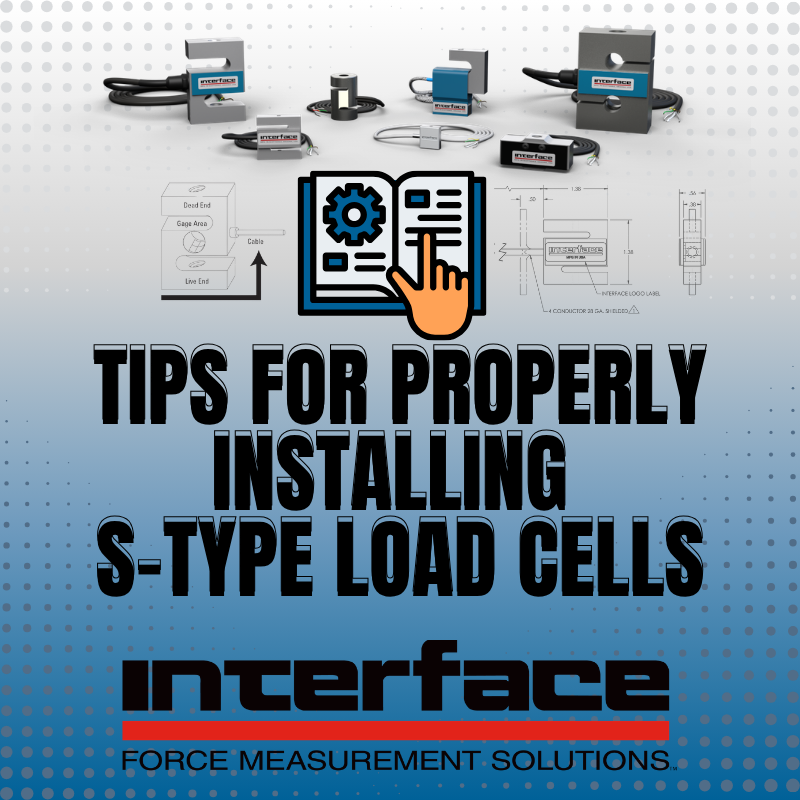
Tips for Properly Installing S-Type Load Cells
 The Interface S-Type Load Cell occupies a distinct niche in industrial and test lab applications, serving as a highly versatile sensor capable of handling both tension and compression forces in a compact form factor.
Unlike single-point, canister, or shear-beam load cells, which are typically designed for unidirectional loading or for specific platforms, the S-type configuration offers a small symmetrical design. This geometry allows the sensor to remain in line with the force path, making it ideal for OEM integration, suspended loads, mechanical scale conversions, and compact test machines.
TIP: Watch S-Type Load Cell Anatomy to understand the core components and functions.
While traditional beam cells are less sensitive to twisting forces during basic installation, S-type models feature a central web that dictates specific handling protocols to avoid structural deformation. Understanding these design differences is critical for ensuring measurement accuracy across varied operating environments.
Four Fundamental Tips for a Successful S-Type Load Cell Installation
#1 Counteract Torque at the Source
Always apply a dual-wrench technique when securing hardware. By holding the specific end of the load cell being worked on with an open-end or Crescent wrench, you ensure that rotational forces are reacted locally and never travel through the delicate central web.
#2 Observe the Thread Depth Rule
Ensure all threaded rods, bolts, or studs engage into the female holes to a depth of at least one full thread diameter. This provides sufficient surface area contact to handle operational loads without stripping the aluminum or steel threads.
#3 Lock Hardware Mechanically
Never leave thread engagements floating or loose. Always lock fixtures tightly in place using a jam nut or torque them down flat against a solid shoulder to prevent microscopic shifting, thread wear, and later calibration drift.
#4 Upgrade Hardware for Higher Capacities
For any application exceeding a 500 pounds-force capacity, ensure all mating rod ends, studs, and clevises are heat-treated to better withstand high mechanical stresses without yielding.
Interface offers a series of accessories, as highlighted in the S-Type Load Cells Typical Installation video. You can find all our Accessories or use our Accessories Selection Guide.

Understanding an S-Type Installation
Installing S-type mini load cells requires greater caution than the relatively straightforward mounting procedures for beam cells. Because the nameplate covers the gauged area, these sensors often appear to be solid pieces of metal. However, beneath this label lies a thin, sensitive measuring zone that is highly susceptible to structural damage.
If torque is accidentally applied across the sensor from the live end to the dead end, it can travel directly through this delicate internal gauged section and permanently ruin the instrument. For this reason, anyone tasked with installing or servicing these components must understand their inner construction and the mechanical vulnerabilities hidden beneath the casing.
To completely isolate the gauged area from destructive rotational forces, installers must react all torque on the exact same end where the force is being applied. Whenever a technician mounts the cell itself or secures a fixture to it, they should use an open-end or Crescent wrench to firmly hold the end that receives the hardware.
A reliable workflow involves securing the fixtures first. By placing the load cell’s live end in a bench vise, technicians can safely attach the required components before mounting the dead end to the machine or framework. This sequence greatly reduces the probability of transmitting unintended torque through the center of the cell, safeguarding the internal strain gages.
As a reminder, here are the different Interface S-Type Load Cell models available in a broad range of capacities:

- SM S-Type Load Cell
- SMA Miniature S-Type Load Cell
- SMT Overload Protected S-Type Load Cell
- SMTM Micro S-Type Load Cell
- SSM or SSM2 Sealed S-Type Load Cell
- SSM-FDH Sealed High Temperature
- SSMF Fatigue Rated S-Type Load Cell
- SSMH Sealed Hazardous Environment
- SuperSC
You can view the full engineering specifications, including capacities, dimensions, and performance data for all Interface S-type models here.
TIP: You can find more technical insights in our Superior S-Type Load Cells Webinar.
Illustrating S-Type Installation Challenges and Solutions
Let’s explore some applications to further highlight the criticality of proper installation of the S-type load cell.
Suspended Vessel Weighing in Chemical Processing
An industrial chemical facility requires precise inventory tracking for a series of overhead liquid-blending tanks. Because floor space is limited, the tanks had to be suspended from the structural steel ceiling grid. S-type mini load cells measure vessel weight via inline tension.
Installation Challenge and Resolution: During installation, the team encountered significant vibrations due to the powerful internal tank mixers and shifting fluid dynamics.
- The team used rod end bearings at both female-threaded ends to eliminate parasitic bending moments from shifting fluid loads.
- Installers used jam nuts to lock all hardware firmly against the load cell shoulder, preventing the severe mixer vibrations from loosening the threads over time.
- Every threaded adapter was checked to confirm it was inserted into the sensor body to a depth of at least one full thread diameter, ensuring structural integrity.
High-Cycle Endurance Testing in Component Manufacturing
A manufacturer designed an automated test stand to perform fatigue testing on automotive control linkages. The application required an S-type sensor capable of withstanding rapidly alternating tension and compression cycles for up to several million repetitions.
Installation Challenge and Resolution: Because any minor misalignment introduces side loads and ruins the testing data, alignment of the entire test string is mandatory.
- The engineering team ordered the S-type load cells with factory-installed and aligned clevises to ensure perfect hole-to-hole spacing and eliminate field alignment errors.
- Technicians clamped the sensor’s live end in a bench vise to attach the initial test fixture, ensuring that no rotational forces were transmitted through the delicate central web.
- High-strength, heat-treated Grade 5 hardware was deployed across the system to prevent micro-yielding and thread deformation under rapid load reversals.
High-Capacity Extraction in Petrochemical Hazardous Environments
An oil and gas processing refinery needed to monitor inline tension on heavy-duty processing equipment operating in a Class I, Division 1 hazardous area.
Installation Challenge and Resolution: The application required a sensor capable of withstanding harsh environmental exposure while handling high-capacity forces of 5,000 to 10,000 lbf. Engineers deployed the SSMH Sealed Hazardous Environment S-type load cell to meet both environmental and high-mechanical-load requirements.
- Because the high-capacity SSMH can handle substantial mechanical forces, the field technicians matched the application with high-strength, heat-treated Grade 5 mating threads to prevent the massive tension forces from stripping or yielding the connection.
- During field assembly, installers applied the mandatory dual-wrench method, using large wrenches to lock the high-capacity sensor’s lower block in place while tightening the mounting hardware at that end, ensuring the high torque required for a 10,000-pound-capacity thread didn’t twist the internally gauged core.
- The team verified that the heavy-duty threaded rods engaged in the female holes to a depth past the minimum of one full thread diameter, ensuring full thread-to-thread contact against a jam nut, so that sudden dynamic load shifts could not loosen the assembly and degrade calibration.
Commitment to Installation Success
Successful S-type load cell installation hinges on recognizing that these sensors are precision instruments masquerading as solid blocks of metal. The ultimate goal of a technician is to protect the hidden, internal gauged area from extraneous mechanical forces during setup.
By ensuring that all tightening torque is applied to a single end, maintaining a minimum thread-depth engagement of one diameter, locking the threads to a shoulder or jam nut, and using high-grade hardware for loads exceeding the sensor’s capacity, you eliminate the leading causes of premature sensor failure. Adhering to these mechanical guidelines preserves the load cell’s calibration integrity, longevity, and safety across all industrial tension and compression applications.
TIP: Each model type listed above has a complete installation manual you can download for your reference.
Are you considering an S-type load cell for your next project? Interface is ready to support your requirements for standard, custom, and complete S-type systems. For questions, please contact our application experts.
Additional Resources
The In-Line Advantage of S-Type Load Cells
New Technical White Paper Analyzes SuperSC S-Type Miniature Load Cells
Eccentric Loading Analysis for SuperSC S-Type Miniature Load Cell White Paper


