
Why Use a Single Load Cell for Platform Weighing?
 A single point load cell is a force sensor specifically designed to measure the weight of objects placed anywhere on a weighing platform while maintaining high accuracy. Unlike other load cell types that require the load to be centered or to use multiple load cells at the corners of a platform, a single point load cell is engineered to compensate for off-center (eccentric) loading, making it common for compact weighing platforms and scales.
How does a single point load cell work? These load cells consist of a machined metal beam, typically made from high-strength aluminum for lower-capacity models or stainless steel for higher-capacity or harsh-environment applications. The beam contains strategically placed openings and thin flexure sections that concentrate strain when the load is applied.
This is where the load cell’s strain gage takes control. Bonded to these flexure areas are foil strain gages arranged in a full Wheatstone bridge circuit. As the beam deflects under load, areas under tension cause some strain gages to stretch, increasing their electrical resistance. Areas under compression cause other strain gages to compress, decreasing their resistance. The Wheatstone bridge converts these tiny resistance changes into a very small electrical output, typically measured in millivolts per volt (mV/V). A signal conditioner, transmitter, digital indicator, PLC, or data acquisition system amplifies and converts this signal into a readable weight value.
Single Point Design for Off-Center Load Compensation
The defining characteristic of a single point load cell is its ability to accurately measure loads even when they are not perfectly centered on the weighing platform. Whether an object is placed in the center, near a corner, or along an edge, the load cell is engineered to produce nearly the same output, ensuring consistent and reliable measurements. This exceptional off-center load compensation is achieved through carefully engineered beam geometry, precise strain gage placement, specialized manufacturing compensation techniques, and calibration processes that minimize corner-loading errors. As a result, manufacturers of platform scales use a single load cell instead of four individual sensors, reducing both system cost and mechanical complexity while maintaining high weighing accuracy.
By design, a typical single point load cell has fixed mounting holes on one end and loading platform holes on the opposite end. The sensor has one or more machined flexure regions and internal strain gages protected with sealant. The device typically has a permanently attached electrical cable. This type of mechanical engineering ensures that the load cell bends only a very small amount, typically just a few thousandths of an inch, while remaining completely within its elastic range.
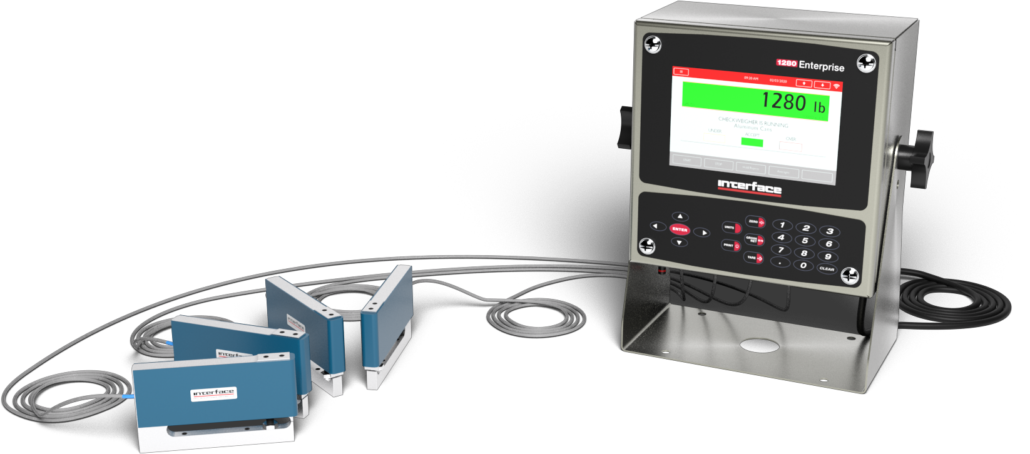
Interface Single Point Load Cells
The SPI Low Capacity Platform Scale Load Cell is a platform load cell. It is compensated for off-center loading and is available in capacities ranging from 3 to 15 lbf (13.34 to 66.72 N). Interface SPI cells with capacities of 3 lbf, 7.5 lbf, and 15 lbf contain an internal compression overload stop to protect the cell up to four times the rated capacity. SPI’s use an additional bar under the lower surface to provide a mount for the internal compression stop screw. The center bar, which holds the strain gages, functions as a bending beam. It is supported by the outer frame with four thin flexure points, two on top and two on the bottom, that offer mechanical strength against side and moment loads. This design enhances the SPI’s ability to cancel moments, ensuring a reliable weight reading throughout the entire weigh pan within its size constraints.
The SPI High Capacity Platform Scale Load Cell is for scales and platforms that require measuring 25 to 150 lbf (111.2 to 667.2 N). These SPI load cells can be protected by placing hard stops under the corners of a weigh pan to catch the pan before excessive deflection damages the SPI cell.
The Interface SPI 1280 Complete System highlights the easy integration of these single point load cells with Interface’s instrumentation, like the 1280 Programmable Weight Indicator and Controller.
Interface’s popular miniature MBI Overload Protected Miniature Beam Load Cell is compact-sized and can function as a single-point load cell. The MBI has better resistance to off-axis loads than similar load cells and is fatigue-rated. This product has capacities from 2 to 10 lbf (10 to 50 N). The ULC Ultra Low Capacity Load Cell is also capable of single point load cell functions for small scales. The ULC is the world’s most accurate ultra-low capacity load cell, measuring loads from 0.1 N to 5 N (0.02 lbf to 1.12 lbf). It has overload protection for safe axial overload up to 10X capacity and safe side load overload up to 5X capacity.
TIP: Gain more insights in Why Choose a Single Point Impact Cell?
Single Point Load Cells Key Considerations
Single point load cells offer several important benefits for weighing applications. As noted above, the number one is excellent off-center loading performance, and only one load cell is required for most platform scales. These load cells are compact and lightweight. A quality single point load cell will offer high repeatability and linearity with fast response times. For weighing, the single point load cell is a cost-effective solution for OEMs and scale manufacturers. They are simple to install, have a long service life, and require low maintenance.
Despite their versatility, single point load cells have some limitations, including their small size, which means they are best used in smaller platforms. Carefully review the specifications to ensure they have the capacity required for general use. They are not advisable for high-capacity industrial weighing. Single point load cells are sensitive to excessive side loads and torsional forces.
Though installation is easy, performance can be affected by improper mounting. Follow the instructions provided in the product data sheet. If overloading consistently exceeds the specified overload capacity, this is likely not the best solution.
Mounting is directly correlated to accuracy. Best practices include mounting the fixed end securely to a rigid structure. Attach the weighing platform only to the loading end and keep the platform within the manufacturer’s recommended dimensions. Proper mounting will prevent side loads and twisting forces. Avoid over-tightening mounting hardware and route the cable to prevent pulling or vibration. If loading beyond capacity is a potential, use overload stops where necessary.
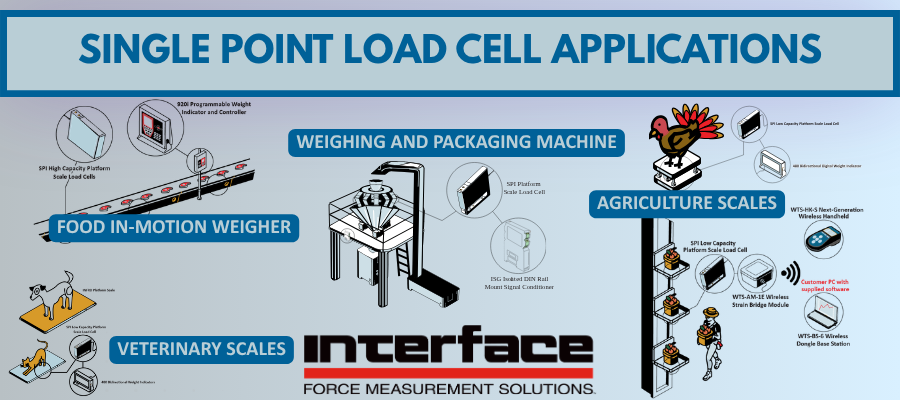
Typical Applications for Single Point Load Cells
Platform scales play a fundamental role across nearly every sector, providing accurate weight measurements where convenience, speed, and spatial constraints matter most. By incorporating a single point load cell, these scales eliminate complex multi-sensor assemblies and deliver reliable readings regardless of where an item is placed on the pan.
Here is how these applications utilize single point load cells across various industries:
- Bench Scales: Found in warehouses, workshops, and light manufacturing, these compact platform scales handle daily parts weighing and inventory checks using a single, durable sensor.
- Retail Price-Computing Scales: Used in grocery stores and delis, these systems combine precise weight measurement with instant price calculation directly at the point of sale.
- Packaging Machines: Integrated into automated packaging lines to quickly weigh bulk materials or discrete products before sealing, ensuring batch uniformity.
- Checkweighers: High-speed in-line scales that verify whether packaged goods fall within strict weight tolerances as they move down a conveyor belt.
- Postal Scales: Employed by shipping centers and mailrooms to determine exact postage costs for letters and parcels based on quick off-center placement.
- Counting Scales: Specialized scales that calculate the exact quantity of small, uniform parts (like fasteners or electronic components) based on total platform weight.
- Medical Weighing Equipment: Used in infant scales, dialysis scales, and specialized medical waste monitors where accurate, repeatable readings are critical for patient care.
- Filling and Dispensing Systems: Automated equipment that controls the flow of liquids or powders into containers, cutting off supply the moment a target weight is reached.
- Food Processing Equipment: Stainless steel platform scales engineered to survive frequent washdowns while accurately portioning ingredients or raw food products.
- Laboratory Balances: High-precision instruments designed for small sample sizes, reliance on delicate flexure beams, and high sensitivity in quality control environments.
- Agricultural Weighing Systems: Rugged platform setups used for weighing harvested produce, animal feed, or portable field equipment under variable environments.
- OEM Weighing Equipment: Custom-built machinery where a single point load cell is embedded directly into third-party equipment, tools, or automated fixtures.
Single point load cells are an ideal solution for platform scale users because they solve the primary mechanical challenge of platform weighing: corner-loading errors. By design, a single sensor handles off-center forces through internal moment-canceling flexures, allowing operators to place items anywhere on the weigh pan without compromising accuracy. This single-sensor approach dramatically lowers manufacturing costs, simplifies mechanical installation, removes the need for summing junction boxes, and delivers a compact, low-profile footprint suitable for both standalone scales and fully automated OEM systems.
ADDITIONAL RESOURCES
Transforming Scales into Smart High-Accuracy Systems
Load Cell Contribution to Accurate Medical Scales
Smart Scales Embrace High-Accuracy Sensor Technologies
Mining Truck Scale Animated Application Note
High Accuracy Load Cell Solutions for Trustworthy Scales
New Interface Case Study Exams Weighing and Scales
Top 10 FAQs for Weighing and Load Cell Integration
A4200 WeighCheck Load Cells and 1280 Programmable Weight Indicator and Controller Weighing System