The Mechanics of Suspended Loads in Heavy Rigging
 Rigging is commonly understood as the specialized lifting system of hardware, equipment, and structural techniques used to secure, hold, hoist, maneuver, and position heavy loads or temporary structures.
At its core, rigging converts rotational, linear, or gravitational forces into controlled mechanical displacement. It relies on calculating vector forces, tension distribution, centers of gravity, and safe working load (SWL) limits to ensure that heavy components remain structurally stable and balanced throughout dynamic motion.
Rigging apparatus encompasses the primary machinery, connecting hardware, and monitoring tools used to lift, secure, and maneuver heavy loads safely. Primary lifting machinery like cranes, winches, and hoists supplies the mechanical force, while connecting hardware, including wire rope or synthetic slings, bow shackles, spreader bars, and turnbuckles, secures the load and distributes its mass evenly to prevent structural distortion.
To ensure complete operational safety, modern rigging setups also integrate force-monitoring sensor technologies, such as load shackles, tension links, load pins, wireless telemetry systems, and load cells. These Interface products provide real-time cable tension and load weight measurements to prevent dangerous overloads of rigging equipment.
TIP: Read why Rigging Engineers Choose Interface Measurement Solutions.
Deconstructing High-Capacity Rigging Applications
Lifting, maneuvering, and holding high-tonnage structural components introduce dynamic vectors that rarely exist in static bench testing. When a multi-ton subassembly is lifted off a staging bay or hoisted onto an offshore platform, the load is rarely distributed evenly across every attachment point. Dynamic shifts caused by wind gusts, crane boom acceleration, line friction, and unexpected structural binding convert simple vertical loads into complex multidirectional forces.
For rigging engineers, managing these variables requires measuring line tension and load weight continuously in real time. Standard static calculations do not account for kinetic energy spikes that occur during initial lift-off or rapid deceleration.
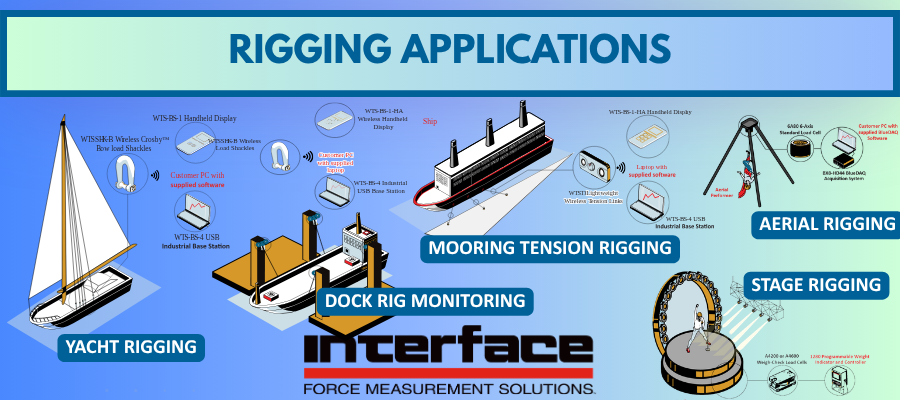
Integrating strain gage measurement hardware directly into the load path of a rigging assembly transforms an unpredictable lift into a controlled, empirical process, ensuring structural safety and preventing equipment destruction, as highlighted in these use cases.
Aerospace Airframe and Engine Integration
During the assembly of commercial aircraft and space launch vehicles, major structural sections, fuselages, and multi-million-dollar propulsion systems must be hoisted and mated with millimeter precision. Rigging engineers embed custom stainless steel load pins directly into clevis joints and overhead spreader bars. These sensors isolate the axial tension applied to each individual hoist point. By transmitting continuous load profiles to multi-channel data acquisition units, engineers prevent localized airframe distortion, ensure symmetrical weight distribution across the lifting rig, and verify that delicate mounting hardware is not overstressed during alignment. Aircraft Engine Hoist App Note defines this solution.
Subsea Energy Infrastructure and Mooring Line Profiling
In deepwater oil and gas operations, positioning heavy wellhead trees, subsea manifolds, and mooring lines demands load monitoring hardware capable of withstanding severe hydrostatic pressure and corrosive saltwater. Heavy-duty tension load links and submersible load shackles are installed directly inline with high-strength synthetic lines and steel cables. These sensors monitor continuous line tension during deep-sea lowering procedures and long-term station-keeping tests, providing immediate detection of cable degradation, seabed grounding, or unexpected surge forces before line snap occurs. Get more information in our Mooring Line Tension Testing App Note.
Automated Industrial Logistics and In-Plant Equipment Relocation
Moving heavy stamping presses, automated assembly gantries, and chemical processing tanks across factory floors involves complex multi-point overhead rigging. To prevent crane tipping and structural floor overload, rigging teams install LowProfile compression load cells beneath jacking points and integrate load shackles into overhead hoist lines. This hardware calculates the exact center of gravity of asymmetrical machinery in real time, allowing engineers to adjust sling lengths and hoist speeds dynamically before executing long-distance transfers.
Theatrical Stage Automation and High-Altitude Aerial Sets
Modern entertainment venues rely on high-speed automated rigging systems to move massive LED arrays, heavy set pieces, and aerial acrobatics rigs safely above performers and audiences. Miniature S-Type Load Cells and compact load shackles are integrated into automated winch lines and overhead trussing to continuously map line tension. If a set piece binds on a guide track or an aerial line experiences an unexpected dynamic tension spike, the sensor feedback loop instantly triggers an automated emergency stop, isolating the hazard before hardware failure can occur. Check out Multi Stage Load Monitoring.

Additional Applications Using Interface Products
- Gantry, overhead, and mobile crane load and weight monitoring
- Hoist tension profiling
- Suspension safety testing and monitoring
- Cable tension for infrastructure
- Load testing for hoists and safety harness durability
- Tension calibration of power line suspensions and utility cables
- Offshore dock and platform rigging alerts and monitoring
- Rig proof loading for winches, slings, and pulling cables
- Maritime yacht rigging and outrigging inspections
Sensor Architecture and Environmental Isolation for Safe Rigging
Ending Physical Cable Vulnerabilities
Physical wiring represents a primary point of failure on active rigging jobs. Long cables trailing from crane hooks, spreader beams, or rotating hoists are highly susceptible to snagging, severe abrasion, and environmental weathering. Modern rigging metrology relies heavily on wireless strain bridge transmitters integrated directly into the sensor body. These modules digitize raw millivolt signals at the load point and broadcast secure, high-frequency telemetry to handheld receivers or central control stations, eliminating dangerous trailing wires entirely. Reference our Wireless and Bluetooth® Selection Guide.
Side Load Rejection and Structural Stiffness
Rigging hardware rarely experiences pure inline tension. Swinging loads, off-axis pulls, and wind shear introduce severe side forces and bending moments that skew standard load cell readings. Advanced rigging sensors utilize specialized internal geometry and multi-axis strain gage placement to reject off-axis interference, ensuring the measurement reflects true structural tension. Furthermore, high natural frequencies and minimal internal deflection ensure the sensor acts as a rigid, unyielding link within the overall lifting system.
Achieving Operational Assurance in Heavy Lifting
Relying on estimation during high-tonnage lifting operations exposes infrastructure, expensive payloads, and personnel to catastrophic risks. Implementing an integrated measurement network consisting of fatigue-rated load shackles, custom clevis load pins, and high-speed telemetry hardware delivers total operational visibility.
To explore our complete application library, product specifications, and regulatory compliance standards for heavy lifting operations, review the rigging solutions.
By converting dynamic physical forces into precise, actionable telemetry, Interface sensor technologies empower rigging engineers across the aerospace, maritime, construction, and energy sectors to execute complex lifts safely, extend hardware operating life, and maintain strict compliance with global safety standards.