

Using Instrumentation to Set Alarms for Force and Torque Measurements
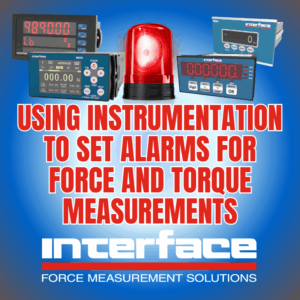 Force and torque measurement load cells and transducers are often paired with instrumentation solutions that include alarm functions. These alarm features are used to create a system that can monitor data from the sensors and trigger alerts when specific conditions are met. This is crucial for safety, process control, equipment protection, and quality assurance in various industrial and laboratory settings.
Alarm features integrated into force, torque, and weighing measurement instrumentation are commonly used in industrial settings. They are essential for the safety of machines and equipment, particularly in conveyors, robotics, cranes, and lifting equipment, where they prevent dangerous overloading. Instrumentation with alarm features is also vital in manufacturing processes, where it monitors parameters such as pressure and torque to ensure product quality and to avoid damage to machinery when values fall outside specified limits.
Beyond industrial use, these instrumentation alarms play a key role in laboratories where precise monitoring is critical. They can be configured to alert technicians to any deviation from a test protocol, which helps ensure the integrity of data and the success of the experiment. This integration of reliable alarm functions across diverse fields highlights their importance in maintaining safety, efficiency, and accuracy.
Types of Instrumentation with Alarm Systems
Interface offers a wide range of analog and digital instrumentation to create a comprehensive system with your paired sensors. Here are a few examples of the instrumentation solutions we offer that incorporate alarm features:
- Wireless relay output receivers are modules, like the WTS-RM1 Wireless Relay Output Receiver Module, that receive data from wireless transmitters and can be programmed to activate relays. These relays can then be used to trigger external alarms, control machinery, or send signals for process automation. They’re highly flexible and are ideal for applications where wired connections are impractical.
- Panel-mount displays, such as the 9870 High-Speed High-Performance TEDS-Ready Indicator, are designed to be mounted directly into control panels, providing a visual display of measurement data. They often have built-in alarm relays that can be configured with specific setpoints. For instance, the model 9870 features a high-performance graphic LCD for a vivid display of process status and multiple intuitive alarms.
- General-purpose indicators, such as the 9825 General Purpose Indicator and 9825-AI General Purpose Analog Input Indicator, are versatile tools for monitoring a range of sensor inputs. They offer an “easy to navigate” menu structure and come equipped with relay setpoints for alarm functionality. The 9825 can be used with mV/V sensors and features two relay setpoints, whereas the 9825-AI is a general analog input indicator with three relay setpoints or one alarm.
- Advanced process indicators, such as the 9894 Analog Input Process Indicator, are examples of advanced process meters. It’s highly configurable and offers multiple alarm modes, including high, low, and fail-safe operations. This level of sophistication allows for precise control and monitoring in complex industrial processes.
- Multipoint indicators, such as the 9890 Strain Gage, Load Cell, and mV/V Indicator, are designed for applications that require the monitoring of multiple load cells. It can support up to twelve 350 Ω load cells and is ideal for multipoint weight measurement systems. The alarm functions on such devices are critical for ensuring uniform loads and preventing overloads across multiple points.
Instrumentation Alarms Use Cases
Manufacturing and Quality Control
In manufacturing, consistent force or torque is crucial for product quality. For example, a transducer that can measure the torque applied when tightening bolts on an assembly line. An instrument like the 9825 can be configured to alarm if the torque is too high (over-tightened) or too low (loose), ensuring every bolt is secured correctly. The alarm feature helps prevent product defects and recalls.
Material Testing Laboratories
In a lab environment, precise control over force and torque is necessary for scientific and engineering tests. An indicator like the 9894 with its advanced alarm settings can be used to monitor a tension or compression test. It can be set to alert a technician when the material reaches its yield strength or ultimate tensile strength, preventing the destruction of the sample before the required data is collected. Read more about Material Tensile Testing.
Multipoint Weighing Systems
Interface’s 9890 is an excellent example for applications that utilize multiple load cells, such as in large silos or tanks. It monitors the load across up to twelve points. Suppose one part of the structure becomes overloaded due to uneven distribution. In that case, the alarm can be triggered to redistribute the load or stop the process, protecting the equipment and ensuring stability.
Industrial and Lifting Equipment
In cranes, hoists, and other lifting machinery, instrumentation with alarm relays is vital for safety. A load cell on a crane can be connected to an indicator, such as the 9870. Suppose the applied load exceeds a predefined setpoint. In that case, the alarm relay is triggered, which can then activate a warning light or sound, or even shut down the lifting operation to prevent structural failure or a dropped load.

The Rise of Continuous Monitoring Requires Reliable Instrumentation Alarms
There is a growing demand for continuous monitoring in industrial and testing environments. This shift is driven by the need to protect expensive equipment and sensitive test environments. Instead of relying on periodic, manual checks, continuous monitoring provides real-time data and alerts.
#1 – Proactive maintenance requires continuous monitoring systems that can detect subtle changes or trends in force and torque data, which may indicate that a sensor is drifting out of calibration or a component is wearing out. This enables predictive maintenance, where issues are addressed before a catastrophic failure occurs, thereby preventing costly downtime and potential damage to the sensor and surrounding machinery.
#2 – Sensor and equipment protection needs continuous monitoring of performance; the system can immediately identify and alert if a sensor is being overloaded or used outside of its safe operating parameters. For example, even a brief momentary spike in force can cause irreversible damage to a load cell. A high-speed indicator, such as the 9870, can capture these events and trigger an alarm, thereby protecting the sensor itself and ensuring the integrity of future measurements.
#3 – Data integrity and compliance in regulated industries require continuous monitoring to provide a complete and auditable record of all test data. The real-time alarms and data logging functions ensure that every test is performed within the required specifications, and any deviations are immediately flagged and recorded. This is crucial for maintaining compliance with industry standards and regulations.
The strategic integration of these advanced instrumentation solutions, from wireless receivers to high-performance indicators, with force and torque measurement sensors, is becoming standard in modern industrial and laboratory environments. By enabling precise, continuous monitoring and instant, data-driven alerts, these systems don’t just measure; they proactively protect, ensuring operational safety, upholding product quality, and safeguarding valuable equipment against damage.
As instrumentation test and measurement technology evolves, the role of these innovative instrumentation alarm features will only grow, becoming even more critical to the integrity and efficiency of a wide range of applications. Use our instrumentation selection guide to review the types of products available to you from Interface.
ADDITIONAL RESOURCES
Benefits of Load Monitoring in Quick Release Hooks
Retrofitting Factories with Measurement Solutions
Load Cells Elevate Gantry Crane Performance
Seaside Ports are Optimizing Efficiency and Safety Using Interface Sensor Technologies
Crane Use Cases and Applications