High-Stakes Oversights That Can Derail Sensor ROI
 In the pressure world of industrial R&D, the difference between a successful product launch and a multi-million-dollar project delay often hinges on a single, overlooked variable in the measurement chain. When considering the requirements for a high-accuracy sensor, a single error in the output instrumentation or a misunderstanding of the wiring setup can derail an entire project.
Today, catalog-driven procurement is common for standard components, and availability is often mistaken for optimization. However, a force measurement sensor is not just a modular commodity. It is a sophisticated instrument that is only as effective as the system it operates within.
To close the gap between lab-grade specifications and real-world reliability, buyers must look beyond the primary data sheet to uncover the hidden technical challenges that could threaten data integrity. The following considerations are critical when evaluating your use case, requirements, and connections in securing the measurement chain for accurate, data-driven success. Consider these in your ROI optimization strategy.
The Mounting Surface is a Structural Component
The mounting environment is often the silent killer of ROI in test and measurement. During the mechanical fit phase, engineers sometimes treat the base or framework as passive support, which is a structural liability. For high-precision hardware such as the LowProfile™ Load Cell Series, the rigidity and flatness of the mounting surface are just as critical to measurement accuracy as the internal strain gages themselves. For example, will you use a pancake load cell with an installed base? If not, consider reviewing Mounting LowProfile Load Cells Without an Interface Base. These are the dimensional considerations that can derail sensor ROI. No matter the sensor type, mini beams or multi-axis, it is important to determine your mounting surface requirements upfront.
When a mounting surface deflects or is not perfectly flat, it causes off-axis loading errors. This not only skews the data but also triggers a troubleshooting cascade that can delay testing by weeks. Beyond flatness, thread and bolt pattern matching must be precise to avoid parasitic torques.
Key Takeaway: The goal of surface preparation is to prevent off-axis loading errors. Ignoring these mechanical details is the most common cause of avoidable system-level inaccuracies.
The Invisible Signal Loss in the Interconnect
Once the physical foundation is in place, the next challenge is the data’s path. The interconnect is often seen as simple cabling, but it can act as an antenna for electromagnetic interference, causing voltage degradation.
Choosing between a 4-wire and 6-wire configuration is a crucial decision for maintaining signal integrity. While 4-wire setups may be sufficient for short distances, they become inadequate for longer runs, where cable resistance causes significant voltage drops. Reference Electrical Wiring and Diagrams for additional support.
Tip: Using a 6-wire cable for long distances allows remote sensing, which compensates for and corrects voltage-drop errors, ensuring the excitation voltage at the sensor stays steady.
The Data Sheet Delusion
One common misconception in engineering is that a sensor’s data sheet guarantees application accuracy straight out of the box. A data sheet shows ideal conditions in a lab, but your application reflects real-world system behavior.
True system-level calibration requires pairing the sensor with the instrument and calibrating them together. This process accounts for the unique scaling factors and electrical quirks of your specific setup. For those managing large fleets of hardware, including a Transducer Electronic Data Sheet (TEDS), is crucial. TEDS enables plug-and-play operation, in which the instrument automatically recognizes the sensor’s specific sensitivity. Without this pair calibration, the accumulated errors between the sensor and the indicator can cause a high-accuracy system to perform poorly.
Planning for the Worst Day
Choosing a sensor based solely on its rated capacity is a recipe for failure. Expert-level selection involves designing for unexpected dynamic spikes and high-cycle fatigue that occur in real-world environments.
There is a critical difference between a functional sensor and an accurate one. If a dynamic spike exceeds the safe overload percentage, the sensor’s internal characterization can be permanently damaged. It may still send a signal, but that signal becomes unreliable. For high-cycle environments, fatigue-rated sensors can withstand millions of cycles without drifting.
Key Takeaway: Matching the hardware’s IP rating to specific environmental hazards is essential to prevent environmental fatigue from increasing your Total Cost of Ownership.
Digital Handshake and Cybersecurity
The final stage of optimization is the digital handshake. As industrial environments shift toward Industry 4.0 and 5.0, the final data destination determines the hardware selection. If your architecture depends on a PLC, the raw signal must be converted to specific analog outputs or digital protocols such as EtherCAT, Profibus, or Ethernet/IP.
However, the modern digital handshake now includes data management and cybersecurity. You need to consider how data is timestamped, synchronized across multi-axis matrices, and protected against unauthorized access. Traceability, which ensures every data point can be traced back to a specific calibration event, is no longer optional. It is a requirement for modern quality standards.
Planning is Key to Optimization
The Interface Sensor Selection Guide was created specifically to help you navigate these critical variables. It serves as an essential framework to prompt these reminders at every stage of your project, ensuring you see beyond the datasheet to the system-level reality. Read more in the Interface Five-Phase Framework for Sensor Selection.
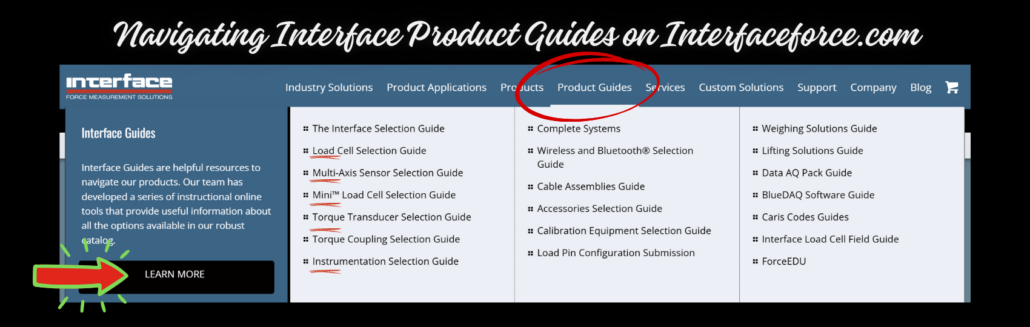
To dive deeper into the sensor types, Interface has a series of product guides you can find on the main navigation of our website. These useful resources enable you to review the details by capacity, specification, and features. Find Interface Guides for different sensors and instrument types here.
Choosing the right measurement system means managing hundreds of variables that a simple spreadsheet cannot include. The most successful projects involve early contact with Interface’s Representatives, Distributors, and Application Engineers, who can assist you in avoiding pitfalls in sensor selection and in meeting your exact needs.