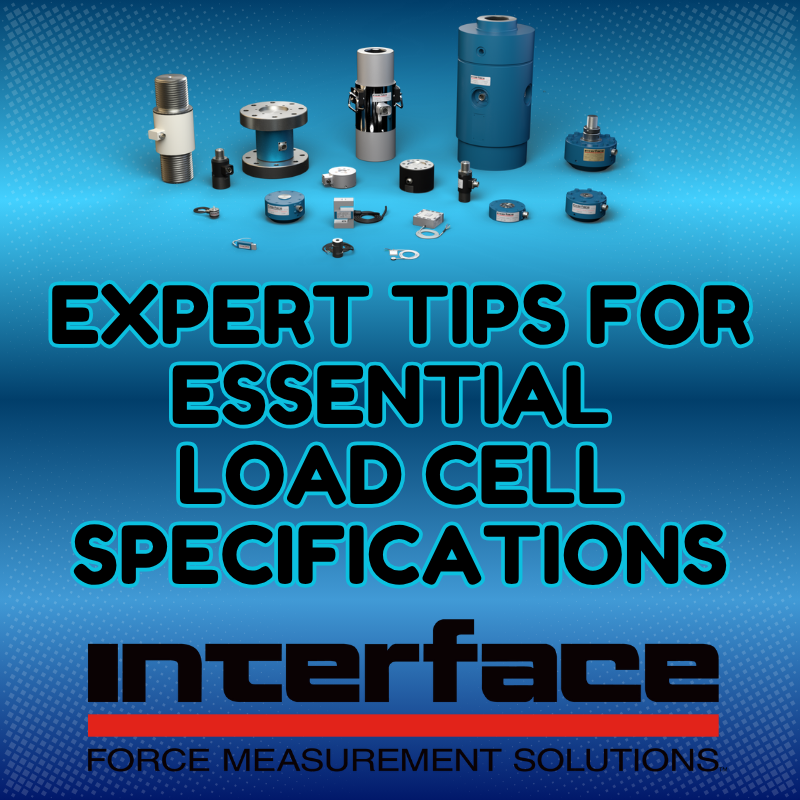
Expert Tips for Essential Load Cell Specifications
 Selecting the right load cell requires a nuanced understanding of its specifications and how they interact with your application’s unique demands.
Interface’s webinar, “Demystifying Specifications,” offers a series of tips that provide valuable guidance for making informed decisions about the type of sensor that will meet your test and measurement requirements. By focusing on key metrics related to capacity range, accuracy, temperature, calibration, and system-level considerations, you can establish realistic expectations for the performance and longevity of your measurement equipment investments.
Five Load Cell Specification Tips and the Impact on Performance
Choosing a load cell is more than just selecting a measurement range; it’s about understanding how the sensor will perform within your specific system. Here are essential tips offered by Interface force measurement experts for navigating five key load cell specifications, ensuring you get the most accurate and reliable measurements.
#1 – Capacity Range
The capacity of a load cell is often the first metric considered, but its impact extends far beyond just handling the maximum expected load. Properly sizing capacity is crucial for both signal quality and product longevity. An oversized load cell might yield a weak signal, while an undersized one risks physical damage.
For applications with extraneous loads, composite loading calculations are essential to determine a capacity that accommodates all forces without compromising signal integrity or causing premature failure. When dealing with cyclic loading, the distinction between standard and fatigue-rated load cells becomes critical. Standard cells are suitable for a few hundred thousand cycles. Still, for millions of cycles or fatigue testing, a fatigue-rated load cell or a significantly higher capacity standard cell is necessary. Even for cyclic loading, unidirectional (compression-only or tension-only) applications at a lower percentage of capacity often allow for non-fatigue-rated cells. Check out: Fatigue-Rated Load Cells 101.
The primary challenge when determining load cell capacity is to ensure it is adequately sized to provide a sufficient signal for quality measurement while avoiding physical damage. Incorrect sizing can significantly impact the product’s quality and lifespan.
CAPACITY TIP: Always compare load cells based on their signal output consistency across capacities, not just the stated capacity, to avoid misinterpreting measurement quality.
#2 – Accuracy Metrics
Accuracy is not a single fixed number. It is a dynamic concept influenced by the details of your measurement use case. Different accuracy specifications are relevant depending on factors like the temperature profile, load profile, and calibration data. If your test environment maintains a constant temperature, temperature-related accuracy specs become less critical. Similarly, for single-ascending load tests, hysteresis is irrelevant. The quality of the excitation supplied to the sensor is also central, as any noise in the excitation will be directly reflected in the measurement signal. Here is a white paper on the subject: Contributing Factors to Load Cell Accuracy.
ACCURACY TIP: Achieving specified accuracy requires considering the entire system, not just the load cell itself.
#3 – Temperature Effects
Temperature significantly impacts both the zero and span of a load cell. While these effects are characterizable and often compensable, it is vital to ensure the temperature around the sensor is as standardized and consistent as possible. It’s highly recommended to run the entire system, including fixturing and cabling, up to temperature without force. This allows you to observe its thermal response and ensures all mechanical elements stabilize. Check out: Understanding Cable Length and Temperature Effects
TEMPERATURE TIP: Focusing solely on the sensor’s temperature response without considering the rest of the system can lead to other error influences that make the sensor’s temperature performance almost irrelevant.
#4 – Calibration
Proper calibration is essential for achieving optimal load cell performance. Calibration should closely match the actual test conditions, considering whether tension, compression, or multi-point data is required. Understanding the type of calibration detailed in the load cell specifications and calibration certificate is crucial. Beyond the calibration method, the uncertainty of calibration itself is a critical, often overlooked factor. Comparing load cell performance requires knowing the calibration uncertainty (e.g., 0.04% vs. 0.02% for dead weight calibration). A load cell with seemingly good specifications but a high or uncredited calibration uncertainty introduces significant risk to your measurements.
CALIBRATION TIP: Always prioritize calibrations with low, traceable uncertainties, such as those from dead weight calibration.
#5 – System-Level
Achieving specified load cell performance requires a system-level approach. This means considering all components that interact with the load cell, including instrumentation, cabling, and fixturing. How are you connecting your load cells to the instrument? What size cable do you require to reach the instrumentation? Are you considering wireless signals? What type of connector will you use? What is the pinout diagram telling you about the sensor’s connector and cable wiring?
Instrumentation, cables, connectors, accessories, signals, DAQ, and fixtures are elements that can introduce errors, such as electrical noise from instrumentation, signal degradation due to long or unshielded cables, or extraneous loads resulting from improper fixtures. The way a load cell is attached and calibrated directly impacts its ability to meet datasheet specifications. By adhering to best practices for load cell integration and calibration, you can ensure the entire measurement system works harmoniously to achieve the desired performance. Understanding your application’s unique needs will help you focus on the few fundamental specifications, streamlining sensor selection and integration.
SYSTEM-LEVEL TIP: It’s essential to follow best practices for connecting and utilizing the load cell properly. Interface strongly recommends system-level calibration when buying a sensor and instrumentation together. It’s the best way to prevent performance errors. Review: System Level Calibration.
Expert Load Cell Specification Tips
Listen in as Brian Peters and Keith Skidmore share insights about these top 5 load cell specification considerations.

Glossary of Key Specification Terms
- Capacity: The maximum load a load cell is designed to measure without sustaining physical damage, which is crucial for maintaining signal quality and extending product life.
- Composite Loading: Calculations used to assess scenarios where a load cell may experience significant extraneous loads in addition to the primary measurement, helping determine required capacity.
- Fatigue Rated Load Cell: A load cell specifically designed and tested to withstand millions of fully reversed (both tension and compression) cycles, typically 100 million.
- Fully Reversed Cycles: Cyclic loading where the force alternates between tension and compression, passing through zero.
- Single-Mode Cycling: Cyclic loading occurs when the loading is either entirely in compression or entirely in tension, but not both.
- Signal Output: The electrical signal produced by the load cell in response to applied force, which needs to be consistent and understood when comparing different load cells.
- Temperature Profile: The pattern of temperature changes a sensor experiences during a test, influencing which accuracy specifications related to temperature become relevant.
- Load Profile: The pattern of load application during a test (e.g., single ascending, cyclic, tension, compression), which influences the relevance of specifications such as hysteresis.
- Hysteresis: The difference in sensor output for the same load when approached from increasing versus decreasing load directions.
- Non-linearity: The deviation of a sensor’s output from a perfectly straight line when plotted against applied load.
- Excitation: The electrical power supplied to the sensor that enables it to produce a measurement signal. Noise in this excitation can affect the measurement.
- Zero Temperature Effect: The change in the sensor’s output when no load is applied, due to temperature variations.
- Span Temperature Effect: The change in the sensor’s sensitivity (output per unit of load) due to temperature variations.
- Calibration: The process of comparing a sensor’s output to a known standard to determine its accuracy and establish its measurement characteristics.
- Multi-point Calibration: A calibration performed at several specific load points across the sensor’s range, providing more detailed data than a single full-scale value.
- Dead Weight Type Calibration: A highly accurate calibration method where known weights are physically applied to the load cell.
- System Specification: The overall performance characteristics of the entire measurement setup, including the sensor, instrumentation, cabling, and fixturing.
- Fixturing: The mechanical components used to attach the load cell to the test setup and apply the load.