At the Fork Where Food Science Meets Sensor Tech
 Before food and beverage products reach the supermarket shelf, the neighborhood barbecue, or the beach cooler, they undergo rigorous testing in research and development kitchens.
Food R&D relies heavily on force measurement to translate the subjective human experience of eating into repeatable, objective data. By using force measurement solutions, including Interface load cells, food scientists quantify the precise physical properties and preparation mechanics that make food appealing, safe, and stable.
It’s noteworthy that the global food processing automation market is projected to reach 40 billion dollars by 2030. This massive industrial footprint underscores the growing reliance on advanced sensor technology, beginning in the initial test kitchen, where precise data determines whether a new product concept is commercially viable.
Let’s look at how force measurement drives innovation in the early stages of food R&D, ensuring that new culinary concepts successfully transition from initial invention to global market distribution.
Quantifying Sensory Profiles
A primary role of force measurement in food R&D is texture analysis. Human terms like crunchy, chewy, tender, or smooth are difficult to replicate without data. Load cells capture these sensations by measuring the resistance of a food sample during controlled mechanical deformation. Here are two quick examples that illustrate this type of sensory profiling.
Analyzing the Perfect Snap – For chips, crackers, or cookies designed to survive different environments, food developers use miniature load cells in test machines to measure the exact peak force needed to break a sample. This type of research testing is used to find the optimal mix that ensures the product keeps its signature snap even as ambient temperatures rise.
Tenderness and Chewiness – Amid the rapid development of plant-based meat alternatives, R&D teams use tension and compression load cells to replicate human biting and chewing cycles. Measuring the force profile across multiple compression cycles allows engineers to compare the structural resistance of various protein types.
Simulating Consumer Interaction
Innovation in food R&D also involves understanding how a consumer physically interacts with the product before the first bite or sip. Load cells are integrated into test fixtures to evaluate the mechanical behaviors that dictate user satisfaction. Here are a couple of examples of these types of behavior tests.
- Peel-and-pull testing in R&D kitchens measures the force required to open single-serve packaging, snack bags, and beverage seals. The goal is to find the sweet spot where the packaging securely protects the food during transit but yields effortlessly to human hands without spilling.
- Extrusion and dispensing of condiments, sauces, or summer treats packaged in tubes and squeeze bottles benefit from the precision of force sensors that measure the actuation force required to dispense the product. Testing ensures that the design accounts for varying grip strengths across different age groups.
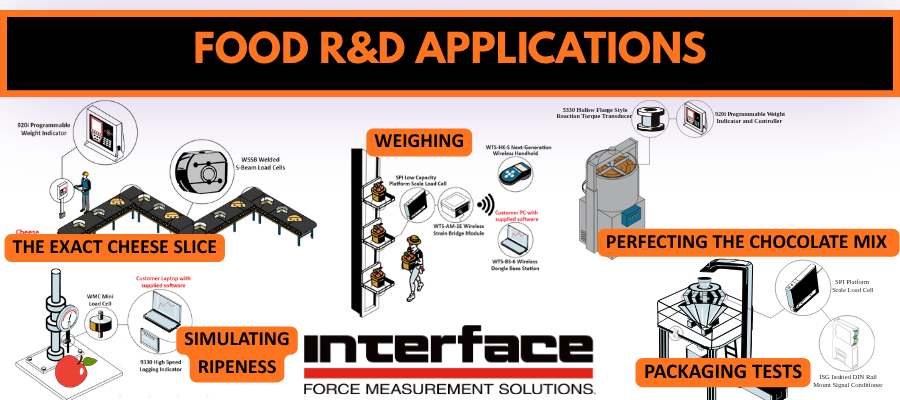
Core Food R&D Sensor Technology Applications
Sensor technologies from Interface support a wide array of specialized testing, recipe development, and automated machinery requirements within food laboratories and early-stage processing environments. Here are some examples of how our load cells, miniature load cells, load buttons, multi-axis sensors, and torque transducers are used in food R&D.
- Harvest Penetrometer Testing to measure the firmness of raw fruits and vegetables to determine peak harvest windows. Visit the app note.
- Food Product Hardness Testing to evaluate the resistance profiles of baked goods and confectionery items.
- Candy Stamp and Confectionery Molding Force Testing to monitor the miniature press mechanisms that delicately print or mold brand logos onto edible treats. See more details in this application.
- High-Precision Ingredient Weighing and Automated Mixing Systems using platform and beam sensors to guarantee the structural integrity and exact balance of complex formulations.
- Cheese Wheel Yield and Portion Control Weighing to measure moisture loss during experimental aging cycles and verify structural density before machine portioning. Learn more in the Cheese Weighing application.
- Cutting Tool and Blade Performance Evaluation to test the blade sharpness, feed-rate forces, and clean-slicing profiles of automated portioning machinery.
- Packaging Material Tensile Strengths and Container Drop Tests to verify the structural reliability of new bioplastics and lightweight canning materials, as highlighted in Force Measurement for Efficiency in Food Processing and Packaging.
- Liquid Dispensing, High-Speed Fill, and Volumetric Weight Analysis to verify fluid flow and cut-off points, reducing overfill waste, as noted in Water Bottle Dispensing and Weighing.
Two Summer Food Innovations From Concept to Consumer
To understand how this looks in practice, consider two growing food trends, protein drinks and plant-based protein diets. As R&D food teams look to bring these concepts to market, let’s imagine two experimental products currently being refined for the summer market.
#1 – The Summer Protein Refresher
Imagine creating a clear, fruit-flavored protein water designed for hot days. Protein isolates typically alter fluid mechanics, often creating an unappealing, heavy mouthfeel that ruins the refreshing sensation. The R&D team has its work cut out to perfect this mix, which is sure to be a summer hit.
In the test kitchen, a low-capacity load cell is integrated into a specialized back-extrusion fixture. A piston pushes down into the liquid, and the load cell measures the fluid’s resistance as it forces its way up around the piston. This data tells developers exactly how the liquid flows under pressure. If the formulation requires too much force to displace, the drink will feel too thick. The load cell helps the team fine-tune stabilizers until the force curve matches the crisp profile of water.
#2 – The Low-Sugar Gourmet Ice Cream
Now consider a plant-based, low-sugar ice cream designed to hold its structure on a warm afternoon without freezing into a solid block. Sugar and milk fat naturally control ice crystal formation and melting rates. When they are removed, the structural integrity changes entirely.
Food developers use a compression load cell to conduct a penetration test on experimental batches immediately after removal from the blast freezer. A cylindrical probe is driven into the ice cream to map the hardness profile. If the load cell records a massive spike in force, the formulation has developed large ice crystals and will feel gritty. If the force profile drops off too quickly when the temperature rises by a few degrees, the ice cream lacks structural stability. Precision force testing allows researchers to balance alternative ingredients to achieve a smooth texture that mirrors traditional dairy.
Driving Kitchen-to-Market Consistency
The ultimate benefit of utilizing quality force measurement in the initial R&D phase is scalability. A successful recipe created by a chef in a test kitchen must behave exactly the same way when manufactured by automated machinery at a rate of thousands of units per hour.
By proving precise baselines during the formulation stage, production engineers calibrate manufacturing equipment to match the exact physical properties verified in the lab. This bridge between culinary art and scientific measurement is what allows food innovators to safely scale up production, ensuring that the very first bite of savory zest or sweetness is just as perfect as the last.
ADDITIONAL RESOURCES
Food and Beverage Conveyor Belt Animated Application Note
Interface Sensors Optimize Food Canning and Production
Smart Food Packaging Uses Force Measurement
Vertical Farming for Sustainable Food Production on Earth and Beyond
Commercial Food Processing App Note
Force Measurement for Efficiency in Food Processing and Packaging