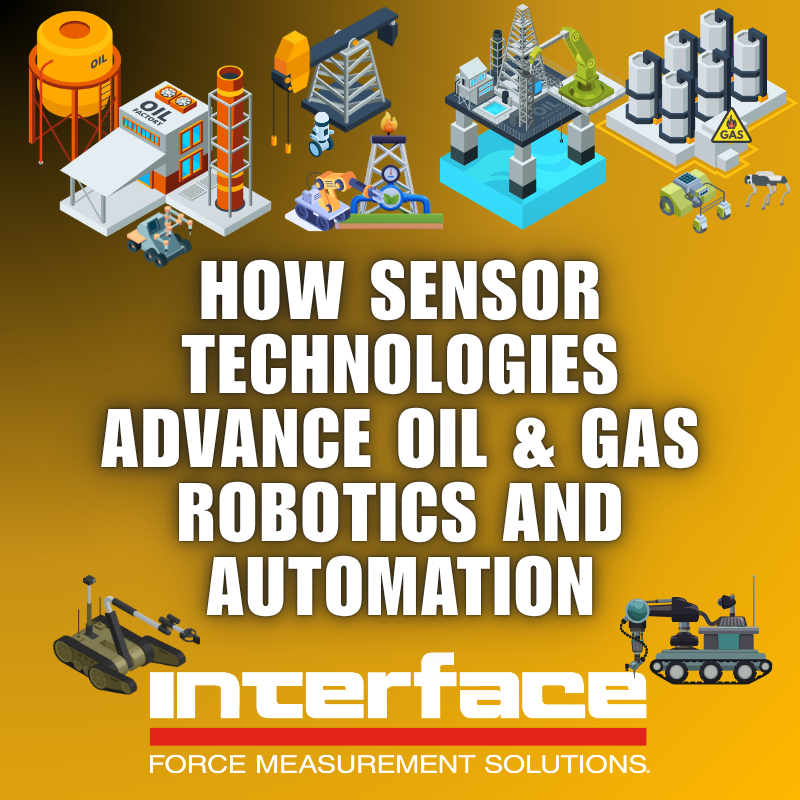
How Sensor Technologies Advance Oil and Gas Robotics and Automation
 The oil and gas industry faces ongoing pressure to improve safety, reduce operational downtime, and extend the life of critical infrastructure. To meet these demands, operators increasingly deploy robotic systems for inspections, maintenance, drilling, and infrastructure operations. These industrial automation systems perform essential tasks in hazardous, high-pressure, and difficult-to-access environments, effectively minimizing human exposure to risk.
Implementing robotics in the oil and gas sector requires accurate feedback loops. Engineers use Interface sensor technologies to measure force, torque, and weight data and to test mobility systems, assess mechanical performance, and confirm the structural integrity of inspection tools.
Accurate force and torque measurements are essential for oil and gas robot design, testing, and monitoring. This requires sensor technologies that refine navigation, control gripping forces, monitor cable tensions, and manage equipment interactions. Reliable data acquisition is achieved through high-fidelity measurement devices such as load cells, torque transducers, multi-axis sensors, wireless telemetry systems, and hazardous location sensors, ensuring safe and predictable operation throughout the asset’s lifespan.

Oil and Gas Robotic and Automation Applications
Robotics in the oil and gas sector utilize Interface sensors and instrumentation to navigate terrain and manipulate hardware safely. Examples of these applications fall into these primary categories: infrastructure, production, and logistics.
Field Infrastructure and Remote Assets Using Robotics
- Autonomous facility surveillance and sensing by ground robots inspect remote locations, unstaffed well pads, and pumping stations. Equipped with load cells and multi-axis force sensors on the onboard manipulator arms, these units manually clear debris, open protective enclosures, and verify the physical positioning of valves.
- Fugitive emission and leak detection use mobile sniffer robots to navigate complex surface piping networks to find leaks. Force feedback sensors regulate the positioning of infrared and optical gas imaging probes against pipe joints and flanges.
- Structural integrity and corrosion scanning by wheeled crawlers that travel along surface pipelines, structural beams, and vertical processing columns use integrated compression load cells.
- Emergency isolation and valve actuation for wellhead incidents or containment failures use explosion-proof ground robots to deploy and isolate high-pressure lines. In the robot design, torque transducers check the exact torque applied to heavy gate valves, preventing over-torque shearing and ensuring a complete mechanical seal.
Robotics for Oil and Gas Subsea Infrastructure
- Pipeline monitoring deploys autonomous underwater vehicles (AUVs) that travel along deep-sea pipelines and use force measurements and visual data to detect structural changes or leaks.
- Wellhead maintenance tasks use subsea robotic arms to adjust valves and perform repairs at depths where hydrostatic pressure prevents human divers from working.
- ROV gripper control for remotely operated vehicles uses multi-axis load cells to regulate the gripping force applied to underwater valves, preventing over-tightening.
Robotics in Drilling and Production
- Automated pipe handling benefits from robotic systems that connect and disconnect drill pipes. In-line sensors monitor axial loads and makeup torque during threading to prevent joint damage.
- Storage tank crawlers are tracked robots that climb storage tank walls to measure plate thickness. Compression sensors verify that ultrasonic probes maintain steady contact with the surface.
Refinery Logistics Robotics and Automation
- Surface maintenance uses robotic units to blast, coat, and weld refinery structures. Multi-axis sensors track surface resistance to keep tools positioned at the correct angle.
- Material handling via automated vehicles and gantries transports heavy equipment. Integrated load cells weigh materials in real time to prevent overloading and track inventory.
Let’s explore two use cases in greater detail.
Load Cells for Quadrupedal Robot Stability

Autonomous quadrupedal robots inspect refineries by navigating steel grating, stairs, and slick surfaces. To maintain balance, engineers install Interface LBM Compression Load Button Load Cell into the robot’s feet.
These mini compact stainless-steel sensors measure up to 50,000 lbf to track ground contact force and weight distribution. Each cell connects to a WTS-AM-1E Wireless Strain Bridge Transmitter, which sends data to a monitoring station via a WTS-BS-6 Wireless Telemetry Dongle. This wireless feedback enables the onboard control loop to adjust the robot’s gait as it transitions between flat concrete and uneven terrain. Autonomous “robot dogs” are also used in security functions.
Multi-Axis Sensors for Internal Pipeline Inspection
Maintaining aging pipeline infrastructure requires reliable, autonomous solutions for internal monitoring. Pipeline inspection robots travel through long conduit networks to perform internal visual and volumetric scans.
To improve tool control, the Interface 6A40 6-Axis Load Cell is integrated into the robotic manipulator arm. This sensor provides multi-axis force and torque feedback during navigation and contact testing. All measurement profiles are logged, displayed, and analyzed using the Interface BX8-HD44 BlueDAQ Series Data Acquisition System to verify structural safety margins.
Wireless Telemetry and Environmental Protection
Physical cables in the field are susceptible to tearing, routing complications, and environmental wear. Wireless telemetry systems remove these physical connections by transmitting sensor data directly to remote receivers.
For subsea and outdoor use, sealed enclosures protect the internal electronics from moisture, salt spray, and corrosive chemicals to maintain measurement accuracy.
Interface is Your Partner for Oil and Gas Robotics and Automation Solutions
Interface has long been a supplier of precision measurement technologies for the oil and gas industry. We understand the demands of industrial, structural, and maintenance applications requiring reliable measurements, and our products are built for these harsh use cases. Interface hazardous-location load cells, torque transducers, and multi-axis sensors are engineered to meet the specific demands of extreme environments and robotic platforms.
Advancements in oil and gas robotics make us a partner who understands the industry and can help guide you in selecting the right products that meet your requirements, whether for design, testing, or ongoing monitoring. Interface is here to help you meet the rigorous operational and safety goals of modern energy infrastructure.
Contact the Interface Application Engineers to explore your sensor requirements for oil and gas industry applications.
ADDITIONAL INFORMATION


