Sensors Provide Intelligence for Safe and Automated Hoisting
 The humble pulley, the mechanical controller in all hoisting, once relied entirely on muscle and guesswork. Today, that simple system has evolved into an intelligent mechatronic asset used in a range of industries from aerospace and infrastructure to maritime and natural resource management.
What is a mechatronic asset? Mechatronics integrates mechanical engineering, electronics, computer science, and control engineering to create intelligent, efficient, and automated systems and products.
The focus in hoisting today has shifted dramatically from mere manpower to exact measurement, transforming hoists into safe, automated machines equipped with fail-safe alarms and overload protection.
Integrating force sensors into hoisting apparatus, including Interface load cells, load pins, tension load links, and load shackles, supports this evolution. These measurement devices are central to providing real-time data on every pound lifted. The accuracy of data enables intelligence and automation, ensures compliance, and prevents catastrophic failure.
Here is a look at eight critical applications where force measurement solutions define modern hoisting safety and efficiency.
Hoist Load Monitoring and Control
Optimizing Lift Dynamics Using Wireless Load Links for Multi-Point Hoists
When lifting asymmetrical or large loads, such as a boat hull hoist, achieving a perfectly balanced load is essential to prevent dangerous torsional stress on the rigging and the load itself. Wireless Tension Load Links or Load Shackles are installed at each pickup point. Balanced load distribution is guaranteed. Real-time individual force readings allow the operator to instantly detect imbalances and make necessary adjustments to rigging or lift speed. This protects the cargo and prevents component fatigue by ensuring the load is lifted at precisely the right level.
Integrating Load Cell Data into Hoisting Controllers
Modern hoisting moves beyond simple weight display by using load data to automate critical control functions. This is supported by using Compression Load Cells or Load Pins with communication outputs in 4-20mA, Modbus, or other protocols based on the system requirements. The force sensor signal is fed directly into a PLC (Programmable Logic Controller), enabling immediate and automated responses. These can include a gradual speed reduction as the load approaches a set limit or an immediate emergency stop upon detecting an overload, removing human reaction time from the safety loop.
Hoist Proof Testing
Hoist Certification Using Calibrated Measurement
Regulatory compliance and operational safety demand that every hoist system be tested beyond its operational limits before it lifts a single piece of actual cargo.
A certified and calibrated load shackle or heavy-duty tension load link is used as the primary, traceable standard for force. These devices are then used to ensure the working load limit (WLL). The system is tested against an accurate standard (often at 125% of WLL), providing verifiable force data needed for regulatory certification and peace of mind.
Evaluating Dynamic Hoist Performance
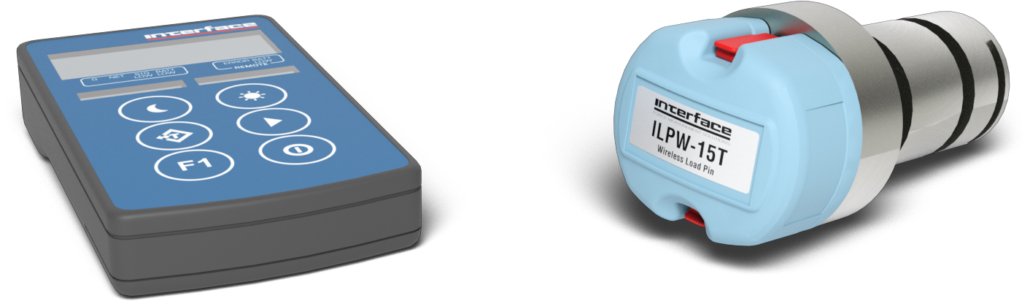
A static test confirms that a hoist can hold a load, but specialized applications, such as rescue hoists, require validation under dynamic conditions where forces fluctuate rapidly. High-speed data logging instrumentation paired with load pins captures rapid force spikes and transient loads that occur during starts, stops, or sudden movements. This data is critical for assuring the hoist can handle the volatile forces encountered during active missions. Check out Interface’s ILPW WTS-BS-1-HA System for a complete system. The ILPW Standard Wireless Load Measuring Pin transmits real‑time force data wirelessly to the WTS‑BS‑1‑HA handheld display, enabling seamless monitoring from multiple sensors on a compact, portable interface.
Hoist Safe Load Monitoring
Preventing Failure with Fatigue in Hoisting Equipment
Material fatigue is a danger for any hoisting components. Continuous, integrated monitoring is essential for predictive maintenance. Permanently installed load pins are integrated directly into critical structural elements, such as sheaves or clevis points. Proactive failure prediction involves continuously monitoring the cumulative history of peak loads and operational cycles, and teams can calculate the remaining fatigue life of components. This allows for scheduled replacement before a metal fatigue failure can ever occur.
Safe Hoisting in Harsh Environments
External factors, particularly high winds and changing marine conditions, can significantly increase the actual load on a hoist system. ATEX and IP-rated wireless load shackles, which are integrated hoisting devices built for harsh environments, can monitor when Dynamic Capacity Derating is applied. The system offers accurate readings in challenging conditions. When paired with wind speed data, the hoist can automatically and dynamically lower the WLL and trigger a ‘no-lift’ alarm if environmental risks surpass the safety threshold.
Hoist Weighing and Overload Protection
Qualified Cargo Weighing
Hoists often serve a dual purpose as certified scales for logistics, inventory, and crucial shipping compliance. Tension Load Links are used as portable, in-line scales in hoisting gear. The sensors easily integrate between the crane hook and the rigging to determine the precise weight of cargo. This is vital for logistics and shipping compliance (such as SOLAS Verified Gross Mass), often replacing the need for separate floor scales. Check out Interface Measurement Solutions for Wireless Weighing Systems. Check out Interface’s WTSTL Wireless Tension Load Link and WTS-BS-4 Wireless Base Station with USB Interface, with an industrial enclosure.

Fail-Safe Alarms
The most fundamental safety function is preventing any lift above the rated capacity, the ultimate protection against equipment failure and personnel risk. A robust, cabled compression load cell or load pin is installed near the winch or in the wire rope’s dead end. The sensor triggers a tiered alarm system in the hoisting equipment, such as a warning at 90% WLL, with an audible/visual alarm at 100% WLL, and a mandatory automatic motor cut-off at 110% WLL to shut the system down before catastrophe. Read: Using Instrumentation to Set Alarms for Force and Torque Measurements.
Smart hoisting through automation and high-accuracy data intelligence is a sophisticated engineering discipline where force measurement is essential. It forms the foundation of operational safety, compliance, and efficiency.

By integrating the right load cell technology, companies can confidently lift the heaviest loads while extending the lifespan of their critical equipment.
ADDITIONAL RESOURCES
A Great Force for Crane and Hoist Solutions
The Rise of Intelligent Measurement in Lifting Equipment