What Is the Difference Between Fatigue and Impact Testing?
 Fatigue testing and impact testing are fundamentally different mechanical test methodologies that impose separate physical and electronic demands on measurement hardware.
Selecting transducers for mechanical durability testing requires a clear understanding of the boundary between cyclic degradation and transient impulse loading. While both test and measurement methodologies evaluate material and structural limits, the instrumentation requirements differ significantly in sensor construction, bandwidth, signal conditioning, and overload design.
Fatigue Testing Principles and Sensor Requirements
Fatigue testing measures the progressive degradation of a material or assembly under repeated cyclic loading below the ultimate tensile strength. Test engineers use this data to generate S-N curves, identify endurance limits, and predict service life under continuous stress reversals. Read: Fundamentals of Fatigue Life Prediction
Transducers used in fatigue applications must withstand millions of fully reversed cycles without zero shift, span degradation, or mechanical failure. A standard general-purpose load cell will often suffer internal strain gage bond failure or structural cracking under continuous alternating loads if it is not designed for this level of performance. Fatigue-rated load cells are engineered with lower internal working stress levels, balanced shear-web geometries, and specialized flexure designs to provide infinite fatigue life (when used properly), within their specified envelope. Find more information in Fatigue-Rated Load Cells 101.
- Sensor Selection: LowProfile fatigue-rated load cells such as the 1000 Fatigue-Rated Universal LowProfile® Load Cell and fatigue-rated miniature load cells, such as the SSMF Fatigue Rated S-Type Load Cell, are engineered by Interface for 100 million fully reversed cycles.
- Instrumentation Needs: Multi-channel strain bridge amplifiers and digital indicators with exceptional long-term zero stability, low thermal drift, and automated shunt calibration to track continuous tests over days or months.
TIP: Learn More and Tune In: Mastering Fatigue Testing with Force Measurement Webinar Recap

Impact Testing Principles and Sensor Requirements
Impact testing evaluates structural response and energy absorption under short-duration, high-amplitude impulse loads. Common methods include drop towers, pendulum impacts (Charpy and Izod), ballistic penetration, and crash barriers.
The priority for impact instrumentation shifts from long-term cyclic survival to transient fidelity. The load cell or force transducer must capture fast rise times without ringing, structural attenuation, or clipping. Transducers in impact setups often encounter off-axis forces, severe deceleration shocks, and momentary overloads far exceeding the primary measurement range.
- Sensor Selection: Load cells, high-capacity multi-axis sensors (such as 3-axis and 6-axis sensors), ruggedized miniature button load cells, and high-frequency load washers are designed for high natural frequencies and peak-force capture.
- Instrumentation Needs: High-speed digital data acquisition systems (such as the BX8 multi-channel DAQ) operating at sampling rates between 100 kHz and 1 MHz per channel, equipped with low-pass analog anti-aliasing filters to prevent spectral leakage.
Learn more in Impact Testing for Millisecond Assessments.
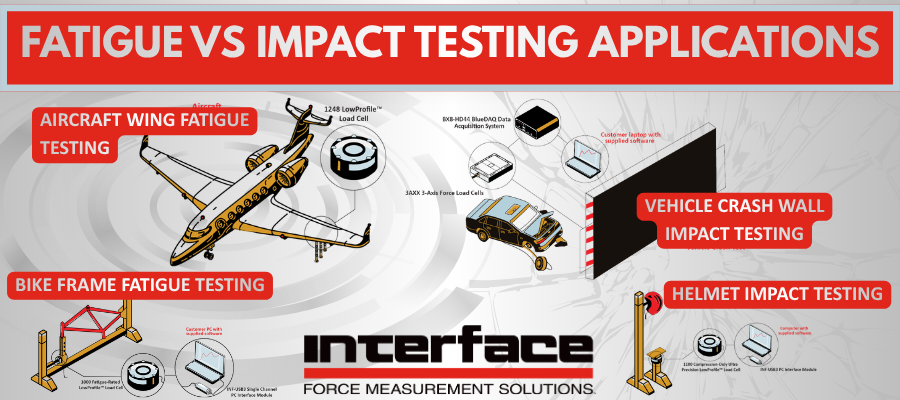
Industry Applications Contrasting Fatigue Versus Impact Testing
Automotive
- Fatigue Application: Suspension links, anti-roll bars, and engine mounts are mounted on multi-axis hydraulic durability rigs running millions of road-load profile cycles. Engineers rely on fatigue-rated LowProfile load cells to monitor continuous tension and compression without calibration shift.
- Impact Application: Frontal crash barriers, side-intrusion beams, and bumper systems undergo high-speed collision testing. Engineers instrument the crash barrier with load cells and high-speed data loggers to capture millisecond force dissipation and peak energy transfer.
Aerospace and Defense
- Fatigue Application: Wing-to-fuselage attachment lugs and landing gear structural components undergo full-scale airframe fatigue life validation over hundreds of thousands of simulated flight hours using fatigue-rated load cells.
- Impact Application: Leading-edge wing sections, turbine cowlings, and cockpit windshields undergo foreign object damage (FOD) and bird-strike testing. High-capacity force transducers and multi-axis sensors measure instantaneous impulse forces during high-velocity projectile contact.
Medical Devices
- Fatigue Application: Total knee and hip replacement implants undergo ISO 14243 and ISO 7206 wear and fatigue protocols, cycling at 1 Hz to 5 Hz for 10 million cycles in physiological fluid. Sealed fatigue-rated load cells track continuous alternating axial and torsional loads.
- Impact Application: Surgical orthopedic instruments, bone nails, and ceramic femoral heads are evaluated on drop-weight impact towers to quantify fracture resistance under sudden drop or hammer mallet impulses using high-frequency miniature load cells.
Renewable Energy
- Fatigue Application: Wind turbine blade root attachments, pitch bearings, and tower foundation bolts endure millions of variable aerodynamic and rotational load cycles. High-capacity fatigue-rated LowProfile load cells and bolt-monitoring force washers measure continuous tension-compression cycles over extended structural validation tests.
- Impact Application: Turbine yaw stops, emergency braking mechanisms, and gust-induced blade-deflection buffers must handle abrupt, severe impulse stops during sudden grid-trip or high-wind brake events. High-capacity compression load buttons and multi-axis load cells capture these short-duration peak shock profiles to verify mechanical catch thresholds.
Heavy Marine and Maritime
- Fatigue Application: Mooring lines, tethered subsea umbilicals, and dockside crane rigging experience continuous, multi-year cyclic tension driven by perpetual wave motion and ocean swells. Hermetically sealed, fatigue-rated tension links and subsea load pins track cyclic load histories to prevent marine corrosion-fatigue failures.
- Impact Application: Subsea anchor drops, dynamic positioning winch lines, and vessel collision fender systems face extreme instantaneous shock loads during anchoring, snap-back events, or docking impact. Ruggedized, submersible high-capacity load pins and compression-only load cells record microsecond peak impact forces to evaluate shear limits and prevent catastrophic structural rupture.
Three Practical Considerations Based on Testing Type
When configuring a test system, engineers must match sensor physics directly to the loading profile based on the test type. Interface highlights the types of testing frequently using force and torque measurement in Types of Testing Applications Using Load Cells and Additional Types of Testing Using Load Cells. The following are key considerations based on your test profile.
#1 – Frequency Response
Fatigue testing conducted on servo-hydraulic or electrodynamic test frames usually runs between 1 Hz and 100 Hz, where standard strain gage excitation and filtering operate cleanly. Impact events occur in sub-millisecond windows, requiring transducers with high natural resonant frequencies so the sensor’s own mass-spring dynamics do not distort the true impact signature.
#2 – Mechanical Overload Protection
Impact fixtures require a sensor capacity selected well above the expected nominal peak to handle unexpected shock spikes without yielding the spring element. For fatigue tests, the sensor’s rated fatigue capacity must match or exceed the maximum cyclic stress range to prevent premature internal failure.
#3 – Data Synchronization
High-channel fatigue monitoring prioritizes continuous logging, trend tracking, and limit triggers. Impact capture requires pre-trigger buffering, precise threshold arming, and synchronized analog-to-digital conversion across all strain, acceleration, and displacement channels simultaneously.
Clarity of Fatigue Versus Impact
Fatigue and impact testing require different approaches to transducer specification. Fatigue applications demand load cells built with low internal working stress and instrumentation optimized for long-term baseline stability across millions of continuous cycles. Impact setups prioritize high natural frequencies, transient overload capacity, and fast sampling DAQ architectures designed to capture millisecond energy transfer without distortion.
Matching the sensor construction, natural frequency, and data acquisition speed directly to the mechanical loading profile ensures measurement accuracy and protects the instrumentation from premature structural failure. Contact our Application Engineers for help finding the best sensor and instrumentation for your testing project.