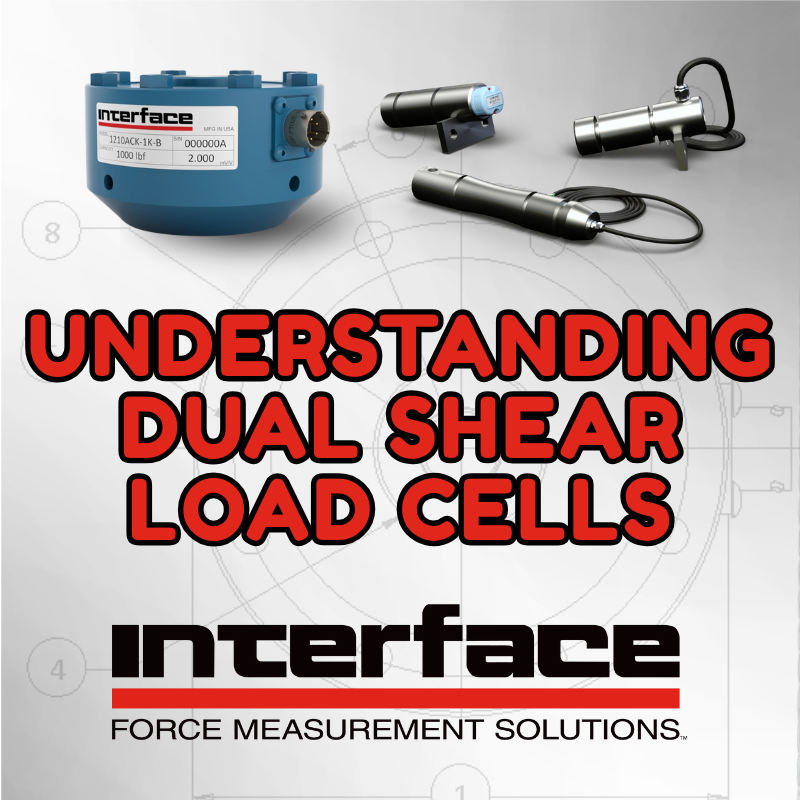
Understanding Dual Shear Load Cells
 In heavy-duty industrial weighing and structural testing, measuring massive loads accurately is only half the battle. Test engineers and equipment operators must also contend with thermal expansion, structural deflection, shifting centers of gravity, and off-axis side forces. Standard single-ended beam sensors may not provide the level of performance required under these complex mechanical conditions.
That is where dual shear load cells, commonly referred to as double-ended shear beam load cells, come in. Engineered to deliver dependable accuracy under grueling conditions, they are a primary solution for high-capacity, multi-directional force environments.
What Is a Dual Shear Load Cell?
A dual shear load cell is a strain gage sensor supported at both ends, with the force applied directly at the center of the beam. Unlike single-ended cantilever beams that measure strain from a single fixed base, the dual-ended design distributes force symmetrically across two matched shear webs. Strain gages are bonded to the machined webs inside the beam and configured in a full Wheatstone bridge circuit to convert mechanical shear stress into an electrical mV/V signal.
Because shear strain remains uniform along the web regardless of minor point-of-load shifts, dual shear load cells maintain high accuracy even when mechanical hardware shifts slightly under load. The Interface Load Pins are an excellent example of this dual-shear design.

Dual Shear Load Pins
Interface’s Load Pin series uses an internal dual-shear configuration in which strain gages are installed along the neutral axis in a center bore, supported on both ends and loaded at the center.
LP Stainless Steel Load Pins are standard and custom engineered-to-order dual-shear load pins designed for clevises, sheaves, pulleys, and shackles. Capacities range from 1.1K lbf to over 3.3M lbf (500 kg to 1,500+ MT) with optional 4–20 mA, 0–5 V, 0–10 V, or RS-485 outputs.
WTSLP Wireless Stainless Steel Load Pins combine dual-shear load pin geometry with Interface WTS Wireless Telemetry for long-range, cable-free force transmission (up to 600 m / 1,969 ft range) in lifting, marine, and heavy-equipment monitoring. These custom sensors are available in capacities that range from 1,000 to three million pounds of force.
ILMP Standard Stainless Steel Load Pin is a standardized configuration designed for direct replacement of load-bearing pivot pins and hardware in mechanical assemblies that require measurement of weight and force. Capacities range from 1.1K lbf (0.5 MT) to 3,307K lbf (1500 MT) with integral signal conditioning. A wireless version is also available: ILPW Standard Wireless Load Measuring Pin.
Dual Shear Web Geometry in LowProfile Load Cells
While distinct from a traditional double-ended rectangular bar, Interface’s flagship LowProfile Series is mechanically derived from dual-shear beam physics. As detailed in the Interface Load Cell Field Guide, the pancake flexure operates on a radial dual-shear web layout.

The LowProfile cutaway shows how the eight holes are bored through the flexure, leaving eight shear webs formed by the material between the holes after boring. This helps visualize how the radial shear webs, along with the center hub and the outside rims on both sides, resemble two shear beam cells end-to-end. The LowProfile® cell thus shows the stability of a double-ended shear beam, and because the circular design is equivalent to four double-ended cells, it provides stability in eight directions about the center point.
It functions symmetrically like multiple double-ended shear beams radiating from a center load point out to a fixed circular base ring, providing 8-direction resistance to extraneous side forces and moments while isolating pure axial force. The LowProfile Series, Interface’s most popular and widely used high-accuracy load cells, includes:
- 1200 Standard Precision Universal LowProfile Load Cell and 1201 Compression-Only Standard Precision LowProfile Load Cell
- 1000 High Capacity Fatigue-Rated Universal LowProfile Load Cell
- 1100 Ultra Precision Universal LowProfile Load Cell
- 1500 Low Capacity Universal LowProfile Load Cell
Five Engineering Advantages of Dual Shear Load Cells
#1 – Center-loaded symmetry balances load distribution across two support points, reducing localized stress concentrations and mechanical fatigue.
#2 – Side-load rejection resists off-axis, torsional, and transverse forces without introducing significant measurement error.
#3 – Thermal expansion tolerance by using end-mount hardware that accommodates slight lateral movement as large structures expand and contract with environmental temperature changes.
#4 – LowProfile models easily integrate into machines and structures, such as directly under vessels, vehicle scales, and structural platforms, without requiring excessive vertical clearance.
#5 – Environmental sealing built from high-grade alloy or stainless steel with hermetic sealing options (IP67/IP68/IP69K) to withstand harsh washdown, outdoor, and industrial conditions.
Core Applications Benefit from Dual Shear Load Cells
Dual shear load cells excel where capacity requirements range from a few thousand pounds to over 100,000+ lbf. A double-ended shear beam load cell operates purely in shear. The strain gages measure principal shear strain on vertical webs situated between the center load point and each supporting end. Specifically designed to tolerate high extraneous side forces and thermal expansion/contraction in large supported structures, these applications benefit from this type of load cell design.
Aerospace and Structural Test Stands – Multi-point structural load frames utilize dual shear beams to isolate pure vertical compression or tension across distributed airframe and rail testing rigs.
Tank, Silo, and Hopper Weighing – Vessel thermal expansion, wind loading, and material shifting introduce continuous side forces. Dual shear assemblies absorb mechanical movement while maintaining real-time asset and inventory tracking.
Truck Scales and Weighbridges – Heavy vehicles create massive impact and braking forces when entering platforms. Dual shear designs handle repetitive high-tonnage cycling and side loads effortlessly. Read: Load Cells Maximize Weighbridge Performance
Rigging, Crane, and Winch Monitoring – Essential for safety verification, overload protection, and load distribution across heavy lifting and tensioning infrastructure.

Optimizing Your Measurement System with Dual Shear Load Cells
A reliable sensor requires a properly matched signal chain to deliver optimal results. Pair sensors with self-checking mount assemblies and hardened load pins or rocker-pin interfaces to minimize binding and ensure pure vertical load transfer. Connect sensors to multi-channel junction boxes, digital indicators, or high-speed data acquisition modules such as the Interface BX8 or digital instrumentation family for clean, low-noise signal conditioning. Request full system-level calibrations of the sensor, cabling, and instrumentation together)to ensure field repeatability and measurement reliability.
If you need assistance configuring the right load cell capacity or mounting assembly for your testing or weighing system, contact the Interface Engineering team to discuss your application requirements. For more information about load cell basics, download our Load Cell Field Guide.


