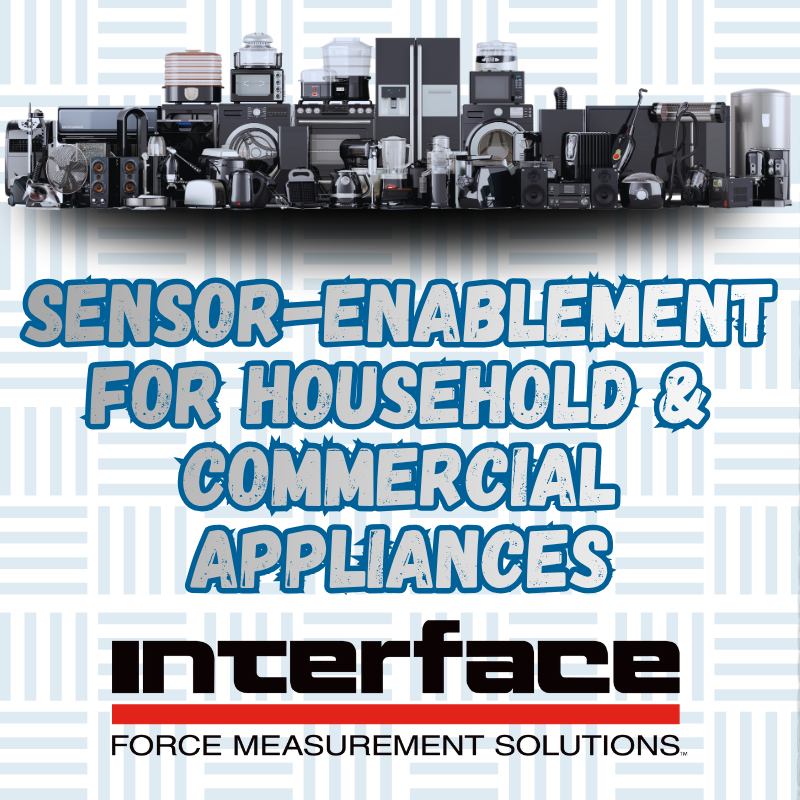
Sensor-Enablement for Household and Commercial Appliances
 The appliance industry spans a wide range of products, traditionally categorized into major subsectors. White goods are considered refrigerators, washing machines, and dishwashers. Small domestic appliances include air fryers, induction cooktops, and blenders. Commercial-grade culinary appliances include trade-use appliances and sanitation systems.
Over the past 75 years, major appliances shifted from post-war household consumer product luxuries into connected, highly regulated domestic and commercial standards. The combined global market for domestic and commercial appliances is valued at $900B and is on track to cross $1T within a few years. Where is this growth coming from?
The appliance industry is moving away from purely mechanical designs toward connected, sensor-driven systems.
Today’s consumers and commercial operators expect appliances to optimize resource consumption, automate complex cycles, and deliver repeatable performance across years of continuous operation. Meeting these performance criteria requires extensive test and measurement throughout the product lifecycle. Design engineers rely on load cells, torque transducers, and multi-axis sensors during the first proof of concept; lab engineers conduct verification testing; factory line production and assembly adopt transducers to improve operations; and manufacturers integrate feedback systems.

Sensor-Enabled Kitchen and Culinary Equipment
Modern cooking and prep equipment often integrates force and torque measurement to automate cooking programs, enhance user safety, and protect mechanical drives.
- Smart induction ranges and cooktops use miniature compression load cells beneath cooking zones to detect pot placement, track boiling liquids by weight, and automatically regulate power levels.
- High-speed blenders, commercial dough mixers, and food processors implement reaction torque sensors on motor mounts to monitor ingredient resistance, prevent motor burnout, and adjust speed based on batch density.
- Automated espresso machines and smart beverage dispensers integrate load cells under drip trays and reservoirs to measure fluid dispense levels in real time for portion control.
- Refrigeration units and pantry storage modules incorporate MB Miniature Beam Load Cells within drawer glides and shelving to track real-time inventory and supply weights.
Measurements for Laundry and Floor Care Systems
Laundry machines, robotic vacuums, and utility equipment operate under high stress and require continuous mechanical balancing.
- Front-load and top-load washing machines use load cells within the suspension geometry to calculate laundry load mass, automatically metering water volume and chemical dosing before the cycle begins.
- Drum support struts use multi-axis force sensors during high-speed spin cycles to detect rotational imbalance, triggering motor adjustments to eliminate severe vibration and mechanical wear.
- Robotic vacuums and motorized floor cleaners use miniature load sensors in wheel assemblies and brush rollers to sense floor transitions, measure downward surface pressure, and detect roller jams.
- Dryer lint traps and filter assemblies use differential force measurements to alert users when airflow restriction creates safety and efficiency risks.
Structural Reliability, Safety Latches, and Logistics Testing
Physical components must endure repetitive user interaction, rough transport, and strict regulatory safety evaluations before entering the market.
- Oven doors, dishwasher latches, and refrigerator seals undergo automated cycle testing using SM S-Type Load Cells and tension-compression load cells to verify gasket compression, seal integrity, and latch release forces.
- Refrigerator tempered glass shelves, storage bins, and oven racks undergo static and continuous loading tests to confirm structural load ratings and prevent catastrophic failure under overload conditions.
- Plumbing systems use Interface load cells in drop testers, shake tables, and transit simulators to evaluate how internal compressors, plumbing connections, and electronics withstand packaging and shipping impacts.
- Commercial trash compactors and smart waste management units use load pins and bending beam sensors to detect fill capacity, prevent mechanical overloads, and trigger compaction cycles.
Appliance OEM Collaboration, Custom Transducers, and Complete Systems
Bringing a new appliance platform from concept to mass production often requires specialized hardware configurations that standard catalog parts cannot accommodate. Interface partners directly with original appliance equipment manufacturers and tier-one component suppliers to engineer tailored solutions for unique design envelopes.
Custom OEM sensor packaging allows engineering teams to embed ultra-miniature load cells directly into internal mechanical linkages, motor brackets, and structural hinges without altering external product dimensions.
High-volume manufacturing programs benefit from application-specific calibration, customized cable harnesses, and tailored mounting geometries built to streamline line assembly.
Complete measurement systems pair multi-axis force and torque transducers with high-speed digital instrumentation, multi-channel data acquisition modules, and wireless telemetry. This provides turnkey test bench setups that sync directly with engineering software for rapid data validation.
Why Appliance Advancements are Supported by Interface
From ultra-compact countertop tools to heavy-duty commercial laundry systems, appliance reliability hinges on mechanical integrity and sensor fidelity. Interface delivers standard and engineered-to-order measurement tools with the fatigue ratings, overload protection, and high-frequency response required for demanding development cycles.
By combining comprehensive sensor capabilities with direct engineering collaboration, Interface equips appliance makers worldwide to design safer hardware, optimize resource efficiency, and deliver dependable performance to every consumer.
ADDITIONAL RESOURCES
Making Products Smarter with Interface OEM Solutions
OEM Solutions Turning an Active Component into a Sensor
Interface OEM Solutions Process
Interface Solutions for Production Line Engineers
Precision Prototyping Uses Force Measurement for Design Validation


