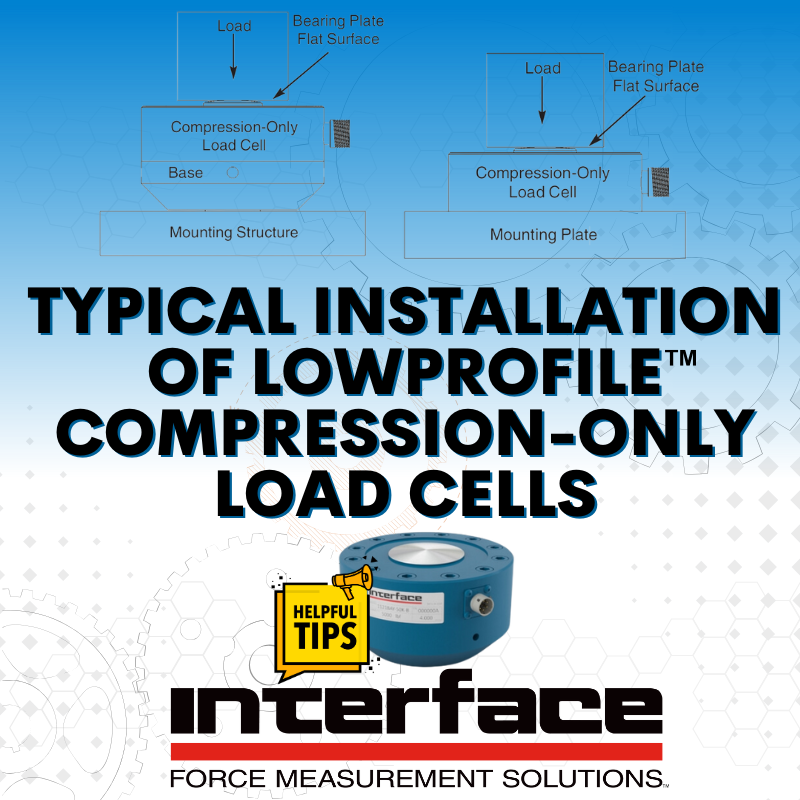
Typical Installation of LowProfile Compression-Only Load Cells
 Effective force measurement starts long before you begin data collection. When configuring your testing requirements, it is vital to evaluate the physical environment of your compression-only load cell.
Because Interface’s Compression-Only LowProfile Load Cell Series 1101, 1201, and 3201 are engineered for high precision and high-cycle fatigue, they are particularly sensitive to the integrity of the mounting setup. Uneven or unstable mounting surfaces introduce parasitic loads that skew readings and create stress concentrations. These concentrations can lead to metal fatigue and the premature failure of the load cell’s internal flexure, essentially turning a precision instrument into a liability.
The Foundation of a Reliable Compression Test
The Interface popular models 1101, 1201, and 3201 Compression-Only Series LowProfile Load Cells must be installed on a flat, rigid surface that remains stable under the full force of the application.
The most straightforward way to ensure this is to use a factory-supplied base or mounting plate. These bases provide a robust, verified platform that minimizes the risk of damage during transportation and ensures the sensor performs exactly as it did during its factory calibration. We strongly recommend ordering your base with your LowProfile selection. Interface also offers load cell base kits as part of our accessories

TIP: For additional information about proper setup, reference the Installation Guide for LowProfile Compression-Only Load Cells here.
If a factory base is not feasible for your specific setup, any alternative surface must provide equivalent support. This means the surface must be ground flat and be substantial enough that it will not deform appreciably when the load is applied. Because these load cells respond to forces perpendicular to the mounting surface, any non-axial force applied at an angle will result in a measurement proportional only to the force multiplied by the cosine of that angle. To secure the cell within your structure, use a spanner wrench via the four holes located on the base of the load cell.
Interface provides a video installation guide. Watch to learn more or save for future reference.

Material Compatibility and Load Application
Material choice at the point of contact is critical for maintaining accuracy. For our precision stainless steel models, the load-bearing surface should be a hardened C45 or higher steel plate. However, when working with aluminum models like the 3201, a mild-steel load-bearing plate is typically sufficient when mating with Interface’s load button accessories.
Proper orientation is the final step in the physical setup. The “dead” end of the load cell, the portion closest to the electrical cable exit or connector, must be mounted to the fixed, non-moving portion of your test frame. It ensures that the cable itself does not influence the “live” end of the sensor, which should be connected directly to where you are measuring the load. Orientation is key, as it establishes the fundamental requirement of force measurement: there must be one, and only one, load path, and it must travel directly through the center axis of the cell.
Versatility of Compression-Only Testing
The Interface 1101, 1201, and 3201 models are engineered for high-cycle fatigue testing, test machines, structural testing, and high-accuracy test labs in a wide array of industries. These versatile sensors provide the critical data needed for both destructive and non-destructive testing environments. Key applications include:
- Materials Testing Machines: Measuring the compressive strength and deformation limits of concrete, composites, and high-performance metals. Reference: Material Testing Solutions and Concrete Compression Testing.
- Stamping and Press Monitoring: Ensuring consistent, repeatable force application in industrial presses to prevent tool damage and part defects.
- Aerospace Component Testing: Performing structural testing on landing gear assemblies or wing sections under high-tonnage compressive loads.
- Jack Calibration: Serving as a precision reference standard to verify the accuracy of hydraulic jacks, cylinders, and other lifting equipment.
- Crush and Crash Testing: Capturing high-speed impact forces during automotive safety evaluations to improve vehicle durability. Compression testing of seals is standard for auto safety checks. Application: Pre-Installation Sealing Sensor Testing
- Medical Device and Orthopedic Testing: Simulating years of weight-bearing stress on prosthetic joints and spinal implants to meet strict durability regulations.
- Renewable Energy Infrastructure: Monitoring pile load testing for solar farm arrays and wind turbine foundations to ensure long-term structural stability. Application: Concrete Pile Static Load Test
- Heavy Machinery and Civil Engineering: Integrating into bridge shoring systems to monitor real-time load distribution on temporary supports during large-scale construction. Reference: Civil Engineering Modernization Relies on Force Measurement Data
RESOURCE: Unidirectional Advantage of Compression-Only Load Cells
Expert Guidance for Success
Our engineers often note that the most common cause of “headaches” related to load cell installation is failure to follow a documented sequence that protects the sensor and your results. Poor installation can cause immediate overload, damaging the load cell and posing safety hazards to operators. Always verify the cleanliness and alignment of your mounting surfaces before the first load is applied.
Installation can also vary widely between load cells and other force measurement solutions. Each product has different processes depending on the mounting components, the application being tested or monitored, and the environment. It is essential to carefully review any materials provided with the instrumentation and sensor.
Interface has a comprehensive library of Installation Guides and Operation Manuals. Following the detailed guides found in the Load Cell Field Guide and Installation Guides is a worthwhile investment of time and resources. Find our Getting Started playlist of videos here.
ADDITIONAL RESOURCES
Force Measurement Installation Guides
I’ve Got a Load Cell – Now What? Episodes 5 and 6
I’ve Got A Load Cell – Now What? Part 6 – Usage & Best Practices
Proper Installation of LowProfile Load Cells Ensures Accurate Tension Measurements
Mechanical Installation Load Cell Troubleshooting 101
Mounting LowProfile Load Cells Without an Interface Base
Load Cell Basics Sensor Specifications


