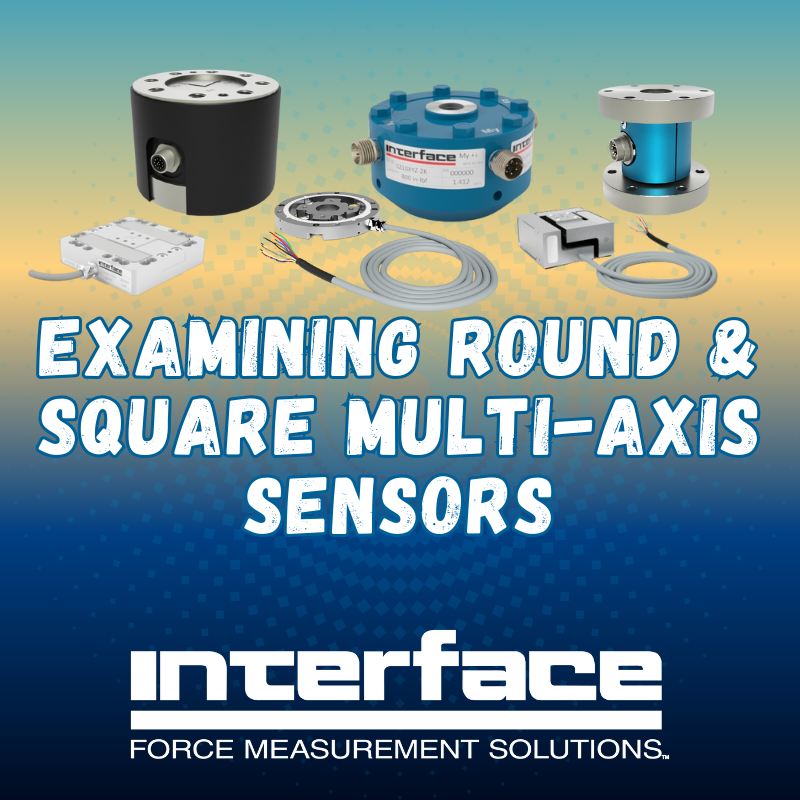
Examining Round and Square Multi-Axis Sensors
 Multi-axis sensors are transducers that measure force and torque in multiple directions simultaneously and convert that measurement into an electrical signal. Interface offers multi-axis sensors, which are available in various capacities for measuring 2, 3, and 6-axis with high accuracy. Two common shapes for Interface multi-axis load cells are round and square, and each has distinct advantages and applications.
The growing popularity of multi-axis sensors is driven by their ability to provide a complete and more accurate picture of force dynamics in complex systems with more data. They are particularly valuable in robotics, prosthetics, and quality control, where understanding multi-directional forces is crucial for performance, safety, and precision. Read more in Better Data and Performance with Interface Multi-Axis Sensors.
Advanced multi-axis sensors are test and measurement devices equipped with multiple bridges that precisely measure force from a single direction, minimizing or eliminating crosstalk from other forces or moments. Interface 2-axis, 3-axis, 6-axis, and axial torsion load cells deliver high-accuracy measurements for advanced requirements of more data than a single-axis load cell.
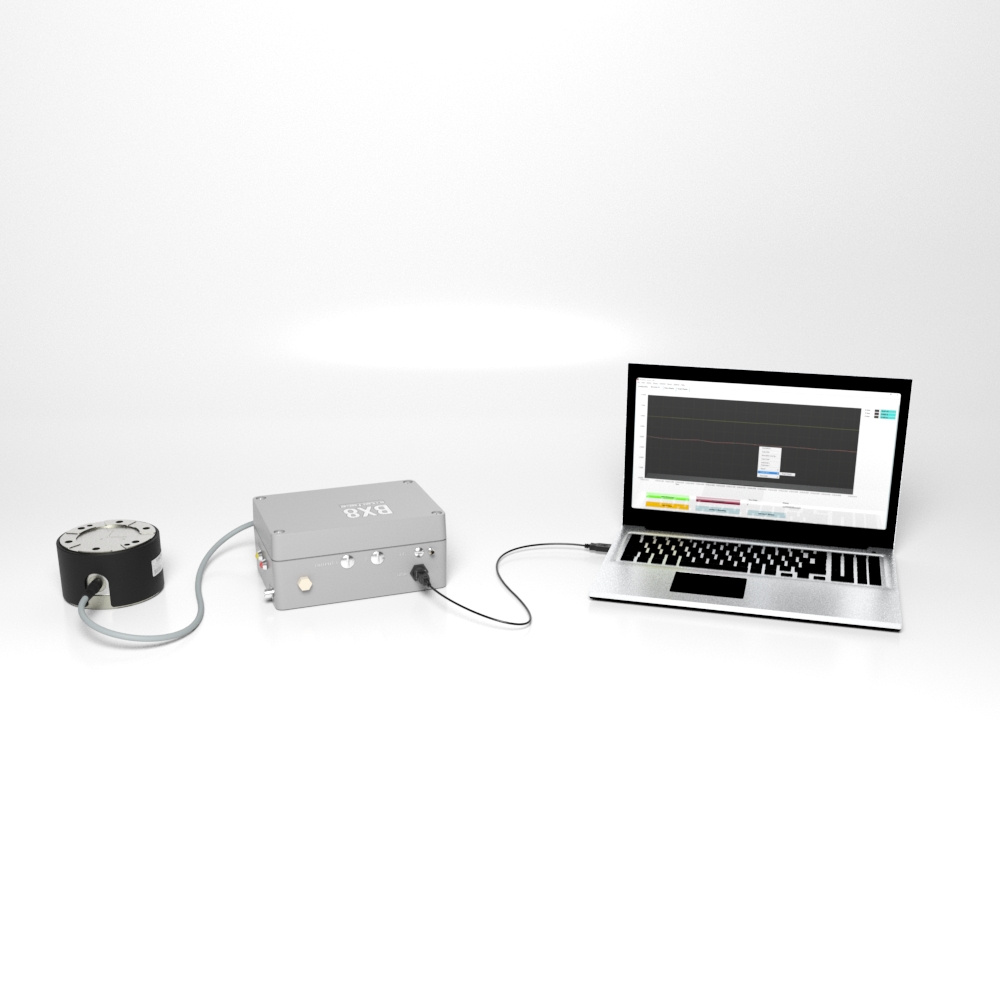
For example, instead of measuring force along a single axis, 6-axis load cells can record data for forces (Fx, Fy, Fz) and torques (Mx, My, Mz) across different axes at one point. This ability makes them essential for applications involving complex loading conditions and when more advanced testing of forces and moments is necessary. Check out the 6A Series BX8 System to see the many benefits of combining Interface’s 6-axis load cells with our advanced instrumentation.
By integrating multiple measurements into a single compact unit, multi-axis sensors simplify mechanical design, decrease the number of components needed, and reduce system weight and complexity compared to using multiple single-axis load cells. This all-in-one functionality not only saves space but also shortens setup time and decreases potential sources of error, making it a cost-effective and efficient solution for advanced engineering and testing applications.
Interface Round Multi-Axis Sensors
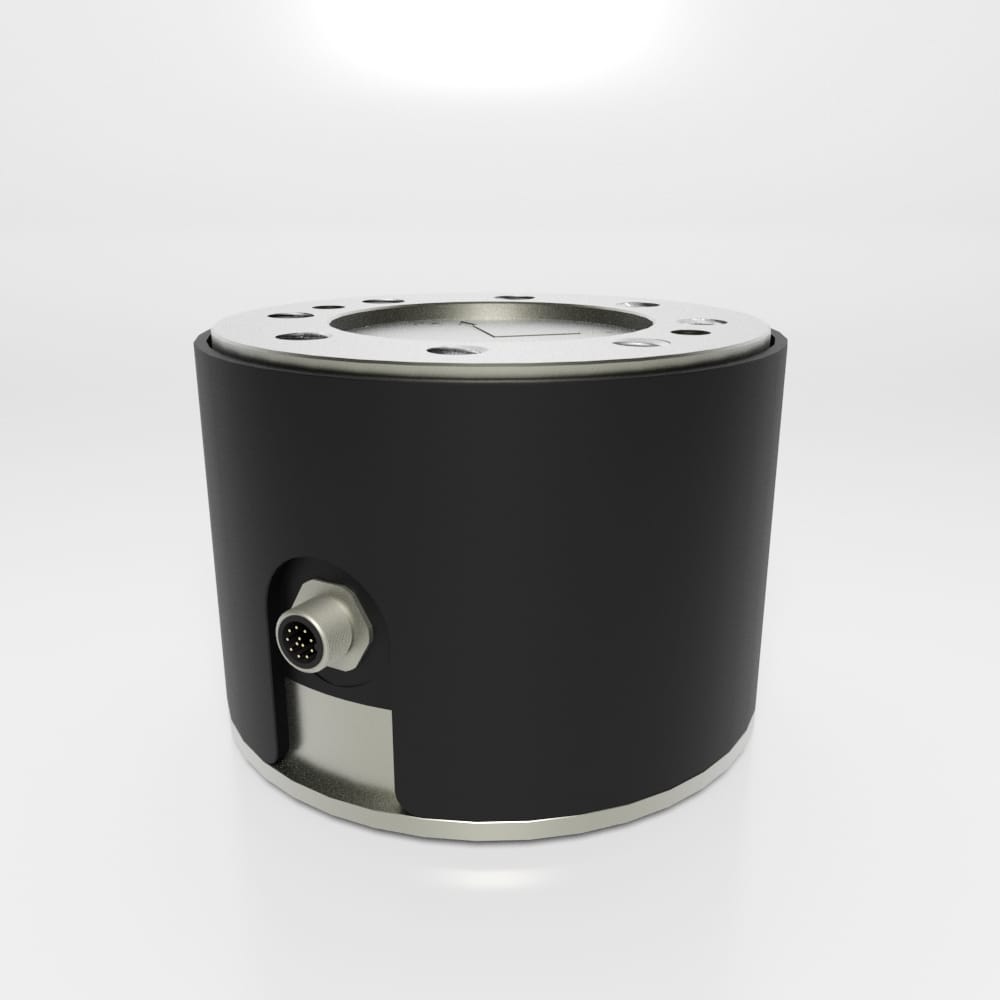 The round multi-axis load cells typically have a cylindrical or disc-like shape. This model design often allows for a more compact, low-profile form factor, which can be crucial in space-constrained applications. The radial symmetry of a round load cell can also be beneficial in specific setups. Here is a list of specific Interface round multi-axis sensors:
1216 2-Axis Axial Torsion Load Cell
1516 2-Axis Axial Torsion Load Cell
2816 2-Axis Axial Torsion Load Cell
5AR Series 3-Axis Force/Torque Load Cells
3AR Series Round 3-Axis Load Cells
5200XYZ 3-Axis Force Moment Load Cell
5600 2-Axis Axial Torsion Load Cell
6A Series 6-Axis Standard Capacity Load Cells – Fx Fy Fz Mx My Mz
6A Series 6-Axis High Capacity Load Cells – Fx Fy Fz Mx My Mz
6ADF Series 6-Axis DIN Flange-Type Load Cells
AT101 2-Axis Axial Torsion Load Cell
AT102 2-Axis Axial Torsion Load Cell
AT103 2-Axis Axial Torsion Load Cell
AT104 Compact Size Force and Torque Sensor
NEW! 6A Series BX8 System
Top 3 Advantages of Round Multi-Axis Sensors
#1 Compactness – They often have a smaller footprint, making them suitable for integration into tight spaces.
#2 Integration – The smooth, round shape can be easier to integrate into existing circular structures or components.
#3 Uniformity – The radial design can offer uniform stiffness in all directions around the central axis, which is sometimes preferred in specific robotic or testing applications.
Round Multi-Axis Sensors Applications
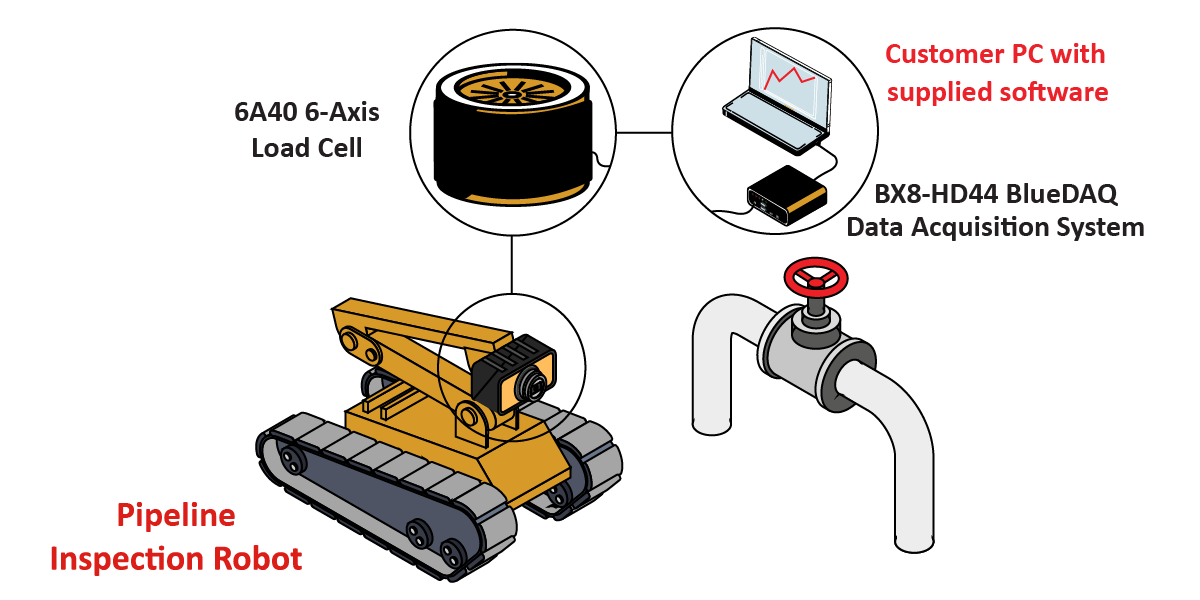
Energy Pipeline Inspection Robots
Oil and gas operations face increasing pressure to maintain aging pipeline infrastructure efficiently, safely, and cost-effectively. As global energy demand grows, operators need more reliable, autonomous, and precise solutions for monitoring pipeline integrity, especially in remote or hard-to-access areas. Pipeline robots have been developed for visual inspections. Interface’s 6A40 6-Axis Load Cell can be integrated into robotic parts like the arm, enhancing control, sensitivity, and feedback during visual inspections and maintenance. These results can be logged, displayed, and measured when connected to Interface’s BX8-HD44 BlueDAQ Series Data Acquisition System with the included BlueDAQ software. Read more: Pipeline Visual Inspection Robot.
Additional Common Use Cases for Round Multi-Axis Sensors
- Robotics in end-effectors, where space is at a premium and a low profile is needed to measure forces applied by the gripper.
- Medical devices for surgical tools or prosthetics to provide haptic feedback and measure precise forces.
- Automotive testing for integration into steering wheel or pedal test rigs to measure applied forces during vehicle development.
Square Multi-Axis Load Cells
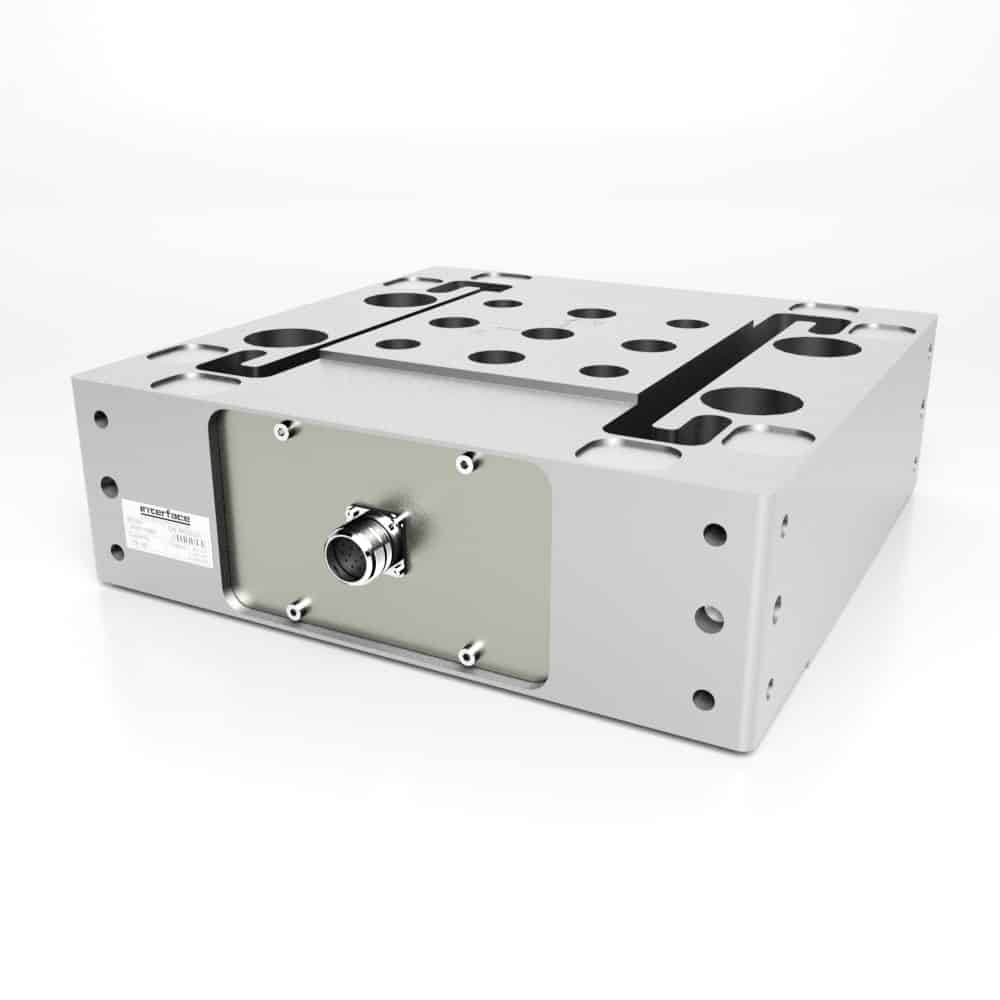 Square multi-axis load cells have a cuboid or block-like shape. This geometry often simplifies mounting and alignment, as the flat, parallel surfaces provide a straightforward way to secure the sensor to a platform or structure. Here are the most popular square multi-axis sensors from Interface:
3A Series 3-Axis Force Load Cells
AT105 Contactless Force and Torque Sensor
NEW! 3A120 BX3-HD44-CAN System
Top 3 Advantages of Square Multi-Axis Sensors
#1 Mounting and Alignment – The flat sides and right angles make them easy to mount and align with other components using bolts or clamps. This is particularly useful in systems with a grid-like or rectilinear structure.
#2 Stability – The broad, flat base of a square load cell often provides excellent stability, resisting rotation or movement when under load.
#3 Modular Design – They can be easily integrated into systems with other square or rectangular components, simplifying the overall design process.
Square Multi-Axis Sensors Applications
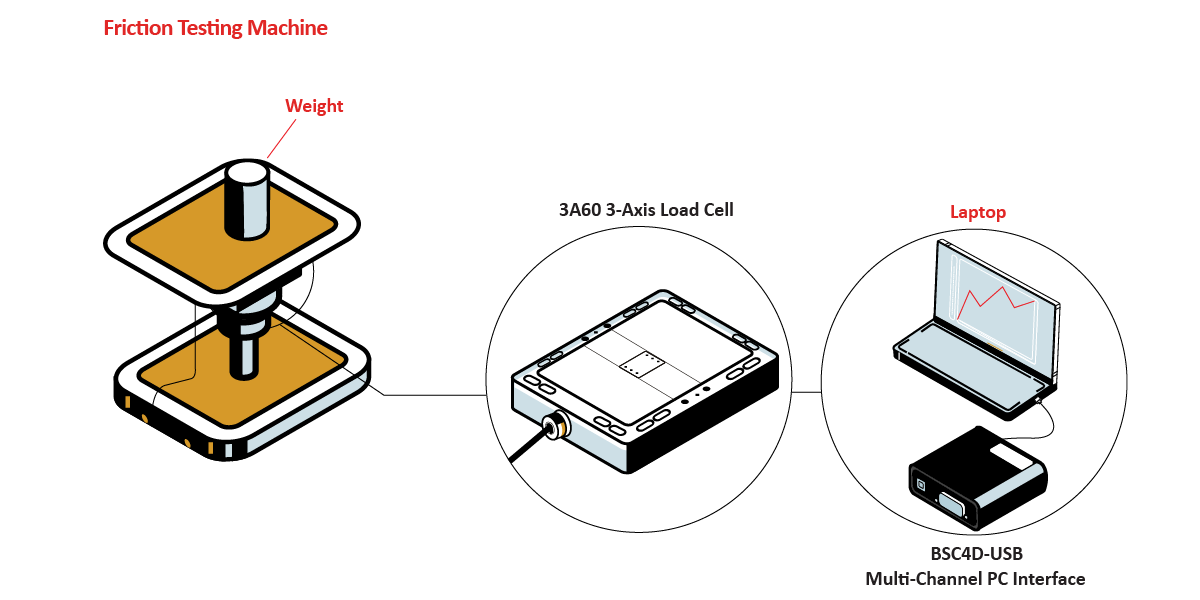 Friction Testing Using 3-Axis Load Cells
A testing laboratory aimed to replace two single-axis load cells in their friction testing machine with a single sensor capable of measuring force on the x, y, and z axes simultaneously. The 3-Axis load cell is mounted between the arm of the friction testing machine and the test specimen. The BX3-HD44-CAN is installed between the 3-Axis load cell and the PC laptop. Weights are placed on top of the arm to generate a downward force. The machine arm drags the test specimen across the material resting on the bed. The 3-Axis load cell measures the forward/back force (x), side-to-side force (y), and downward force (z) applied to the test specimen. The sensor’s output is transmitted to the BX3-HD44-CAN and then to a laptop, where it is displayed using the included software. Read more: Friction Testing
Additional Common Use Cases for Square Multi-Axis Sensors
- Aerospace testing in wind tunnel models to measure aerodynamic forces on wings or other surfaces, where precise alignment is critical.
- Industrial automation by integrating into assembly lines for quality control, where they measure forces applied during pressing or joining operations.
- Structural health monitoring on bridges, buildings, or other large structures to measure forces and moments, with their geometry making it easy to bolt them to a beam or plate.
For additional information about Interface multi-axis sensors, watch this video:

ADDITIONAL RESOURCES
The Power Combo of Multi-Axis Sensors Plus Instrumentation
X-Y-Z Robots and Multi-Axis Sensors are Advancing Automation
Get Acquainted with Interface’s Expanding Line of Multi-Axis Sensors