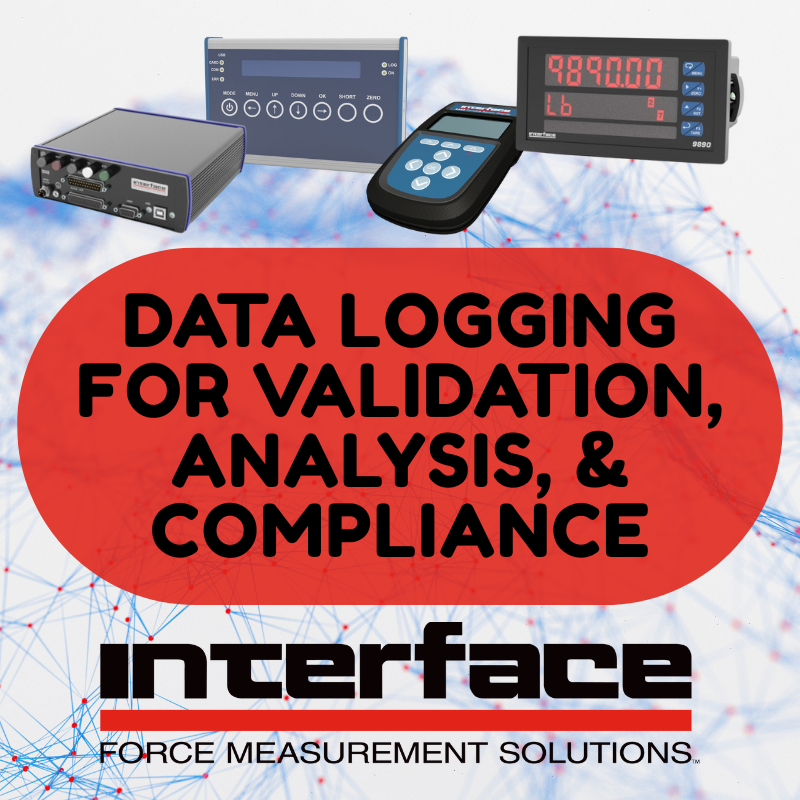
Data Logging for Validation, Analysis, and Compliance
 In high-stakes industries including aerospace, automotive, medical, energy, and infrastructure, accurate measurement is the foundation of safety and a validator of innovation.
Sensor technologies, including Interface load cells, torque transducers, and multi-axis sensors, provide real-time data for immediate consideration and decisions.
As you prepare your test and project plans, what happens when instantaneous information is not enough? Often, the true value of critical test and measurement applications across industries lies in selecting the proper instrumentation to capture data from your sensor technologies. It is not always in the momentary reading on a digital display, but in the logged, archived, and analyzed history of performance.
Data logging indicators are the essential bridge that turns raw physical signals into actionable, traceable intelligence. How are you managing the data from your sensors? When you decide which measurement device you intend to use, the next question is, how will you collect and store the data?
TIP: Use the Interface Instrumentation Selection Guide to aid in your tool evaluation.
The Three Non-Negotiables of Data Logging
For engineers, test lab professionals, quality managers, and R&D teams, neglecting data logging can result in costly blind spots. Here are three reasons why continuous data capture is fundamental to modern test and measurement (T&M).
#1 Proof and Compliance for Traceability
Every component validation, material test, or regulatory audit hinges on reliable proof. Data logging ensures that you have audit-ready records. Generating an objective, time-stamped record of every test run and load profile is essential for ISO standards and warranty claims. Providing quantifiable evidence that a component meets or exceeds design specifications under peak stress or repeated endurance cycles. Without logged data, your validation is anecdotal.
#2 Diagnostics by Capturing Transient Failures
Systems rarely fail gracefully. They often succumb to momentary stresses, power fluctuations, or intermittent mechanical issues that a human observer or simple real-time indicator will miss. A high-speed data logger acts as a forensic tool for spike detection. It captures short-duration anomalies and force/torque spikes that lead to eventual failure, enabling precise root-cause analysis (RCA). Data logging provides intermittent diagnostics. It allows engineers to correlate sensor readings over long periods to environmental factors or operational changes, transforming “unexplained” failures into predictable events.
#3 Optimizing Long-Term DUT Performance and Continuous Monitoring
Data logging is used in short-term tests on objects and facilitates continuous, long-duration monitoring. It is a requirement for truly optimizing product lifespan and reliability. Using data logging enables engineers to track phenomena like drift, material fatigue, and creep over months or even years. The measurements are historical data, which is the core input for AI and machine learning models, enabling accurate predictions of when a sensor or component might require maintenance and significantly reducing unplanned downtime.

Selecting the Best Data Logging Instrumentation
You know you want to use the data from your testing project or monitoring program. What’s next? Choosing the right data logging indicator is as important as selecting the right sensor.
Before investing in your next test bench or system, use these questions to define your exact requirements.
- Connectivity – How are you physically connecting your sensor? Will it be a single-wired load cell, or a multi-channel junction box requiring simultaneous wireless inputs?
- Data Storage Requirements – Is temporary internal memory sufficient, or do you require a permanent, robust archive via removable SD cards or secure network storage?
- Mobility and Power – Will the instrumentation be permanently wired, or do you require the flexibility of hand-held, battery-powered, wireless, or Bluetooth-enabled devices?
- Display and Visualization – Beyond data capture, how must the output be displayed? (e.g., on-unit screen, dedicated PC software, or integrated into an existing HMI/SCADA system.)
- Channel Capacity – How many independent force, torque, or multi-axis channels must the logger handle simultaneously?
- Signal Output Preference – Does your system need an analog output (e.g., 0−10V, 4−20mA) for legacy systems, or a high-speed digital output (RS-232, USB, Ethernet, CAN) for modern integration? Listen to this 11-minute InterfaceIQ podcast about analog and digital signals.

The data logger ensures that every resource spent on your load cell, torque transducer, or multi-axis sensor delivers a complete, defensible story.
Popular Interface Data Logging Instrumentation Solutions
Interface’s extensive line of advanced data logging indicators is essential for converting raw force and torque signals into actionable, traceable information that is vital for validation, compliance, and optimization.
- 9330 Battery-Powered High-Speed Data Logging Indicator
- DIG-USB USB Output Module
- 9850 Torque Transducer and Load Cell Indicator
- 9890 Strain Gage, Load Cell, and mV/V Indicator
- 9894 Analog Input Process Indicator
- INF-USB3 Universal Serial Bus Single Channel PC Interface Module
- 9325 Portable Sensor Display
- BSC1-HD Single Channel PC Interface Module with Analog Output
- BSC1A Strain Gage Amplifier
- BSC2 Dual Channel PC Interface Module
- BX8-HD15 BlueDAQ Series Data Acquisition System for Discreet Sensors with Lab Enclosure
- BX8-HD44 BlueDAQ Series Data Acquisition System for Multi-Axis Sensors with Lab Enclosure
We also offer complete systems that include the sensor, instrumentation device, and display. Check out our Data AQ Pack Guide.
Additional Resources
Did you know that Interface has helpful guides, videos, and installation materials available for set-up? Here is an example of one of these videos from your Getting Started playlist.

Find Interface instrumentation installation manuals and product support references in our Technical Library.
For additional information about logging your data, check out Interface Instrumentation Connects Sensors to Actionable Data.