Moment Compensation Relevance for Aerospace, Robotics, and Structural Testing
 Moment compensation is a fundamental engineering principle that ensures stability and accuracy by counteracting unwanted forces. While its importance is clear in a lab setting, its impact carries over into high-stakes industries where precision is non-negotiable.
At Interface, the moment compensation principle is a core part of our load cell design best practices, making our force measurement solutions a decisive component in some of the world’s most demanding applications.
Why Interface’s Moment Compensation is a Premium Benefit for Force Measurement
Interface LowProfile™ Load Cells are moment compensated to provide the highest possible accuracy, even when loads are off-axis. This is achieved through a meticulous process that goes beyond standard industry practices. We deliberately load each cell eccentrically, monitor and record the output signal, and then make internal adjustments to minimize errors.
Unlike many manufacturers who use a basic four-gage design, we employ eight strain gages strategically placed on our radial flexure beams. This configuration, combined with our rigorous compensation process, allows our load cells to detect and counteract the effects of extraneous forces, ensuring a more precise and reliable measurement.
Moment compensation improves the stability of a load cell, particularly in situations where the load is off-center or subject to torque. This can prevent the load cell from shifting or becoming damaged, leading to more consistent and reliable measurements. For a technical dive, watch Moment and Temperature Compensation – Load Cell Performance Starts By Design Webinar.

Now, let’s explore how our moment-compensated products enable success in three key industry uses: aerospace, robotics, and structural testing.
Moment Compensation in Aerospace Applications
In aerospace, even the smallest error can have monumental consequences. Every component, from a jet engine to a satellite part, undergoes rigorous testing where forces, weights, and torques must be measured with absolute accuracy. Off-axis loading from a shifting engine on a test stand or the subtle vibrations of a wing during a fatigue test can introduce moments that skew data.
This is where Interface’s LowProfile™ Load Cells prove invaluable. Their unique radial design and use of eight strain gages are specifically engineered to minimize sensitivity to extraneous loads and torques. This allows aerospace engineers to:
- Accurately measure thrust, isolating the pure axial force of an engine from the influence of side loads and vibrations.
- Conduct precise structural testing on airframe components, even when the test setup isn’t perfectly aligned.
- Validate and calibrate flight simulators, providing the clean, reliable data needed for critical system validation.
Safe and Smart Robotics and Automation Machines
The world of robotics relies on a delicate balance of power and exactness. A robotic arm needs to “know” exactly how much force it’s applying to avoid crushing a fragile component or dropping a heavy one. A moment created by a sudden stop or a change in the weight of a gripped object can cause a robot to fail its task.
Interface offers a range of sensors that provide the reliable data robotic control systems need to succeed. Our multi-axis sensors and moment-compensated load cells give robots a sense of touch, enabling:
- Precision gripping, where a sensor at the end of an arm accurately measures and adjusts the force to prevent damage.
- Automated assembly, ensuring parts are pressed into place with the exact force required, free from the errors moments can cause.
- Real-time feedback, allowing the robot to make instant adjustments in dynamic environments, is crucial for both efficiency and safety.
Structural and Materials Testing
Engineers design bridges, buildings, and vehicles to withstand immense forces. To test the strength of materials and components, they must create flawless test environments. Any off-axis loading from a test fixture or a slight misalignment can introduce a moment that compromises the test data. This could lead to a flawed design or cause excellent material to fail a test unnecessarily.
Interface’s reputation for superior moment compensation makes our products the go-to solution for structural testing. Our high-capacity load cells are built to withstand and compensate for eccentric loads, guaranteeing that the measured force is an accurate representation of the material’s strength. This allows engineers to:
- Conduct reliable tension and compression testing, ensuring a pure, on-axis force measurement despite minor imperfections in the test specimen.
- Perform long-term fatigue testing with confidence, knowing our sensors will provide stable and repeatable measurements over millions of cycles.
- Verify the quality of products by ensuring they meet rigorous safety and durability standards.
A Differentiator for Every Challenge
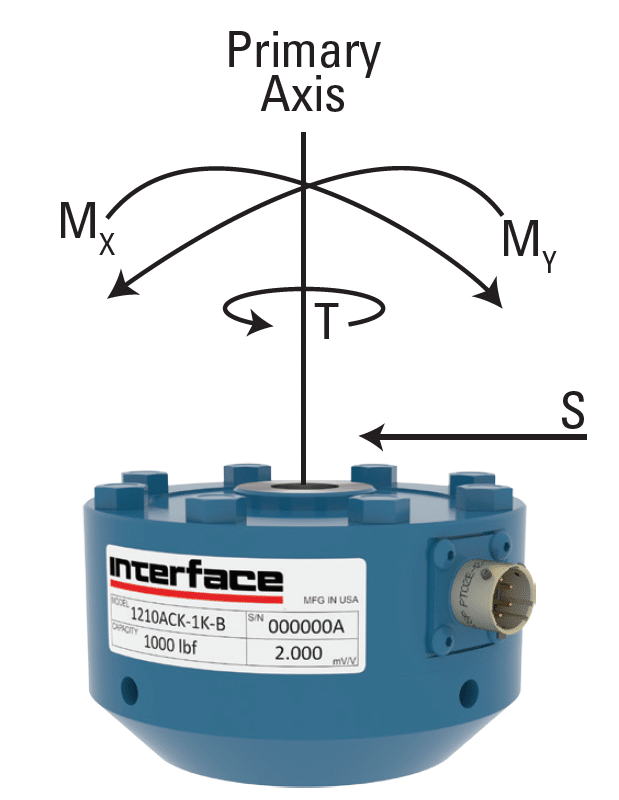 Moment compensation is not just a technical feature for load cells, as detailed in What is Moment Compensation?. It’s a core design philosophy that makes Interface products a trusted solution across a wide range of industries. Our commitment to this principle allows us to deliver unparalleled accuracy and reliability in the world’s most demanding applications.
Interface guarantees maximum extraneous load error and physically adjusts every load cell. The Interface 1200 Series cells have eccentric load sensitivity less than ±0.25% of reading per inch, and the 1000, 1100, and 1600 Series are further adjusted to come in at less than ±0.1% of reading per inch. Most competing load cells will have an extraneous load error 10 times higher (or even more) than with a superior Interface load cell.

To learn more about how our moment compensation can improve your force measurement applications, use our Load Cell Field Guide as the ultimate reference. You can also find additional references in our new ForceEDU education hub.
ADDITIONAL RESOURCES
Addressing Off-Axis Loads and Temperature-Sensitive Applications