
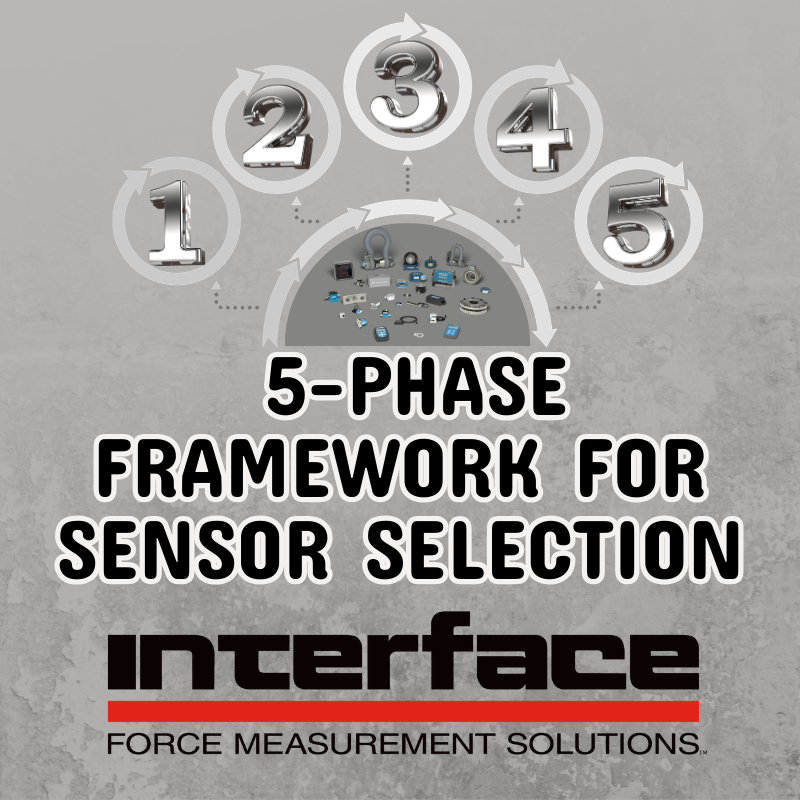
Interface Five-Phase Framework for Sensor Selection
 In test and measurement, the difference between a successful project and a costly delay often comes down to a single variable in the measurement chain. Choosing a sensor is not a modular commodity purchase. It is the integration of a sophisticated instrument into a complex system.
To help force measurement buyers, technicians, and engineering professionals navigate the process of choosing the right products, we have developed the Interface Sensor Selection Guide. The essential tool is a checklist of considerations and questions through the process of choosing devices, instruments, and accessories. Download the tool to use for reference when buying new devices.
Using this five-phase framework, designed to move beyond basic specs, provides a disciplined evaluation model for sensor characterization, mechanical fit, interconnect requirements, instrumentation capabilities and protocols, and finishes with validation of reliability and traceability. This method helps optimize your measurement system for accuracy, reliability, and long-term ROI.

Phase 1: Sensor Characterization and the Physics of the Application
The selection process must begin with a fundamental definition of the physics at play. This isn’t just about picking a capacity; it’s about matching the sensor’s character to the task.
The first question is always: What is the primary mode of measurement? You must determine whether the force is linear, requiring a standard load cell. Or do you need reaction- or rotary-based measurements that require a torque transducer? Or is this project complex enough to require a multi-axis sensor (2, 3, or 6 axes)? Once the mode is defined, the form factor follows. Does the application require the stability of a LowProfile™ pancake model or the specialized footprint? The capacities and functions can be dramatically different from beam to shackle. For example, the capacities of forms such as a miniature S-Type and a column load cell differ greatly from those of a round or square multi-axis sensor and a tension load link.
Crucially, this phase addresses potential consequences. Selecting based solely on rated capacity is a common pitfall. Engineers must verify the safe overload percentage to protect against unexpected dynamic spikes. A sensor that hasn’t physically snapped can still have its internal characterization permanently compromised by a single overload event, rendering all subsequent data a liability.
Phase 2: Solving Mechanical and Physical Fit
A sensor is a structural element, not just a data source. In Phase 2, we move from theoretical specs to physical integration. Dimensionally, what are your limits and space requirements? This requires a deep dive into 3D CAD files and specification details to ensure the sensor fits within the physical envelope, including necessary clearance for connectors and cable exit. Note: Interface provides our product design files and dimension details online under each product.
One of the most overlooked factors here is mounting rigidity. For high-precision hardware, the flatness and stiffness of the mounting surface are as critical as the internal strain gages. If a mounting surface deflects or is uneven, it introduces off-axis loading errors and parasitic forces that manifest as nonlinearity. Engineers must meticulously match thread sizes and bolt-circle patterns to prevent torque-induced skewing before the test even begins.
Phase 3: The Interconnect and Signal Integrity
Once the physical foundation is set, you must define the path the data takes. The interconnect is often viewed as simple cabling, but it can cause voltage degradation and electromagnetic interference (EMI).
A pivotal decision here is the wiring configuration: 4-wire versus 6-wire. While 4-wire setups may suffice for short distances, 6-wire cables are essential for long runs. By using remote sensing, a 6-wire system enables the instrumentation to monitor and compensate for voltage drops in real time, ensuring the excitation voltage at the sensor remains constant. This phase also demands a review of environmental protection, selecting cables with the proper IP rating and abrasion resistance to ensure the path is as durable as the sensor itself.
TIP: Use the Sensor Interconnect Cable Assemblies Guide for a quick reference.
Phase 4: Defining the Instrumentation and Output Destination
Phase 4 shifts the focus to the data destination. Where is the signal going, and what language does it need to speak? If you are using a raw mV/V sensor, your instrumentation must provide the necessary excitation voltage and high-speed signal conditioning.
This stage requires matching signal types to the control system, whether that is a local analog display, a PLC requiring 4-20mA/0-10V, or a high-speed DAQ. As industrial environments move toward Industry 4.0, this phase also covers communication protocols such as EtherCAT, Profibus, and IO-Link. Without ensuring software compatibility and data management policies (like timestamping and synchronization) at this stage, the most accurate sensor in the world becomes a data silo rather than a strategic asset. To understand terms and abbreviations for instrumentation, reference the Instrumentation Cheat Sheet.
TIP: Use Interface’s Instrumentation Selection Guide to review your options.
Phase 5: Calibration, Validation, and Traceability
 The final phase ensures that the theoretical accuracy of the system becomes a repeatable reality. The premium setup is system-level calibration, in which the sensor and the instrument are calibrated together as a matched pair. This process accounts for the unique electrical idiosyncrasies of the specific setup, providing the highest out-of-the-box accuracy.
Long-term success depends on a validation plan. Engineers must establish calibration intervals and determine if TEDS (Transducer Electronic Data Sheet) is required for plug-and-play interchangeability. By documenting these standards early, you ensure that every data point produced is audit-ready and aligns with ISO/IEC 17025 requirements.
Guiding Your Sensor Selection Success
The Interface Sensor Selection Guide is a support resource that prompts these critical reminders at every stage. While no checklist can capture every variable of a custom multi-axis matrix or an embedded sensor design, this framework provides the structure needed to avoid common oversights.
Ready to optimize your next project? Download and save the Interface Sensor Selection Checklist for reference.
The Interface Selection Guide


