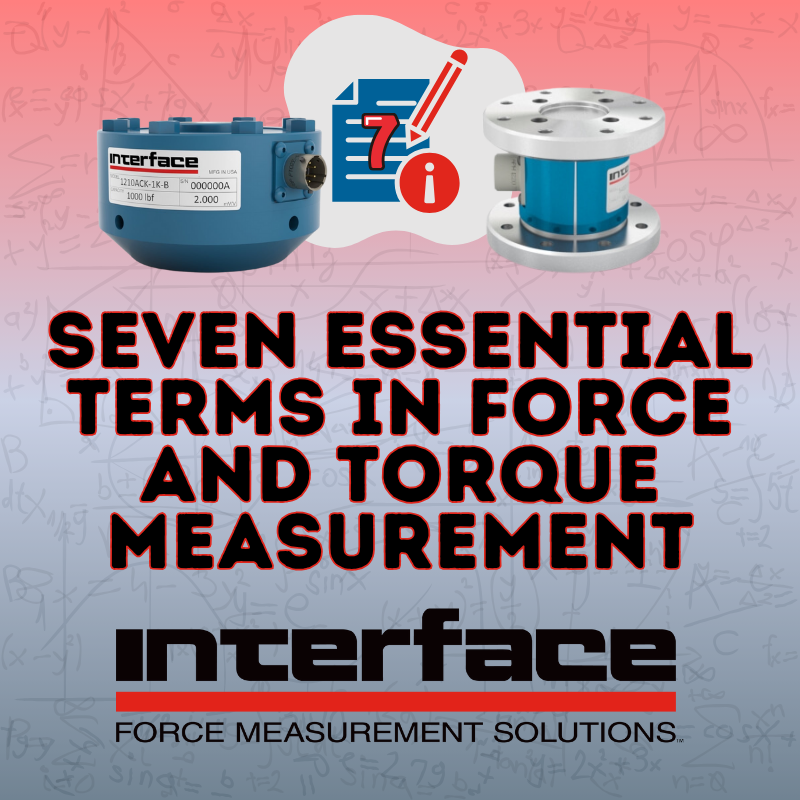
Seven Essential Terms in Force and Torque Measurement
 Whether you’re designing a high-precision testing rig or just setting up a check-weigher on a production line, the success of your project depends on accurately measuring force and torque.
Terms like side load, moment, and ultimate overload aren’t just technical jargon. They are the critical boundaries that determine your sensor’s accuracy, lifespan, and safety. Misunderstanding even one of these concepts can lead to catastrophic failure or, worse, years of unreliable data.
Force and torque measurement rely on precise technical vocabulary. Understanding these terms is crucial for selecting, installing, and correctly interpreting data from load cells and torque transducers. In each term definition, we’ve included a test and measurement example for better illustration.
Load and Capacity Terms
#1 – Load is the fundamental quantity being measured, either the applied force (tension or compression) for a load cell or the applied twisting force for a torque transducer. For example, in a crane operation, the load is the weight of the steel beam being lifted, measured in pounds or kilograms by the load cell attached to the rigging.
#2 – Safe Overload (Safe Load) is the maximum load a sensor can withstand without causing a permanent change to its performance or specifications. Exceeding this value means the sensor may still function, but its accuracy, for example, in terms of zero balance, could be permanently affected. A 1,000 lb-rated load cell has a safe overload of 1,500 lbf (150% of its rated load). To illustrate, if a lab technician accidentally applies 1,400 lbf, the sensor, with a 150% safe overload capacity, will survive and retain its original calibration for future use. Read more about Key Considerations for Overload Protection in Load Cells.
#3 – Ultimate Overload (Ultimate Load) is the absolute maximum load a sensor can withstand before suffering catastrophic mechanical failure, either breaking apart or yielding. Exceeding this value will likely result in the sensor being destroyed and creating a safety hazard. To continue with an example, ff that same 1,000 lbf sensor is subjected to 3,000 lbf, exceeding its ultimate overload, the internal sensing element will likely yield or fracture, rendering the sensor permanently inoperable. Learn about
#4 – Maximum Axial Load (Specific to Torque Transducers) is the maximum force (pushing or pulling) that can be applied along the axis of rotation of a torque transducer without damaging its internal components. An engine dynamometer uses a torque transducer to measure engine power. To explain further, if the mechanics over-tighten the coupling bolts, the resulting force pushing along the shaft (the maximum axial load) could damage the transducer, even if the measured rotational torque is well within limits.
Types of Applied Force
These terms describe the different directions and types of forces acting on a sensor.
#5 – Torque is the rotational equivalent of linear force. It is the turning effort or twisting motion that torque transducers are specifically designed to measure. For instance, an assembly line that uses a wrench with an in-line torque transducer to ensure every bolt on an airplane wing is tightened to a precise specification. Read more in Torque Transducers 101 and Torque Transducers Review Plus Glossary of Torque Terms.
#6 – Moment (or bending moment), in the context of load cells, refers to a force that is applied off-center or at an angle, causing the sensor’s measuring element to bend or twist in an unintended way. This is a primary source of measurement error. For example, let’s assume a platform scale uses four load cells. If a heavy item is placed only on one corner, the resultant off-center force creates a significant moment on the nearest load cell, causing it to read inaccurately compared to a load centered on it. Check out: What is Moment Compensation?
#7 – Side Load, also known as an off-axis load, is a force applied perpendicular to the primary axis of measurement of the sensor. It introduces shear stress and bending that can significantly reduce accuracy and damage the sensor. For a clearer illustration, a process tank equipped with load cells is used to mix a thick slurry. The mixing action pushes horizontally against the tank walls, creating a side load on the vertically oriented load cells. Proper mounting hardware must be used to mitigate this effect. Side Load Sensitivity 101 provides more information.
TIP: Interface has created a technical library of terms, along with sensor cheat sheets for assets, as well as other relevant references. You can access them in our ForceEDU Resource Center.
Engineering Precision
Understanding these critical terms isn’t just about reading a datasheet; it’s about understanding the underlying concepts. It is ultimately about guaranteeing the integrity and reliability of your entire measurement system, regardless of scale.
Whether you’re relying on jumbo load cells in a structural test rig for a spacecraft launch vehicle, where ultimate overload failure is not an option, or you’re monitoring the performance of a miniature beam load cell within a life-saving medical device, precision hinges on these specifications.
By recognizing the difference between the actual load you measure and the safe overload limit, you protect your investment. By carefully designing mounting systems to mitigate parasitic forces, such as side load and moment, you ensure measurement accuracy. And by checking the maximum axial load on your torque sensors, you prevent premature mechanical wear.
Mastering this vocabulary ensures you select the right sensor for the job, maximize its lifespan, and, most importantly, trust the data that drives your most critical engineering decisions.
REMINDER! The ultimate resource for technical terms and understanding force measurement is our Interface Load Cell Guide. You can get a free copy of the online book here.
You can also explore more details in our ‘Demystifying Specifications Webinar’ excerpt below.