
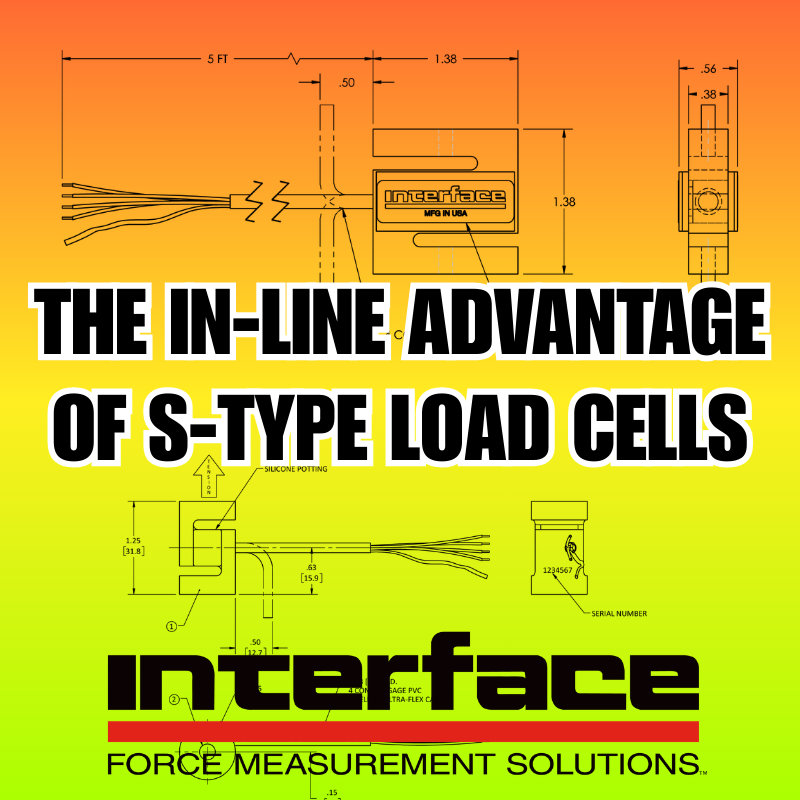
The In-Line Advantage of S-Type Load Cells
 While the most popular pancake Interface LowProfile Load Cell revolutionized the industry with its shear-web design, capable of handling massive capacities and resisting off-center loads, the S-Type was born from a different engineering need in test and measurement. Interface’s patented S-Type Load Cell is engineered for in-line simplicity and miniaturization.
Historically, the S-Type (or S-Beam) evolved as a replacement for mechanical spring scales. Engineers needed a way to translate those same vertical tension and compression forces into a digital signal without the footprint of a large pancake sensor. The design’s uniqueness lies in its unitary construction. Unlike multi-component sensors, the S-beam is a single block of metal precision-machined into its signature shape.
As seen in our Anatomy of an S-Type video, this creates a centralized load path. While a pancake cell uses multiple radial shear struts to distribute a load, the S-Type concentrates the force into specific flexure zones in the center of the “S.” This makes the S-Type incredibly sensitive to even microscopic deformations, allowing for high-precision data in a fraction of the physical space.

The S-Type Load Cell Design
Interface invented and introduced the SM S-Type and SSM Load Cell to the market in 1974. The more efficient inline package, compared with standard bending-bridge sensors, offers improved off-axis insensitivity and has been used by test and measurement professionals for more than 50 years.
The dimensions of an S-Type allow for flexibility to meet the geometric engineering requirements within a miniaturized flexure. This is evident in our micro SMTM and SuperSC, the smallest S-Types in our product series. The S shape is not just a design choice; it is functional geometry. This structure creates controlled flexure zones.
- The Spring Element: Typically machined from high-strength alloy steel, stainless steel, or aluminum, the body deforms minutely when force is applied.
- Threaded Load Points: Located at the top and bottom, these holes are where the action happens. Force pulls through them in tension or pushes through them in compression.
- The Wheatstone Bridge: Inside the body, strain gages are bonded to high-strain areas. These gages are wired into a Wheatstone bridge circuit, which converts tiny changes in electrical resistance into a stable mV/V output signal.
Learn more about the design of S-Type Load Cells by reviewing the Superior S-Types Webinar Recap and New SuperSC post.
S-Type Cheat Sheet for Key Technical Terms
When selecting an S-Type load cell, the specifications define its limits and reliability. Here are the critical metrics to keep on your radar:
- Static Error Band – The worst-case deviation including nonlinearity, hysteresis, and nonrepeatability.
- Compensated Range – The temperature window where accuracy is guaranteed.
- Safe Overload – The maximum load the cell can handle without physical damage.
- Toggle/Zero Float – The shift in zero balance after a full cycle of tension and compression.
- Creep – The change in signal over time while under a constant load.
- Natural Frequency – How fast the sensor naturally vibrates; critical for dynamic testing.
Resource: Be sure to download Interface’s S-Type Cheat Sheet for a quick reference to abbreviations, mechanical and electrical terms, as well as accuracy and temperature definitions.

Why Choose an S-Type?
The S-Type is one of Interface’s most popular load cells. Engineers favor Interface S-Type load cells for three primary reasons:
- Cost-effectiveness in that these high-accuracy Mini Load Cells provide high-accuracy measurements at a lower price point than many pancake-style cells.
- Versatility of universal sensors, capable of measuring both pulling and pushing forces.
- A compact footprint is the primary reason, as it meets the demands of a smaller precision sensor for easier integration into equipment, machines, and OEM products. Their slim profile makes them ideal for tight spaces and for product designers who need a reliable, accurate sensor within their invention.
Pro Tip: While S-Types are versatile, they are sensitive to sideloading or sway. If your application involves an object that rotates or sways, or if extreme compression accuracy is the top priority, consult our application engineers to determine the better fit.
At Interface, we recognize that a standard does not fit every lab. Our S-Type line includes specialized models for extreme cycling and environments. Interface’s SSMF Fatigue Rated S-Type Load Cell models and SMT Overload Protected S-Type Load Cell are very popular and have been tested to withstand millions of test cycles.
Our environmentally sealed S-type sensors are rated IP65 to IP67 to protect against moisture and dust. The Interface high-temperature, intrinsically safe models, such as our SSM-FDH Sealed High Temperature S-Type Load Cell, are ideal for hazardous or high-heat industrial testing. For requirements that need a vacuum-rated design, these are engineered specifically for cleanroom or space-simulated environments.
A Universal Sensor Designed to Fit
The Interface S-Types are preferred by engineers and testing labs for their precision, size, value, ability to fit into tight spaces, and ease of integration into original equipment, machines, and testing rigs. Because of their unitary spring element and high-sensitivity Wheatstone bridge, our S-Types are utilized in a broad range of applications, including robotics, consumer products, medical devices, drones, weighing, and lifting equipment.
Whether you are managing axial overload in a drone motor test or monitoring creep in a medical weighing system, these in-line sensors provide a reliable, high-frequency response in a compact package. They are universal sensors designed to meet demanding technical protocols in aerospace, automotive, robotics, consumer products, and more.
Contact us if you need help in selecting a specific S-Type model for your precision requirements.
ADDITIONAL RESOURCES
New Technical White Paper Analyzes SuperSC S-Type Miniature Load Cells
Superior S-Type Load Cells Webinar
Eccentric Loading Analysis for SuperSC S-Type Miniature Load Cell White Paper


