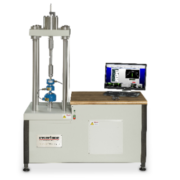

Multi-Axis Sensors 101
 Have you ever tried to build a piece of furniture with half the tools necessary? It just doesn’t work. And this same problem occurs when you try to test and measure force and torque on complicated types of machinery, like an aircraft assembly or advanced robotics, on a single axis. In response to meet this complex force measurement need, Interface offers a product line of multi-axis sensors.
A multi-axis sensor (load cell) is a type of transducer that measures forces and torques simultaneously in multiple spatial directions. Whereas a single-axis sensor only measures force along one direction, a multi-axis sensor provides a comprehensive data representation of the forces acting on a device under test (DUT).
Most force and torque sensors are bidirectional, meaning they can measure forces and torques in two opposing directions along the same axis. For example, a single-axis force sensor can measure both tension and compression, while a torque sensor can measure both clockwise and counterclockwise rotation. This is because the sensor’s internal design, often a single strain gage bridge, is engineered to respond to these opposing loads, providing a positive or negative output signal depending on the direction of the applied force or torque.
Uniquely, multi-axis sensors are different. They incorporate additional bridges specifically to provide separate output signals for varying axes or types of mechanical loading, such as , , , and their corresponding torques, all from a single, integrated sensor body. The internal flexure and resulting sensor designs for multi-axis sensors generally fall into three categories.
#1 – Axial load cell with added torsional or moment bridges. The sensor is primarily optimized for axial force measurement, and you should expect lower capacity limits on the non-axial bridges.
#2 – Torsional load cell with added axial bridges, where the sensor is fundamentally designed for torque measurement, resulting in lower axial capacity limits.
#3 – Dedicated multi-axis designs are the most versatile sensors, specifically engineered from the ground up to measure forces and torques in multiple directions simultaneously, and they typically feature more balanced capacity limits across all axes. These designs can provide discrete signal outputs for each axis or, particularly in 6-axis models, a composite signal output that combines multiple measurements.
Data-driven design is at the forefront of product development, especially in highly-regulated markets like aerospace, medical, and industrial automation. Interface’s 2-axis, 3-axis, 6-axis, and axial torsion load cell sensors are designed to provide the most comprehensive force and torque data points on advanced machinery. With our industry-leading reliability and accuracy, these multi-axis sensors can provide the data our customers need to ensure performance and safety in their product design.
TIP: Use the Interface Multi-Axis Sensor Guide to find the right solution based on your test criteria. To provide you with more insight, here’s an overview of Interface’s multi-axis sensors and their unique capabilities.
3-Axis Load Cells
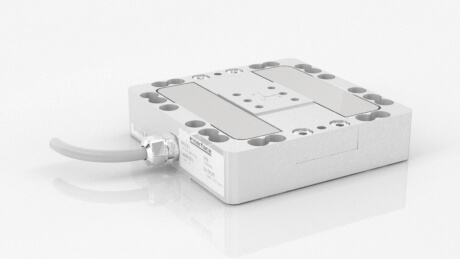
Interface’s 3-axis load cell measures force simultaneously in three mutually perpendicular axes: X, Y, and Z – tension and compression. Each axis provides a unique mV/V output and requires no mathematical manipulation. The 3-axis load cell is built to minimize eccentric loading effects and crosstalk between axes. The company offers various models of our 3-axis load cell, designed for a wide range of capacities. For definitions and reference to terminology associated with our 3-axis load cells, use our new cheat sheet: 3-Axis Load Cell Cheat Sheet.
6-Axis Load Cells
Interface’s 6-axis load cells measure forces along three perpendicular axes and the corresponding torques about those axes, using six (standard‑capacity) or twelve (high‑capacity) full‑bridge channels. Six full bridges provide mV/V output on six independent channels. Interface’s 6‑axis load cells employ coefficient matrices (36‑term for standard, 72‑term for high capacity) to resolve loads and moments, offer low crosstalk, temperature compensation, and compact design, and serve applications in aerospace, robotics, automotive, and medical research. An 8-channel amplifier with a USB PC interface is also available, which simplifies data analysis. The company offers a range of 6-axis load cells, catering to various capacities. Be sure to check out more information in our 6-Axis Load Cell Cheat Sheet.
Axial Torsion Load Cells
Interface’s axial torsion load cells are used for measuring both torque and force in a single sensor. Typical applications of its axial torsion transducer include bearing test and material test machines. The features of our axial torsion load cell include minimal crosstalk, extraneous load resistance, and it is fatigue rated. Customers can also add the following options: an integral cable, compression overload protection, and a connector protector.
2-Axis Load Cells
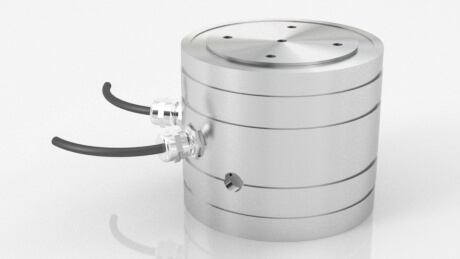 Interface’s 2-axis load cells are designed to simultaneously measure forces in two perpendicular directions, such as X and Y or axial and torsional. These sensors feature low crosstalk, high accuracy, and a fatigue-resistant construction, making them ideal for applications that require precise multi-directional force analysis. With multiple models and capacity ranges available, Interface’s 2-axis load cells support a wide variety of industrial and research needs where bi-axial measurement is essential for performance monitoring and test validation. It is commonly used in applications where dual-axis measurement is essential in design and testing.
Interface multi-axis load cells are ideally suited for various industrial and scientific applications, including aerospace, robotics, automotive, and medical research. In fact, their unique capabilities are helping the medical industry optimize prosthetic design via multi-axis testing. The automotive industry is using Interface’s multi-axis products in wind tunnels, and the military is using them to test the center of gravity in aerospace applications.
Do You Require A Multi-Axis Sensor?
Before starting any test, it’s essential to ask how well you can trust your data and whether it presents a complete view. Potential side or eccentric loads, which are forces and moments not aligned with the primary axis of measurement, can significantly alter test results and introduce measurement error. This can lead to undocumented and inaccurate loading of the device under test (DUT).
By asking questions like “How accurate is my test model?” and “Would more thorough testing provide a better solution?”, you can enhance existing testing protocols. The goal is to move beyond a simple pass/fail metric and ensure that your test setup truly captures all relevant mechanical loads, providing a more comprehensive and reliable understanding of the DUT’s performance using a multi-axis sensor.
As with all force measurement products available from Interface, we’re happy to work with you to provide a custom design. We can customize our products to accommodate varying capacities between X-Y and Z, with higher temperature capabilities, or provide OEM and private labeling if needed.