Tag Archive for: IQBlog
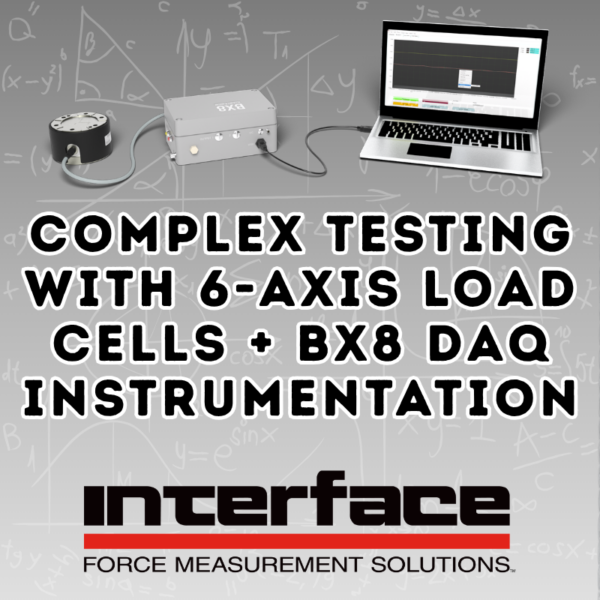
Complex Testing with 6-Axis Load Cells and BX8 DAQ Instrumentation

Interface 6-Axis Multi-Axis Sensors and BX8 Instrumentation Complete Systems are designed for complex test and measurement applications. Discover how combining an Interface 6-Axis Load Cell with the high-speed BX8 DAQ eliminates channel crosstalk using real-time hardware matrix math.

Moment 101
Interface's 101 Series defines moment as the measure of a force's tendency to cause rotational movement, bending, or tilting when applied at a distance from a fixed point or axis. In force measurement, moment is the physical displacement or rotation that occurs when an unbalanced force acts on an object, and measuring moment in multi-axis sensors provides critical data for a variety of industry applications. Learn more in Moment 101.

The Mechanics of Suspended Loads in Heavy Rigging

Interface products provide real-time measurements of cable tension and load weight to prevent dangerous overloads of rigging equipment. Rigging converts rotational, linear, or gravitational forces into controlled mechanical displacement. It relies on calculating vector forces, tension distribution, centers of gravity, and safe working load (SWL) limits to ensure that heavy components remain structurally stable and balanced throughout dynamic motion.

Why Use a Single Load Cell for Platform Weighing?

Interface Tech Talk answers how a single point load cell measures the weight of objects placed anywhere on a weighing platform or scale. Interface Single Point Load Cells compensate for off-center (eccentric) loading, have high repeatability and linearity, and have fast response times. For weighing, the single point load cell is a cost-effective solution for OEMs and scale manufacturers. They are simple to install, have a long service life, and require low maintenance.

Digital Twins Bridge Physical Stresses and Virtual Models in Test and Measurement

Interface sensor technologies are used in digital twins for structural testing, fatigue monitoring, and model validation. A digital twin uses force or torque inputs of load, torque, and weight to bind virtual simulations to actual mechanical behavior. By integrating Interface load cells, torque transducers, wireless telemetry systems, and digital instrumentation into your digital twin framework, you eliminate simulation drift and ground your virtual assets in real physical evidence.

Interface Miniature Beam Load Cells Installation Help

Interface MB Miniature Beam Load Cells (MB) are high-performance, low-capacity bending beam sensors. Learn installation tips, design and engineering considerations, and resources for high-accuracy, reliable Mini Load Cells. They are common across industries in test machines, OEM, integration applications, and general testing when precision matters and space is limited.

Long-Haul and Heavy-Duty Vehicle Test & Measurement

Interface’s load cells, torque transducers, and instrumentation are used in testing long-haul and heavy-duty vehicles for safety, weighing, and performance. Every heavy-duty vehicle, from design to road use, must undergo testing and measurement. From long-haul regional freighters and autonomous electric transport systems to diesel tire tests and freight load balancing, accurate data demands sensor reliability. With 30 million active heavy-duty vehicles worldwide, precise force, load, and torque sensors are vital to heavy-duty transportation safety and efficiency. Discover how advanced load cells, torque transducers, and wireless telemetry validate structural integrity, optimize electric vehicle powertrains, and secure the next generation of automated freight transport.

Multi-Axis Sensor Fundamentals from Design to Calibration

Discover Interface's Fundamentals of Multi-Axis Sensors to learn about 6-axis selection, assembly, calibration, managing crosstalk, and key sensor design models. Interface's extensive technical resource that details 6-axis sensor selection, accuracy, mounting, resolution, and sensor form factors. Find engineering tips, error prevention, load limits, and calibration resources. It's a complete guide to multi-axis load cells and specifically 6-Axis Sensors.

Load Cell Electrical Components, Connectors, and Wiring Standards
Interface provides technical specifications, pinouts, and wiring documentation for load cells, torque transducers, multi-axis sensors, and instrumentation for each product. Achieving high-accuracy measurement data depends completely on the integrity of the electrical connections between the sensor and the instrumentation. Simple wiring errors or incorrect pin mapping can result in inverted data, thermal drift, or irreversible damage to components in the data acquisition system. Interface Support offers Electrical Wiring and Diagrams resources, including cable, connector, and assembly wiring colors and references.