Tag Archive for: robotics

Using Instrumentation to Set Alarms for Force and Torque Measurements
Interface load cells and transducers are often paired with instrumentation devices that include alarm features to create a system that can monitor data from the sensors and trigger alerts when specific conditions are met. Instrumentation alarms are crucial for safety, process control, equipment protection, and quality assurance in various industrial and laboratory settings.

Measuring Control in Animatronics and Entertainment Robotics
Animatronics is a dynamic field of entertainment that fuses puppetry, anatomy, mechatronics, and robotics. Behind the expansion of animatronics and entertainment robotics is the increasing demand for immersive, interactive experiences supported through high-accuracy force, torque, and weight measurements using Interface measurement solutions and sensor technologies.

Interface Sensors Advance Picking and Sorting Efficiency
Interface sensors, including load cells, torque transducers, and multi-axis sensors, enhance the efficiency and precision of automated pick-and-sort systems in manufacturing and logistics. Industrial automation is transforming picking and sorting operations using advanced force measurement solutions.

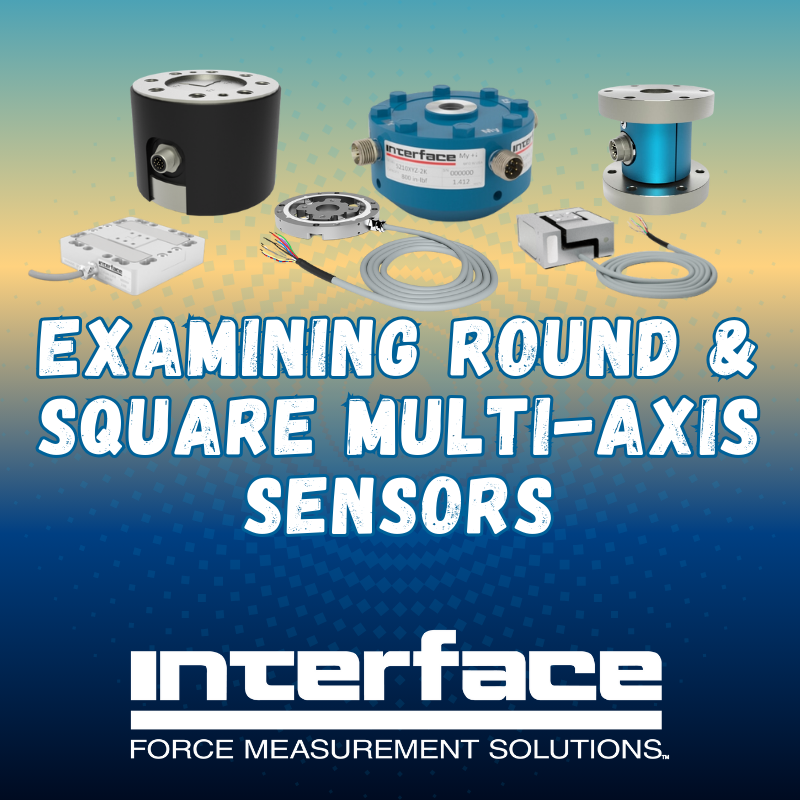
Examining Round and Square Multi-Axis Sensors
Two common shapes for Interface multi-axis load cells are round and square. Square multi-axis load cells have a cuboid or block-like shape. This geometry often simplifies mounting and alignment. Round multi-axis load cells have a cylindrical or disc-like shape. This model design is a compact, low-profile form factor, which can be crucial in space-constrained applications. Interface 2-axis, 3-axis, 6-axis, and axial torsion load cells deliver high-accuracy measurements for advanced requirements of more data than a single-axis load cell.

IO-Link Load Cells 101
Interface 1200 and Model 1201 Series IO-Link Universal and Compression-Only Load Cells are IO-Link compatible load cells that offer precision force measurements with the benefits of digital communication. They connect directly to an IO-Link Master without requiring any additional electronics. This not only simplifies installation but also ensures a clean, noise-free digital signal. The digital point-to-point connection of IO-Link offers a manufacturer-independent, fieldbus-independent communication technology. IO-Link allows intelligent connection of sensors and actuators to automation systems. The comprehensive, standardized communication with each IO-Link capable sensor enables additional sensor data, transmission of measurement and switching signals without losses, and numerous independent diagnostic functions.

Complete Force Measurement Systems
Interface Complete Systems simplifies the process of creating a high-accuracy measurement system by providing expertly curated packages. These systems eliminate the guesswork, pairing sensors with compatible instrumentation, cables, and connectors to guarantee signal integrity and precise data from the start. Each system overview details specifications for the sensor, instrumentation, and accessories. Interface provides system-level calibrations, ensuring that the entire setup is verified for accuracy.

Integrating Sensors in Virtual Reality for a Superior UX
Virtual reality's success is now contingent upon its ability to replicate the physical world flawlessly, making the integration of force measurement sensor technologies a universal necessity throughout the entire VR hardware lifecycle. From the initial design and prototyping stages to rigorous testing and final manufacturing, these sensors are no longer optional. They are the critical components that provide the precision data essential for creating compelling haptic applications and delivering a truly authentic user experience, whether the end product is a device for gaming and entertainment or a highly specialized tool for complex surgical simulations.

Moment Compensation Relevance for Aerospace, Robotics, and Structural Testing
Moment compensation is a fundamental engineering principle that ensures stability and accuracy by counteracting unwanted forces. Industries like aerospace, robotics, material and structural testing know precision is non-negotiable. At Interface, the moment compensation principle is a core part of our load cell design best practices, making our force measurement solutions a decisive component in some of the world's most demanding applications.

Measuring Minute Force with Interface’s Ultra Low Capacity Mini Load Cell
Interface's Ultra Low Capacity Load Cell, the ULC, is designed to measure forces as minute as 0.1 N to 5 N. Part of Interface's Mini Load Cell series, the ULC is engineered for applications demanding unparalleled accuracy in measuring extremely light forces such as robotics, medical devices, consumer products, and electronics.