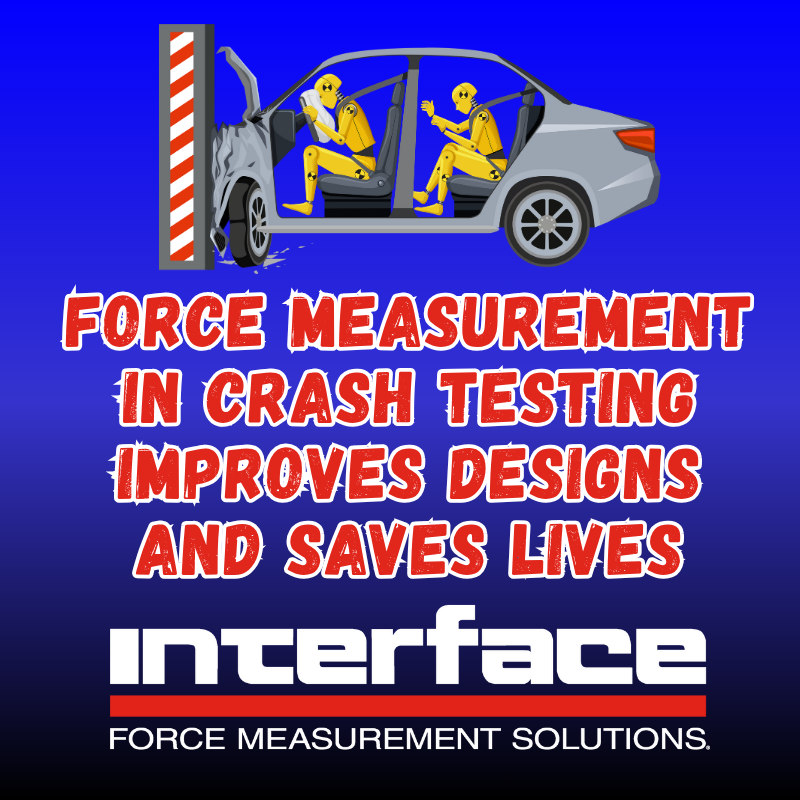
Force Measurement in Crash Testing Improves Designs and Saves Lives
 Automotive safety testing using measurement technologies shows that the moment of collision isn’t a failure but a crucial data point. Advanced crash testing is an exact science that goes far beyond simply crashing a vehicle into a wall. It’s an intricate process built on the reliability of sensors such as Interface Load Cells, which measure the significant forces that govern occupant survival in all types of vehicles.
The collision blueprint for automotive crash tests falls into three main categories: developmental tests, structural testing of the vehicle itself, and regulatory and compliance tests mandated by organizations like the National Highway Traffic Safety Administration (NHTSA) and the Insurance Institute for Highway Safety (IIHS).
Each scenario is designed to replicate common real-world accidents and reveal a vehicle’s specific vulnerabilities. Each testing category relies heavily on a precise force-measurement solution to quantify the collision’s energy and impact.
Types of Crash Tests Using Force Measurement
Testing begins with frontal impact simulations. These include full-width barrier impacts, which simulate a head-on collision, as well as more complex offset/overlap tests. These offset tests are particularly revealing, as they simulate collisions in which only 25% to 40% of the vehicle’s front width contacts a rigid object, such as a pole or tree.
Engineers then conduct side impact tests. These scenarios involve a significant barrier striking the stationary vehicle’s side, simulating an intersection collision, as well as the demanding side pole test, in which the vehicle is pulled sideways into a narrow pole at the driver’s seating location.
Vehicle safety also requires rollover and roof crush evaluations. This testing determines a vehicle’s susceptibility to rollover. It assesses the roof’s structural integrity to ensure it can support the vehicle’s weight and protect occupants in the event of a rollover. Separately, component testing focuses on specific safety systems such as seat belts, seats, and airbags, and uses impact testing to evaluate a material’s ability to withstand sudden, high-force impacts.
Every one of these tests requires high-speed, accurate force data to determine vehicle safety ratings and guide design improvements.
What Engineers Look to Measure in Crash Testing
Engineers use sensors embedded in the vehicle, the crash test dummies, and the barriers themselves to capture thousands of data points. The most critical data points relate to injury metrics, gathered from load cells and accelerometers inside the crash test dummies.
These sensors measure critical injury risk indicators, including head injury criteria (HIC), chest deflection, and femur load. Simultaneously, they monitor the structural response to see how the vehicle’s crumple zones absorb and distribute kinetic energy. A key goal is maintaining the structural integrity of the passenger compartment to prevent intrusion into the occupants’ space.
Across all tests, sensors also record impact force and material response, measuring the sheer force of the collision and the resistance of components like bumpers and internal structures.

Load Cells and Force Sensing in Crash Testing
To ensure accuracy and consistency, every Newton of force must be measured precisely in crash testing. This is where high-precision load cells and accompanying data acquisition systems become essential.
For development and compliance testing, force measurements need to capture the chaotic, multi-directional nature of a collision. Engineers can use the Interface 3-Axis Force Load Cells for this purpose. Multiple units are often bolted to the back of a concrete crash test wall, forming a load-cell wall. Interface Multi-Axis Sensors are crucial because they measure all forces on all axes (X, Y, and Z) simultaneously, offering a complete picture of the forces acting on the barrier during impact. Check out the Vehicle Crash Test Load Cell Wall application.
On the other hand, for targeted component testing, such as for airbags or seat belts, impact testing is performed using the Interface Single Point Impact Load Cells (SPI and MBI). These sensors work alongside accelerometers to measure the instantaneous, high-force impact and the material response of critical safety components.
Reliable sensing is just the first step. The data must then be accurately recorded. Data acquisition systems need to be robust enough to withstand the demanding environment of a crash lab while capturing data at very high speeds. The BX8-HD44 Interface BlueDAQ Series Data Acquisition Systems reliably record force data from multi-axis load cells. Engineers can quickly analyze high-resolution, real-time data to enhance vehicle design.
Precision Testing and Accurate Force Measurements Save Lives
The crash test data underscores its significant role in public safety and the future of transportation. Years of comprehensive testing, supported by precise load cell measurements, have led to substantial improvements in vehicle design. The data directly links to saving lives. For example, a driver in a vehicle rated “good” in the moderate overlap frontal test is about 46% less likely to die in a frontal crash than a driver in a similar car rated “poor.” This notable difference shows that any design improvement, validated by accurate load cell data, can make the difference between a serious injury and a fatality.
The importance of modern testing and measurement solutions grows as autonomous vehicles become more common in urban and rural settings. The future of autonomous travel depends entirely on absolute accuracy and dependability. Interface isn’t just a supplier of vehicle testing solutoins. We are a trusted partner for OEMs, machine builders, test engineers, and labs, helping them bring next-generation AVs to life with accurate safety analysis and measurement data.
Unlike human drivers, who can adjust to unexpected situations, autonomous systems must perform flawlessly in all conditions. This means every component, from the structural framework to the deployment of the restraint system, must be proven reliable to an even higher standard. Interface force measurement devices are used in this vital testing, both in commercial and industrial vehicle design, to ensure that the self-driving future is safe.
Interface is a long-time supplier of high-accuracy testing solutoins used in the automotive industry. From our brake pedal load cells to our AxialTQ torque transducer, we offer a wide range of products designed for various testing projects. Learn more about why Interface is selected as a top provider of standard and custom solutions for all types of testing, from EV battery testing to crash tests.
ADDITIONAL RESOURCES
Join us at the Automotive Testing Expos in Asia, Europe, and the United States. Here are some of the products you will be able to see “live” and connect with our application engineers and auto testing solutions experts.

Accelerating Advanced Automotive Testing Using Torque Transducers
The Future of Automotive Performance Requires Precise Torque Measurement


