Tag Archive for: load cell design

Calibration Grade Solutions For Demanding Applications

Interface Gold and Platinum Standard calibration-grade load cells deliver unparalleled accuracy and reliability. Our unique sensor design, utilizing multiple strain gages and rigorous 30-point testing, ensures premium quality. Explore our calibration testing equipment and lab solutions trusted by labs, engineers, metrologies, and calibration service providers around the world.

Load Cell Performance Starts by Design Webinar Recap

Interface Load Cell Performance Starts by Design emphasizes the engineering perspective in designing the world's leading force measurement devices used to test everything from rockets to medical devices. In the recap and webinar recording, learn about flexures, strain gages, specifications, engineering design tips, types of load cells and more in this advanced technical load cell seminar.

Load Cell Performance Starts by Design Webinar
Interface ForceLeaders event Load Cell Performance Starts by Design provides a detailed engineering perspective of sensor technologies designed for precision force measurement. The technical webinar features an advanced perspective on specifications and criteria to perfect the performance of the world's best test and measurement devices to measure force.

Comparing Shear Versus Compaction Force Measurement

Interface load cells are used in shear and compaction force measurement. Understanding the differences between shear and compaction is determinative, as it directly impacts applications, sensor choices, and output data for testing analysis. Learn about shear force versuse compaction, also known as compressive, measurement, applications and load cell types. This understanding aids in making informed test and measurement decisions in material science, mechanical engineering, and industrial automation.

Side Load Sensitivity 101
Interface 101 highlights the side force effect, side load sensitivity, and eccentric load sensitivity. Side load sensitivity is how a load cell's output is influenced by a side force. It reveals the load cell's sensitivity to forces applied off its intended axis. A side force effect in compression testing with load cells refers to a force applied perpendicular to the intended axial compression force. This can happen due to misalignment between the load cell under test and the testing machine's loading plates.

Load Cell Flexures 101
Interface designs all of our load cell flexures. A flexure is a specially designed component that can bend under a load without breaking. They are used in sensors where precise, frictionless movement is needed, like measuring force. The flexure, a complex machined part, acts as the spring element. With thousands of models, capacities, and configurations, manufacturing our flexures is paramount to our load cell accuracy, quality, and precision performance.

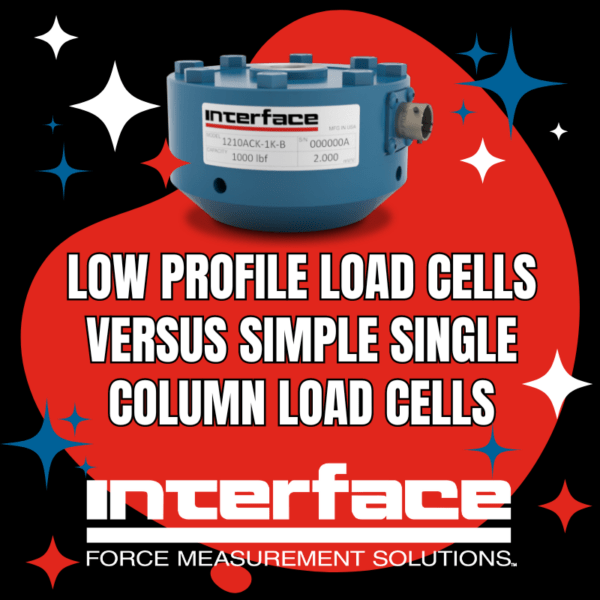
Low Profile Load Cells versus Simple Single Column Load Cells

The Interface LowProfile Load Cell, a pancake design, is dramatically better than the simple single column cell in every respect. The low profile design outperforms the single column design. The overall proprietary Interface LowProfile design is more compact, with all the components bonded to the flexure structure, making it better able to withstand the 100 million-cycle fatigue life. Our standard 1200 “Blue” LowProfile Load Cell is the most popular load cell in the market and is used in testing labs and industry applications worldwide.

What is Moment Compensation?
Every Interface LowProfile™ load cell is moment compensated to minimize sensitivity to extraneous loads. Moment compensated load cells are designed to counteract the external forces or moments by using a configuration of strain gages and electronics that can detect and compensate for these forces. The strain gages are arranged in a way that allows the load cell to measure the force applied to it in multiple directions, and the electronics can then use this information to calculate the impact of external forces and moments on the measurement.

Load Cell Stiffness 101
The selection of a load cell with an appropriate stiffness is critical to ensuring optimal performance in each application and should be carefully considered in the design and implementation of any measurement system. Load cell stiffness can significantly alter the performance. Load cell stiffness refers to the ability of a load cell to resist deformation when a load is applied to it.