• Facebook
  • Twitter
  • LinkedIn
  • Mail
  • Youtube
  • Advanced Product Search
  • Login / Register
  • My Account
  • Questions? | Email Us!
  • 480-948-5555
Interface
  • Industry Solutions
      • Industry Solutions

      • Our customers work in aerospace, automotive, energy, medical, industrial automation industries and test labs. If you are looking for inspiration or ideas, check out our solutions by industry.
      • Learn More
      • Aerospace
      • Agriculture
      • Automotive and Vehicle
      • Consumer Products
      • Education
      • Energy
      • Entertainment
      • Industrial Automation
      • Infrastructure
      • Internet of Things
      • Lifting
      • Manufacturing
      • Maritime
      • Medical and Healthcare
      • Natural Resources
      • Original Equipment Manufacturer
      • Test and Measurement
      • Weighing
  • Product Applications
      • Product Applications

      • Explore the diverse array of case studies, white papers, and application notes tailored to showcase the transformative potential of our products.
    • Applications Notes
      • Our skilled application engineers work with our customers to provide load, torque, multi-axis and force measurement solutions. Take a look at our library of Interface Application Notes.
    • Case Studies
      • Interface Case Studies are real examples of how our products are used for various applications, from packaging robots to launching rockets.
    • White Papers
      • Our technical white papers provide detailed insights, tips and expertise about various measurement technologies and use cases.
  • Products
    • Products Overview
    • Complete Systems
    • Load Cells
      • Calibration Grade
      • Column
      • Compression Only
      • Fatigue-Rated
      • Load Washers
      • Low Profile Load Cells
      • Moment Compensated
      • Overload Protected
      • Rod End
      • Sealed
      • Side Load Sensitivity
      • Stainless Steel
      • Submersible
      • Tension and Compression
      • Weighing Systems
    • Mini Load Cells
      • Compression Only
      • Fatigue-Rated
      • Rod End
      • Weighing Systems
      • Overload Protected
      • S-Type
      • Sealed
      • Stainless Steel
      • Tension and Compression
    • Load Button Load Cells
      • Compression Only
      • Load Button
      • Sealed
      • Stainless
    • Multi-Axis Sensors
      • Robot Flange
      • 2-Axis Sensors
      • 3-Axis Sensors
      • 6-Axis Sensors
      • Axial Torsion
      • Flange Mount
      • Force and Torque
      • Moment Compensated
    • Torque Transducers
      • Calibration Grade
      • Flange Mount
      • Force and Torque
      • Overload Protected
      • Reaction (Static)
      • Rotary (Dynamic)
      • Shaft
      • Square Drive
      • USB Output Option
    • Load Pins, Tension Load Links, and Load Shackles
      • Load Pins
      • Load Shackles
      • Submersible
      • Tension Load Links
      • Weighing Systems
      • Wireless Sensors
    • Instrumentation
      • Bridge Completion
      • Calibration Grade
      • Data Acquisition
      • Data Logging
      • Digital Indicators
      • Digital Output
      • Portable Instruments
      • Signal Conditioners
      • TEDS Ready
      • USB Interface Module
      • Weighing Systems
    • Digital Instrumentation
      • Data Acquisition
      • Data Logging
      • Digital Indicators
      • Digital Output
      • Portable Instruments
      • Signal Conditioners
      • TEDS Ready
      • USB Interface Modules
    • Wireless
      • Acquisition Modules
      • ASCII Serial Output
      • Base Stations
      • Bluetooth®
      • LED Display
      • Relay Output Receiver
    • Hazardous Locations
      • ATEX
        • Amplified
        • Non-Amplified
      • IECEx
        • Amplified
        • Non-Amplified
      • North America
        • Amplified
        • Non-Amplified
    • Calibration Equipment
      • Calibration Accessories
      • Calibration Grade Load Cells
      • Calibration Grade Torque Transducers
      • Calibration Instruments
      • Load Frames
      • Portable Calibration Systems
      • Precision mV/V Output
    • Load Cell Simulators
      • Varable Range Simulator
      • Excitation Only
      • Precision mV/V Output
    • Accessories
      • Base Kits
      • Cable Assemblies
      • Calibration Adapters
      • Calibration Equipment
      • Clevises
      • Couplings
      • Enclosures
      • Jam Nuts
      • Load Cell Load Buttons
      • Load Cell Simulator
      • Mating Connectors
      • Mounting Plates
      • Resistors
      • Rod End Bearings
      • TEDS
      • Thread Adapters
    • G-Series
      • Load Button Load Cell
        • Compression Only
        • Load Button
        • Sealed
        • Stainless
      • S‐Beam Load Cell
        • Overload Protected
        • S-Type
        • Tension and Compression
      • Threaded In-Line Load Cell
        • Sealed
        • Stainless
        • Tension and Compression
    • Quickship
  • Product Guides
      • Interface Guides

      • Interface Guides are helpful resources to navigate our products. Our team has developed a series of instructional online tools that provide useful information about all the options available in our robust catalog.
      • Learn More
      • Load Cell Selection Guide
      • Multi-Axis Sensor Selection Guide
      • Mini™ Load Cell Selection Guide
      • Torque Transducer Selection Guide
      • Torque Coupling Selection Guide
      • Instrumentation Selection Guide
      • Complete Systems
      • Wireless and Bluetooth® Selection Guide
      • Cable Assemblies Guide
      • Accessories Selection Guide
      • Calibration Equipment Selection Guide
      • Load Pin Configuration Submission
      • Weighing Solutions Guide
      • Lifting Solutions Guide
      • Data AQ Pack Guide
      • BlueDAQ Software Guide
      • Caris Codes Guides
      • Interface Load Cell Field Guide
      • ForceEDU
  • Services
    • Interface Technical Services
      • 50+ years of combined experience calibrating and repairing load cells and 100,000+ calibrations performed annually.
    • ISO 17025 Scope of Accreditation
      • Interface calibration certificates are the most complete in the industry.
    • Calibration Services
      • Interface provides calibration services on load cells and other force measurement devices from nearly any manufacturer.
    • Repair Services
      • Interface provides repair services on load cells and other force measurement devices from nearly any manufacturer. Repairs include a complete evaluation of the device prior to repair and calibration upon completion.
    • Load Cell Troubleshooting
      • Performance of a load cell force (or weigh) measurement system is dependent upon the integrity of the physical installation, correct interconnection of the components, proper performance of the basic components which make up the system, and calibration of the system.
    • Technical Information
      • Our technical library covers cable length effects, glossaries, system calibrations, and load cell troubleshooting resources.
  • Custom Solutions
      • Custom Solutions

      • Interface Custom Solutions empowers you to utilize our expert engineering, design and manufacturing teams to build custom force, torque and specialty products that are customized to meet your exact needs, with precision.
      • Learn More
      • Custom OEM Solutions
      • Custom Integrated Solutions
      • System Level Calibration
  • Support
    • Locate Reps and Distributors
      • Interface’s success is due to our global network and partnership with its representatives and distributors.
    • Catalogs and Brochures
      • Interface offers downloadable PDF catalogs and brochures, including product, industry, and service guides.
    • Installation and Operation Manuals
      • Find installation and operation manuals for load cells, torque, multi-axis, load pins, links, shackles, instrumentation.
    • Software and Drivers
      • Download drivers, software and mobile apps.
    • Electrical Wiring and Diagrams
      • Electrical selection chart, load cell cable and connector wiring diagrams and more.
    • Technical Library
      • Our technical library covers cable length effects, glossaries, system calibrations, and load cell troubleshooting resources.
    • ForceEDU
      • Welcome to Interface’s ForceEdu – your go-to resource for training and professional development of Interface’s products and more. Here, you’ll find a wealth of educational materials, including training videos, 101 articles, blogs, and brochures.
  • Company
      • Company Overview

      • Founded in 1968, Interface is a U.S. based, women-owned technology and manufacturing company of the world’s best load cells, headquartered in Scottsdale, Arizona.
      • Learn More
    • Interface Capabilities
      • Interface is the world’s trusted leader in technology, design, and manufacturing of force measurement solutions. We empower engineers around the world to measure force and performance at the highest degree.
    • Trade Shows and Events
      • Throughout the year and across the globe, Interface hosts virtual ForceLeaders events, local ForceLeaders Summits, exhibits at trade shows and presents at global conferences.
    • Careers
      • Our business encompasses many different functions and capabilities, allowing you to explore careers in various fields. You can discover engineering, finance, manufacturing, marketing, product development, sales, and more opportunities.
    • Certifications and Compliance
      • Interface designs and manufactures high-performance sensors and instrumentation, ensuring ISO-compliant quality for the test and measurement market. We’re dedicated to delivering precision, reliability, and superior quality in every product.
    • InterfaceIQ Podcast
      • Listen to the InterfaceIQ Podcast, hosted by Max Newton and Molly Moment. The podcast created for new listeners, engineers, and innovators who want to learn more about force measurement technology!
  • Blog
  • Menu Menu
  • 0Shopping Cart
You are here: Home1 / Products2 / Instrumentation3 / Data Logging4 / 9890 Strain Gage, Load Cell, and mV/V Indicator5

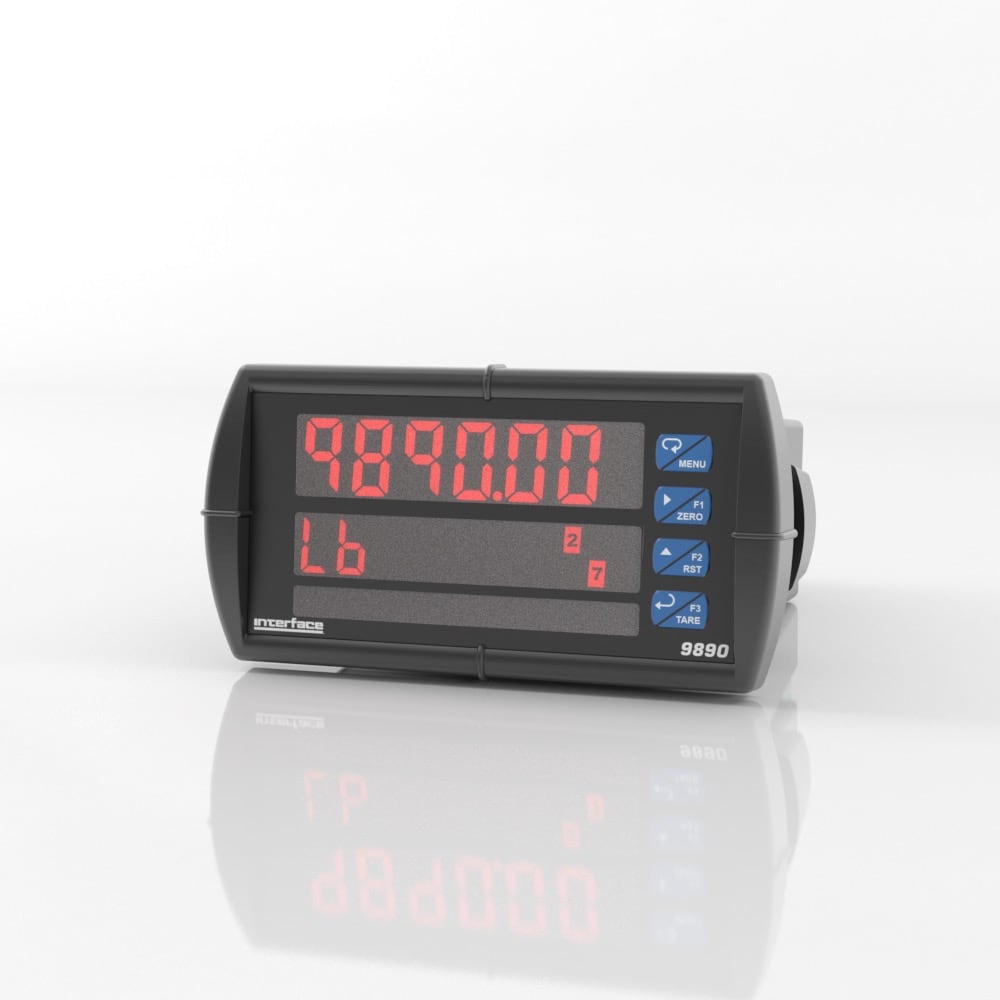
9890 Strain Gage, Load Cell, and mV/V Indicator

9890 STRAIN GAGE, LOAD CELL, & MV/V INDICATOR

Featured in these Case Studies

  • Protecting Ultra HD Monitors
  • Launching into Orbit with Interface

PRICING NOTICE

The pricing listed on our website is only for U.S. buyers and all pricing is subject to change without notice. Any inquiries for products from buyers outside of the U.S. will receive a quote and availability from the licensed distributor nearest your region. These prices will be based on product availability, currency conversions, markets, taxes, shipping costs, as well as local support.

9890 Strain Gage, Load Cell, and mV/V Indicator

mV/V Input Indicator

Get Your Free Quote

Model 9890 is a full-featured multipurpose, easy-to-use digital strain gage & load cell meter ideal for weight and force measurement applications. With a max current of 350 mA at 10 V, it can support up to twelve (12) 350 Ω load cells (minimum load resistance of 28 Ω), making it ideal for multipoint weight measurement applications. It accepts mV input signals up to 300 mV (unipolar) and ± 250 mV (bipolar). The 9890’s powerful dual-scale capability allows the measurement to be displayed in two different units of measure.

Product Downloads

Please login or register for Product Pricing and File Access

  • Data Sheet
  • Manual
  • Software
  • 9890 STP File

Model 9890 is a full-featured multipurpose, easy-to-use digital strain gage & load cell meter ideal for weight and force measurement applications. With a max current of 350 mA at 10 V, it can support up to twelve (12) 350 Ω load cells (minimum load resistance of 28 Ω), making it ideal for multipoint weight measurement applications. It accepts mV input signals up to 300 mV (unipolar) and ± 250 mV (bipolar). The 9890’s powerful dual-scale capability allows the measurement to be displayed in two different units of measure.

Please Login to view pricing and product downloads

Need a quote or looking to purchase this item?

Login, scroll to see your model descriptions and SKU part number, then use the Request for Quote button to submit your request.

Request a QuoteRequest a CAD File

SKU: N/A Categories: Instrumentation, Quickship, Data Logging Tags: And MV/V Indicator, Load Cell
  • Features and Benefits
  • Specifications
  • Dimensions
  • Connector Pin Diagram
  • Shipping Information
  • Product Video

Features and Benefits

  • Large Dual-Line 6-Digit Display, 0.60″ & 0.46″
  • 0.03% Accuracy
  • Peak and valley monitoring
  • 24-bit resolution
  • USB Port with programming and viewing software
  • Powers up to 12 x 350 ohm Sensors
  • 32-point linearization
  • ±15, ±25, ±150, ±250 mV Bipolar Input Ranges

Options

  • 12-24 VDC Power
  • 4-20mA Analog Output
  • Internal relays (2 or 4)
  • Large format display with 1.8″ digit height for increased visibility at distance (both lines, increases panel size)
  • RS232 & RS485 serial communication
  • Additional external relay module
  • Digital I/O expansion module
  • Scalable Analog Output 4-20mA

Accessories

  • Benchtop Enclosure
  • NEMA 4X Enclosure
  • Plexiglas bench top tilt stand

Specifications

Specifications


International System of Units (SI) dimensions and capacities are provided for conversion only. Standard products have U.S. capacities and dimensions. SI capacities available upon special request and at an additional cost.

Dimensions

Dimensions


International System of Units (SI) dimensions and capacities are provided for conversion only. Standard products have U.S. capacities and dimensions. SI capacities available upon special request and at an additional cost.

Connector Pin Diagram

Sensor Excitation Voltage Selection (EX+, EX-)


All meters, including models equipped with the 12-24 VDC power option, are shipped from the factory configured to provide 10 VDC excitation for the sensor. If the sensor requires 5 VDC excitation, the internal jumper J3 must be configured accordingly.

To access the voltage selection jumper:

  1. Remove all the wiring connectors.
  2. Unscrew the back cover.
  3. Slide out the back cover by about 1 ½ inches.
  4. Configure the J3 jumper, located behind the input signal connector, for the desired excitation voltage as shown.

⚠

Caution! Do not use 24V to power a strain Gage bridge. The 24 V jumper configuration should only be used for mV input applications from 4 wire sensors.

Sensor Excitation Voltage Selection

Connections


All connections are made to removable screw terminal connectors located at the rear of the meter.

⚠

Caution! Use copper wire with 60°C or 60/75°C insulation for all line voltage connections. Observe all safety regulations. Electrical wiring should be performed in accordance with all applicable national, state, and local codes to prevent damage to the meter and ensure personnel safety.

Connectors Labeling


The connectors’ label, affixed to the meter, shows the location of all connectors available with requested configuration.

⚠

Warning! Do not connect any equipment other than Interface Inc. expansion modules, cables, or meters to the RJ45 M-LINK connector. Otherwise damage will occur to the equipment and the meter.

Connector Labeling for Fully Loaded 9890

Power Connections


Power connections are made to a two-terminal connector labeled POWER on Figure 6. The meter will operate regardless of DC polarity connection. The + and – symbols are only a suggested wiring convention.

Power Connections

Signal Connections


Signal connections are made to a six-terminal connector labeled SIGNAL on Figure 6. The EX+ and EX- terminals are used to sense the sensor excitation voltage for ratiometric operation, when the sensor is powered externally (switch 1 is off).

Switch Configuration


Setup and programming is performed both through the front panel buttons and switch settings shown below. The switch configuration must correspond to the setup and programming starting on page 29 (same range, type, etc.).

Strain Gage Configuration Switch

Excitation (Switch 1)


The excitation switch designates whether the meter will use its internal power supply or an external power supply.

Switch 1 ON Excitation Internal Excitation When switch is turned ON, the 9890’s power supply is used.
OFF Excitation External Excitation When switch is turned OFF, an external power supply is used.

Range (Switch 2)


The range switch adjusts the gain of the internal circuitry. Narrower ranges require more amplification.

Switch 2 ON Range Higher Internal Gain Turn this switch ON for the following input ranges: 15, 30, ±15, or ±25 mV.
OFF Range Lower Internal Gain Turn this switch OFF for the following input ranges: 150, 300, ±150, or ±250 mV.

Polarity (Switch 3)


Switch 3 ON Polarity Range starts at zero (unipolar) Range starts below Turn this switch ON for the following input ranges: 15, 30, 150, or 300.
OFF Polarity Range starts below zero (bipolar) Turn this switch OFF for the following input ranges: ±15, ±25, ±150, or ±250 mV.

The polarity switch selects whether the range is unipolar and starts at zero (i.e. 0 to 30 mV) or bipolar and starts at a negative value, or below zero (i.e. -15 to +15 mV).

Source (Switch 4)


The source switch tells the 9890 whether the input is a strain Gage bridge (i.e. Multiple Strain Gages Connected Through Junction Box diagram below), or it is a signal from a 2 or 4 wire transducer, or mV source (i.e. mV Transducer Input Connections diagram below) .

Switch 4 ON Source Source is mV input transducer Turn this switch ON if the connected source is a transducer*
OFF Source Source is strain gage bridge Turn this switch OFF if the source is a strain gage bridge

*Ratio should be set to NO in Setup Input Menu

Shunt Resistor (Switch 5)


The 9890 provides a means of simulating strain in a strain Gage bridge circuit via a 60.4KΩ shunt resistor included in the meter. This will simulate an approximate 70% full-scale load in the case of a 350Ω strain bridge.

Switch 5 ON Shunt Shunt resistor is connected to the input bridge. Turn switch ON when you want to simulate a strain load
OFF Shunt Shunt resistor is disconnected from the input bridge. Turn this switch OFF to remove the shunt resistor

Strain Gage Connections


The following figures show examples of strain Gage connections. There is a 5-position DIP switch (CONFIG) to set up the input ranges and ratiometric operation.

NOTE: Refer to the 9890 Strain Gage, Load Cell, and mV/V Indicator Installation & User Manual Switch Configuration starting on page 12 for proper configuration switch positioning.

Strain Gage Powered by Internal Supply

Strain Gage Powered by External Supply

NOTE: Refer to Switch Configuration starting on page 12 for proper switch positioning for the following wiring configurations.

When connecting multiple strain gauges to the meter, each must be wired in parallel. This is typically done with the use of a junction box.

Multiple Strain Gages Connected Through Junction Box

mV Transducer Input Connections

Shunt Calibration


The 9890 is equipped with a means of simulating strain in a strain gauge bridge circuit, via an included shunt resistor in the meter. This technique is performed by enabling the “shunt resistor” switch (switch 5), which in turn shunts one leg of a connected strain bridge with a predetermined resistive load (60.4k). This technique can be used as a means of verifying instrumentation by simulating a physical input. With no load connected, the enabling of the shunt resistor (switch 5) will simulate approximately a 70% F.S. load in the case of a 350Ω Strain Bridge.

Shunt Resistor

Modbus RTU Serial Communications


Serial communications connection is made to an RJ45 connector labeled M-LINK on Error! Reference source not found. For interfacing to the 9890 use the 989X-232 for RS-232 or the 989X-485 for RS485. The same port is used for interfacing with all expansion modules (e.g. external relays, digital I/O).

Relay Connections


Relay connections are made to two six-terminal connectors labeled RELAY1 – RELAY4 on Figure 6. Each relay’s C terminal is common only to the normally open (NO) and normally closed (NC) contacts of the corresponding relay. The relays’ C terminals should not be confused with the COM (common) terminal of the INPUT SIGNAL connector.

Relay Connections

Switching Inductive Loads


The use of suppressors (snubbers) is strongly recommended when switching inductive loads to prevent disrupting the microprocessor’s operation. The suppressors also prolong the life of the relay contacts. Suppression can be obtained with resistor-capacitor (RC) networks assembled by the user or purchased as complete assemblies. Refer to the following circuits for RC network assembly and installation:

AC and DC Loads Protection

Choose R and C as follows:

R: 0.5 to 1 Ω for each volt across the contacts
C: 0.5 to 1 µF for each amp through closed contacts

Notes:

  1. Use capacitors rated for 250 VAC.
  2. RC networks may affect load release time of solenoid loads. Check to confirm proper operation.
  3. Install the RC network at the meter’s relay screw terminals. An RC network may also be installed across the load. Experiment for best results.

Low Voltage DC Loads Protection

RC Networks Available from Interface Inc.


RC networks are available from Interface Inc. and should be applied to each relay contact switching an inductive load. Part number: PDX6901.

Note: Relays are de-rated to 1/14th HP (50 watts) with an inductive load.

4-20 mA Output Connections


Connections for the 4-20 mA transmitter output are made to the connector terminals labeled MA OUT. The 4-20 mA output may be powered internally or from an external power supply.

4-20 mA Output Connection

Analog Output Power Supply


If the analog output is not using the 24 VDC supply to power the output loop, it can be used for other things. The I+ Terminal is the +24 V and the R terminal is the return.

F4 Digital Input Connections


A digital input, F4, is standard on the meter. This digital input is connected with a normally open contact across F4 and COM, or with an active low signal applied to the F4. The functionality of the F4 input is set up in the Advanced Features, User menu.

F4 Digital Input Connections

External Relays & Digital I/O Connections


The relay and the digital I/O expansion modules PDA1004 & PDA1044 are connected to the meter using a CAT5 cable provided with each module. The two RJ45 connectors on the expansion modules are identical and interchangeable; they are used to connect additional modules to the system. Note: The jumper located between the RJ45 connectors of the PDA1044 must be removed on the second digital I/O module in order for the system to recognize it as module #2.

⚠

Warning! Do not connect or disconnect the expansion modules with the power on! More detailed instructions are provided with each optional expansion module.

Expansion Modules & DIN Rail Mounting Kit

External Relays Module Connections

Digital I/O Module Connections

Interlock Relay Feature


As the name implies, the interlock relay feature reassigns one, or more, alarm/control relays for use as interlock relay(s). Interlock contact(s) are wired to digital input(s) and trigger the interlock relay. This feature is enabled by configuring the relay, and relative digital input(s) (Refer to the 9890 Strain Gage, Load Cell, and mV/V Indicator Installation & User Manual, Page 39.). In one example, dry interlock contacts are connected in series to one digital input which will be used to force on (energize) the assigned interlock power relay when all interlock contacts are closed (safe). The interlock relay front panel LED flashes when locked out. The interlock relay would be wired in-series with the load (N/O contact). See below.

Interlock Connections

For more information visit Electrical Wiring Diagrams

Additional Information

Dimensions 6 × 4.68 × 2.45 in

Product Video

  • Features and Benefits
  • Specifications
  • Dimensions
  • Connector Pin Diagram
  • Shipping Information
  • Product Video

Features and Benefits

  • Large Dual-Line 6-Digit Display, 0.60″ & 0.46″
  • 0.03% Accuracy
  • Peak and valley monitoring
  • 24-bit resolution
  • USB Port with programming and viewing software
  • Powers up to 12 x 350 ohm Sensors
  • 32-point linearization
  • ±15, ±25, ±150, ±250 mV Bipolar Input Ranges

Options

  • 12-24 VDC Power
  • 4-20mA Analog Output
  • Internal relays (2 or 4)
  • Large format display with 1.8″ digit height for increased visibility at distance (both lines, increases panel size)
  • RS232 & RS485 serial communication
  • Additional external relay module
  • Digital I/O expansion module
  • Scalable Analog Output 4-20mA

Accessories

  • Benchtop Enclosure
  • NEMA 4X Enclosure
  • Plexiglas bench top tilt stand

Specifications

Specifications


International System of Units (SI) dimensions and capacities are provided for conversion only. Standard products have U.S. capacities and dimensions. SI capacities available upon special request and at an additional cost.

Dimensions

Dimensions


International System of Units (SI) dimensions and capacities are provided for conversion only. Standard products have U.S. capacities and dimensions. SI capacities available upon special request and at an additional cost.

Connector Pin Diagram

Sensor Excitation Voltage Selection (EX+, EX-)


All meters, including models equipped with the 12-24 VDC power option, are shipped from the factory configured to provide 10 VDC excitation for the sensor. If the sensor requires 5 VDC excitation, the internal jumper J3 must be configured accordingly.

To access the voltage selection jumper:

  1. Remove all the wiring connectors.
  2. Unscrew the back cover.
  3. Slide out the back cover by about 1 ½ inches.
  4. Configure the J3 jumper, located behind the input signal connector, for the desired excitation voltage as shown.

⚠

Caution! Do not use 24V to power a strain Gage bridge. The 24 V jumper configuration should only be used for mV input applications from 4 wire sensors.

Sensor Excitation Voltage Selection

Connections


All connections are made to removable screw terminal connectors located at the rear of the meter.

⚠

Caution! Use copper wire with 60°C or 60/75°C insulation for all line voltage connections. Observe all safety regulations. Electrical wiring should be performed in accordance with all applicable national, state, and local codes to prevent damage to the meter and ensure personnel safety.

Connectors Labeling


The connectors’ label, affixed to the meter, shows the location of all connectors available with requested configuration.

⚠

Warning! Do not connect any equipment other than Interface Inc. expansion modules, cables, or meters to the RJ45 M-LINK connector. Otherwise damage will occur to the equipment and the meter.

Connector Labeling for Fully Loaded 9890

Power Connections


Power connections are made to a two-terminal connector labeled POWER on Figure 6. The meter will operate regardless of DC polarity connection. The + and – symbols are only a suggested wiring convention.

Power Connections

Signal Connections


Signal connections are made to a six-terminal connector labeled SIGNAL on Figure 6. The EX+ and EX- terminals are used to sense the sensor excitation voltage for ratiometric operation, when the sensor is powered externally (switch 1 is off).

Switch Configuration


Setup and programming is performed both through the front panel buttons and switch settings shown below. The switch configuration must correspond to the setup and programming starting on page 29 (same range, type, etc.).

Strain Gage Configuration Switch

Excitation (Switch 1)


The excitation switch designates whether the meter will use its internal power supply or an external power supply.

Switch 1 ON Excitation Internal Excitation When switch is turned ON, the 9890’s power supply is used.
OFF Excitation External Excitation When switch is turned OFF, an external power supply is used.

Range (Switch 2)


The range switch adjusts the gain of the internal circuitry. Narrower ranges require more amplification.

Switch 2 ON Range Higher Internal Gain Turn this switch ON for the following input ranges: 15, 30, ±15, or ±25 mV.
OFF Range Lower Internal Gain Turn this switch OFF for the following input ranges: 150, 300, ±150, or ±250 mV.

Polarity (Switch 3)


Switch 3 ON Polarity Range starts at zero (unipolar) Range starts below Turn this switch ON for the following input ranges: 15, 30, 150, or 300.
OFF Polarity Range starts below zero (bipolar) Turn this switch OFF for the following input ranges: ±15, ±25, ±150, or ±250 mV.

The polarity switch selects whether the range is unipolar and starts at zero (i.e. 0 to 30 mV) or bipolar and starts at a negative value, or below zero (i.e. -15 to +15 mV).

Source (Switch 4)


The source switch tells the 9890 whether the input is a strain Gage bridge (i.e. Multiple Strain Gages Connected Through Junction Box diagram below), or it is a signal from a 2 or 4 wire transducer, or mV source (i.e. mV Transducer Input Connections diagram below) .

Switch 4 ON Source Source is mV input transducer Turn this switch ON if the connected source is a transducer*
OFF Source Source is strain gage bridge Turn this switch OFF if the source is a strain gage bridge

*Ratio should be set to NO in Setup Input Menu

Shunt Resistor (Switch 5)


The 9890 provides a means of simulating strain in a strain Gage bridge circuit via a 60.4KΩ shunt resistor included in the meter. This will simulate an approximate 70% full-scale load in the case of a 350Ω strain bridge.

Switch 5 ON Shunt Shunt resistor is connected to the input bridge. Turn switch ON when you want to simulate a strain load
OFF Shunt Shunt resistor is disconnected from the input bridge. Turn this switch OFF to remove the shunt resistor

Strain Gage Connections


The following figures show examples of strain Gage connections. There is a 5-position DIP switch (CONFIG) to set up the input ranges and ratiometric operation.

NOTE: Refer to the 9890 Strain Gage, Load Cell, and mV/V Indicator Installation & User Manual Switch Configuration starting on page 12 for proper configuration switch positioning.

Strain Gage Powered by Internal Supply

Strain Gage Powered by External Supply

NOTE: Refer to Switch Configuration starting on page 12 for proper switch positioning for the following wiring configurations.

When connecting multiple strain gauges to the meter, each must be wired in parallel. This is typically done with the use of a junction box.

Multiple Strain Gages Connected Through Junction Box

mV Transducer Input Connections

Shunt Calibration


The 9890 is equipped with a means of simulating strain in a strain gauge bridge circuit, via an included shunt resistor in the meter. This technique is performed by enabling the “shunt resistor” switch (switch 5), which in turn shunts one leg of a connected strain bridge with a predetermined resistive load (60.4k). This technique can be used as a means of verifying instrumentation by simulating a physical input. With no load connected, the enabling of the shunt resistor (switch 5) will simulate approximately a 70% F.S. load in the case of a 350Ω Strain Bridge.

Shunt Resistor

Modbus RTU Serial Communications


Serial communications connection is made to an RJ45 connector labeled M-LINK on Error! Reference source not found. For interfacing to the 9890 use the 989X-232 for RS-232 or the 989X-485 for RS485. The same port is used for interfacing with all expansion modules (e.g. external relays, digital I/O).

Relay Connections


Relay connections are made to two six-terminal connectors labeled RELAY1 – RELAY4 on Figure 6. Each relay’s C terminal is common only to the normally open (NO) and normally closed (NC) contacts of the corresponding relay. The relays’ C terminals should not be confused with the COM (common) terminal of the INPUT SIGNAL connector.

Relay Connections

Switching Inductive Loads


The use of suppressors (snubbers) is strongly recommended when switching inductive loads to prevent disrupting the microprocessor’s operation. The suppressors also prolong the life of the relay contacts. Suppression can be obtained with resistor-capacitor (RC) networks assembled by the user or purchased as complete assemblies. Refer to the following circuits for RC network assembly and installation:

AC and DC Loads Protection

Choose R and C as follows:

R: 0.5 to 1 Ω for each volt across the contacts
C: 0.5 to 1 µF for each amp through closed contacts

Notes:

  1. Use capacitors rated for 250 VAC.
  2. RC networks may affect load release time of solenoid loads. Check to confirm proper operation.
  3. Install the RC network at the meter’s relay screw terminals. An RC network may also be installed across the load. Experiment for best results.

Low Voltage DC Loads Protection

RC Networks Available from Interface Inc.


RC networks are available from Interface Inc. and should be applied to each relay contact switching an inductive load. Part number: PDX6901.

Note: Relays are de-rated to 1/14th HP (50 watts) with an inductive load.

4-20 mA Output Connections


Connections for the 4-20 mA transmitter output are made to the connector terminals labeled MA OUT. The 4-20 mA output may be powered internally or from an external power supply.

4-20 mA Output Connection

Analog Output Power Supply


If the analog output is not using the 24 VDC supply to power the output loop, it can be used for other things. The I+ Terminal is the +24 V and the R terminal is the return.

F4 Digital Input Connections


A digital input, F4, is standard on the meter. This digital input is connected with a normally open contact across F4 and COM, or with an active low signal applied to the F4. The functionality of the F4 input is set up in the Advanced Features, User menu.

F4 Digital Input Connections

External Relays & Digital I/O Connections


The relay and the digital I/O expansion modules PDA1004 & PDA1044 are connected to the meter using a CAT5 cable provided with each module. The two RJ45 connectors on the expansion modules are identical and interchangeable; they are used to connect additional modules to the system. Note: The jumper located between the RJ45 connectors of the PDA1044 must be removed on the second digital I/O module in order for the system to recognize it as module #2.

⚠

Warning! Do not connect or disconnect the expansion modules with the power on! More detailed instructions are provided with each optional expansion module.

Expansion Modules & DIN Rail Mounting Kit

External Relays Module Connections

Digital I/O Module Connections

Interlock Relay Feature


As the name implies, the interlock relay feature reassigns one, or more, alarm/control relays for use as interlock relay(s). Interlock contact(s) are wired to digital input(s) and trigger the interlock relay. This feature is enabled by configuring the relay, and relative digital input(s) (Refer to the 9890 Strain Gage, Load Cell, and mV/V Indicator Installation & User Manual, Page 39.). In one example, dry interlock contacts are connected in series to one digital input which will be used to force on (energize) the assigned interlock power relay when all interlock contacts are closed (safe). The interlock relay front panel LED flashes when locked out. The interlock relay would be wired in-series with the load (N/O contact). See below.

Interlock Connections

For more information visit Electrical Wiring Diagrams
Additional Information

Dimensions 6 × 4.68 × 2.45 in

Product Video

Short Description Sku Price
Model 9890 Strain Gage, Load Cell, & mV/V Indicator, AC Power 9890-000-1 $ 650
Model 9890 Strain Gage, Load Cell, & mV/V Indicator, DC Power 9890-000-3 $ 745
Model 9890 Strain Gage, Load Cell, & mV/V Indicator, AC Power, 4-20mA Output 9890-001-1 $ 775
Model 9890 Strain Gage, Load Cell, & mV/V Indicator, DC Power, 4-20mA Output 9890-001-3 $ 870
Model 9890 Strain Gage, Load Cell, & mV/V Indicator, AC Power, 4-20mA Output, 4-Relays 9890-041-1 $ 900
Model 9890 Strain Gage, Load Cell, & mV/V Indicator, DC Power, 4-20mA Output, 4-Relays 9890-041-3 $ 950
×

Variation Image

Additional Products

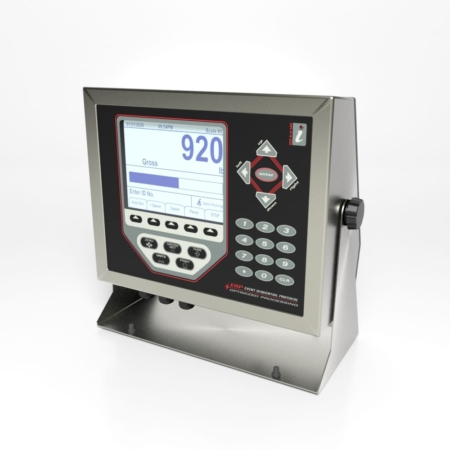
  • 480 Bidirectional Weight Indicator

    480 Bidirectional Weight Indicator

    Buy Now!Please Login to view pricing and product downloads
    Read more
  • CSD Embedded Load Cell Converter and Digitizer Module

    Buy Now!Please Login to view pricing and product downloads
    Read more
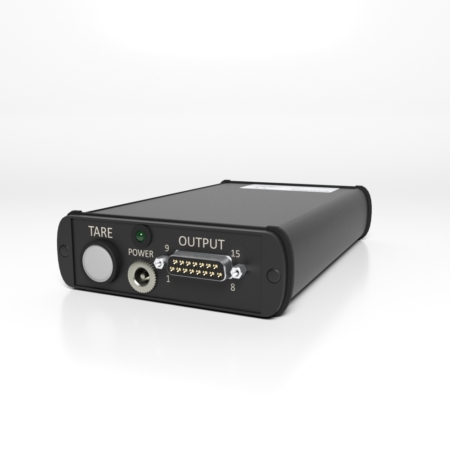
  • DIG-USB USB Output Module

    Buy Now!Please Login to view pricing and product downloads
    Read more Show Details
  • 1280 Programmable Weight Indicator and Controller

    1280 Programmable Weight Indicator and Controller

    Buy Now!Please Login to view pricing and product downloads
    Read more

Featured in these Application Notes

    Aircraft Lifting Equipment Hydraulic Jacking System Testing Furniture Fatigue Cycle Testing Prosthetics Load and Fatigue Testing Surgical Stapler Force Verification


All Products

  • Load Cells
  • Interface Mini
  • Load Button Load Cells
  • Multi-Axis Sensors
  • Torque Transducers
  • Load Pins, Tension Links, and Load Shackles
  • Instrumentation
  • Digital Instrumentation
  • Wireless Telemetry System
  • Bluetooth® Telemetry System
  • Intrinsically Safe
  • Calibration Systems
  • Accessories
  • G-Series

Contact Us

  • Customer Support
  • Contact Form
  • Career Opportunities
  • Certifications and Compliance
  • Locate A Rep or Distributor

Solutions

  • ForceEDU
  • Custom Solutions
  • Industry Solutions
  • Application Notes
  • Animated Application Notes
  • Case Studies
  • White Papers
  • Interface Training Videos

Services

  • Calibration and Repair Request
  • Load Cell Troubleshooting
  • Software and Drivers
  • Technical Library

News

  • Events
  • Newsletter
  • Interface IQ Blog
  • InterfaceIQ Podcast
ISO 17025 Scope Accreditation
Copyright 2026 - Interface, Inc.
  • Warranty And Repair Policy
  • Privacy Policy
  • Certifications and Compliance
T25 High Speed Shaft Style Rotary Torque Transducer 9840 CALIBRATION GRADE MULTI-CHANNEL LOAD CELL INDICATOR 9840 Calibration Grade Multi-Channel Load Cell Indicator
Scroll to top

We use cookies to enhance your browsing experience, serve personalized content, and analyze our traffic. By clicking "Accept All Cookies", you consent to our use of cookies.

Accept All CookiesReject AllCookie Settings

Cookie and Privacy Settings


How we use cookies

How we use cookies

We may request cookies to be set on your device. We use cookies to let us know when you visit our websites, how you interact with us, to enrich your user experience, and to customize your relationship with our website.

Click on the different category headings to find out more. You can also change some of your preferences. Note that blocking some types of cookies may impact your experience on our websites and the services we are able to offer.

Essential Website Cookies

Essential Website Cookies

These cookies are strictly necessary to provide you with services available through our website and to use some of its features.

Because these cookies are strictly necessary to deliver the website, you cannot refuse them without impacting how our site functions. You can block or delete them by changing your browser settings and force blocking all cookies on this website.

Google Analytics Cookies

Google Analytics Cookies

These cookies collect information that is used either in aggregate form to help us understand how our website is being used or how effective our marketing campaigns are, or to help us customize our website and application for you in order to enhance your experience.

If you do not want us to track your visit to our site, you can disable tracking in your browser here:

Other external services

Other external services

We also use different external services like Google Webfonts, Google Maps and external Video providers. Since these providers may collect personal data like your IP address we allow you to block them here. Please be aware that this might heavily reduce the functionality and appearance of our site. Changes will take effect once you reload the page.

Google Webfont Settings:

Google Map Settings:

Privacy Policy

Privacy Policy

I agree to the terms and conditions laid out in the Privacy Policy

Update Your SettingsDo not accept and hide notification
Open Message Bar

Please share your location to continue.

Check our help guide for more info.

share your location