6A55RI 6-Axis Robot Flange Force-Torque Sensor

6A55RI 6-Axis Robot Flange Force-Torque Sensor Fx (N), Fy (N), Fz (N), Mx (Nm), My (Nm), Mz (Nm) System

The 6A55RI 6-Axis Robot Flange Force-Torque Sensor integrates directly into the customer’s EtherCAT P system to provide real-time measurement of forces in three axes (Fx, Fy, Fz) and moments in three axes (Mx, My, Mz). Its integrated EtherCAT P measuring amplifier handles signal conditioning and digital communication while allowing both sensor power and measurement data to travel through a single 4-wire connection. This eliminates the need for a separate external amplifier and simplifies integration with the customer’s EtherCAT-compatible PLC, industrial PC, robot controller, or automation system. The customer can acquire synchronized 6-axis force and torque data at data frequencies from 1 Hz to 1000 Hz for monitoring, feedback control, testing, robotic force control, and other automated processes. The ISO 9409-1 robotic flange also makes the sensor particularly well suited for integration between a robot and an end-of-arm tool or other mechanical assembly.
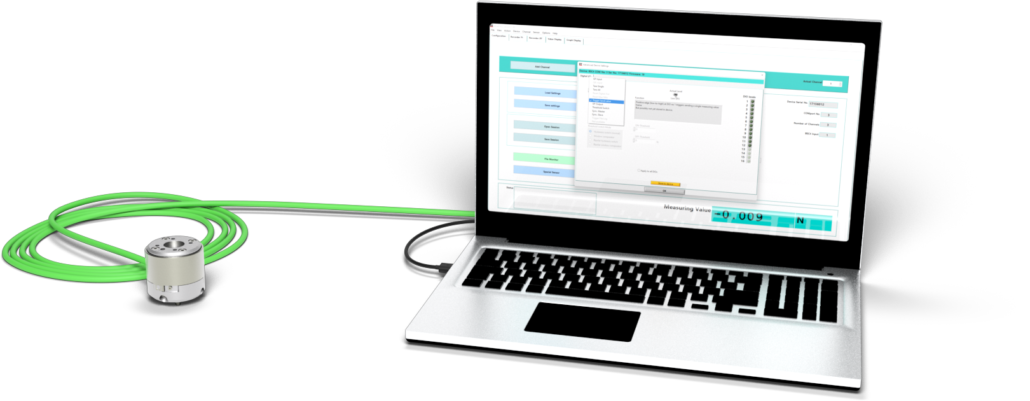
  • 6A55RI 6-Axis Robot Flange Force-Torque Sensor:
    • Robotic Flange ISO 9409-1
    • EtherCAT P measuring amplifier
    • 6-axis force-torque sensor
    • 5m EtherCAT P cable, 4-pole, shielded, PUR, suitable for drag chains
    • Assembled with EtherCat P M8 circular connector
    • Data frequency 1Hz – 1000 Hz
6A55RI System

Applications:

  • Robotics
  • Medical Technology
  • Measurements in Automation Technology
  • Mounting and Assembling of Parts in Production Lines
  • 6-Axis Force/Torque Platforms Consisting of 4x 3AR Sensors
  • Research and Testing

System Components

6A55RI

3AR Round 3-Axis Load Cells

Fx (N), Fy (N), Fz (N)

Force/Torque: 450lbf/2.2Klbf, 1.1Klbf/4.5Klbf, 2.2Klbf/6.7Klbf, 4.5Klbf/13.5Klbf to 33.7Klbf/90Klbf, 45Klbf/180Klbf, 56.2Klbf/225Klbf
Force/Torque: 2kN/10kN, 5kN/20kN, 10kN/30kN, 20kN/60kN to 150kN/400kN, 200kN/800kN, 250kN/1MN

Interface’s 3AR 3-axis load cell measures forces simultaneously in 3 mutually perpendicular axes: X, Y, and Z – tension and compression. Each axis provides a unique mV/V output and requires no mathematical manipulation. The 3-axis load cell is built to minimize eccentric loading effects and crosstalk between axes. The 3AR Series 3-axis load cell is ideally suited to many industrial and scientific applications, such as aerospace, robotics, automotive and medical research (orthopedics and bio-mechanical). The load cell is provided in various capacity ranges and sizes with each of the three axes providing the same capacity. We are happy to work with your design needs – providing a custom design if warranted for varying capacities (between X, Y, and Z), higher temperature capability, or OEM/private labeling if needed.

Features & Benefits

  • Robotic Flange ISO 9409-1
  • EtherCAT P measuring amplifier
  • 6-axis force-torque sensor
  • 5m EtherCAT P cable, 4-pole, shielded, PUR, suitable for drag chains
  • Assembled with EtherCat P M8 circular connector
  • Data frequency 1Hz – 1000 Hz

Options

  • Special calibration

Options

  • CT-XXX-2M 2-meter cable with M8 EtherCAT P connector
  • CT-XXX-5M 5-meter cable with M8 EhterCAT P connector
  • CT-XXX-10M 10-meter cable with M8 EhterCAT P connector
  • CT-XXY-2M 2-meter cable with RJ45 connector
  • CT-XXY-5M 5-meter cable with RJ45 connector
  • CT-XXY-10M 10-meter cable with RJ45 connector
Setup 6AXX Sensor SS

BlueDAQ Software

The BlueDAQ software is suitable for live viewing, recording, and analysis of stored measuring data. The multiple channels can be recorded over the time axis (y-t diagram) or via an “X-axis” (X-Y diagram). The BlueDAQ software is available for models BSC1, BSC2, BSC4D, BX6, BX8, and the 9330. The measuring data is stored in binary “TDMS” by recording and can be opened, displayed, and exported in text or Excel format with the integrated “File Monitor”.

Features & Benefits

  • Setting the Measuring Frequency
  • Setting the display (unit and scaling factor)
  • Calculate the Scaling Factor for sensors (force, displacement, torque, and active sensors with voltage or current output)
  • Online Monitor (graphical live display)
  • Setting the Digital Filter
  • Simulation of the Digital Filter (represent frequency response and step response)
  • Configuration of Analog Outputs (BX8)
  • Configuration of the Digital I/O Ports (BSC4D, BX6, and BX8)
  • Configuration of the CAN Bus parameters (BX6 / BX8)
  • Loading and saving of the complete settings (Sessions) to file
  • Loading and saving of configurations (Settings) in the amplifier memory
  • Loading and exporting (Excel and CSV) of stored data (File-Monitor)
  • Integrating of the calibration matrix for 3-axis sensor (5AR) and 6-axis sensor (6AXX and 6ADF)
  • Stress analysis with strain gages rosettes
  • Hardware triggered data recording via digital input (BSC4D / BX8)
  • Software Triggered data recording via threshold value over, undershoot, or timed
  • Call Parameters for inclusion in scripts and batch files or Windows Task Scheduler
  • Context help
  • Opening multiple graphical life displays
  • Setting the axis scaling “autoscale” or fixed
  • Assigning of the Channel Names
  • Live display of the spectral power density (frequency analysis)
  • Useful keyboard “Shortcuts“, like F12, Ctrl-Z, and Ctrl-A
  • Reading and writing of TEDS with BX8
  • Large Display of measuring values
  • Configuration of Data Format
  • Administration Settings: Lock (write protection against unauthorized configuration), Operating hours counter, and error memory
SystemLevelCalibration

System Level Calibration

Interface strongly recommends requesting a system-level calibration when purchasing a force measurement sensor with instrumentation. This final step ensures the sensor and instrumentation are properly calibrated and functioning together before leaving Interface.