Solution


Proving Theoretical Cutting Forces of Rotary Ultrasonic Machining

Rotary ultrasonic machining is a hybrid process that combines diamond grinding with ultrasonic machining to provide fast, high-quality drilling of many ceramic and glass applications. This new method has been theoretically proven using computer models. Proving this theory in the real world requires a better understanding of the forces happening during the machining process.
Summary

  • Customer Need / Challenge

    Rotary ultrasonic machining is a hybrid process that combines diamond grinding with ultrasonic machining to provide fast, high-quality drilling of many ceramic and glass applications. This new method has been theoretically proven using computer models. Rotary ultrasonic machining generates forces of a very small magnitude. To prove this theory, any load cell used for measurement must be sensitive, while at the same time retaining high structural stiffness within a compact, low-profile envelope.

  • Interface Solution

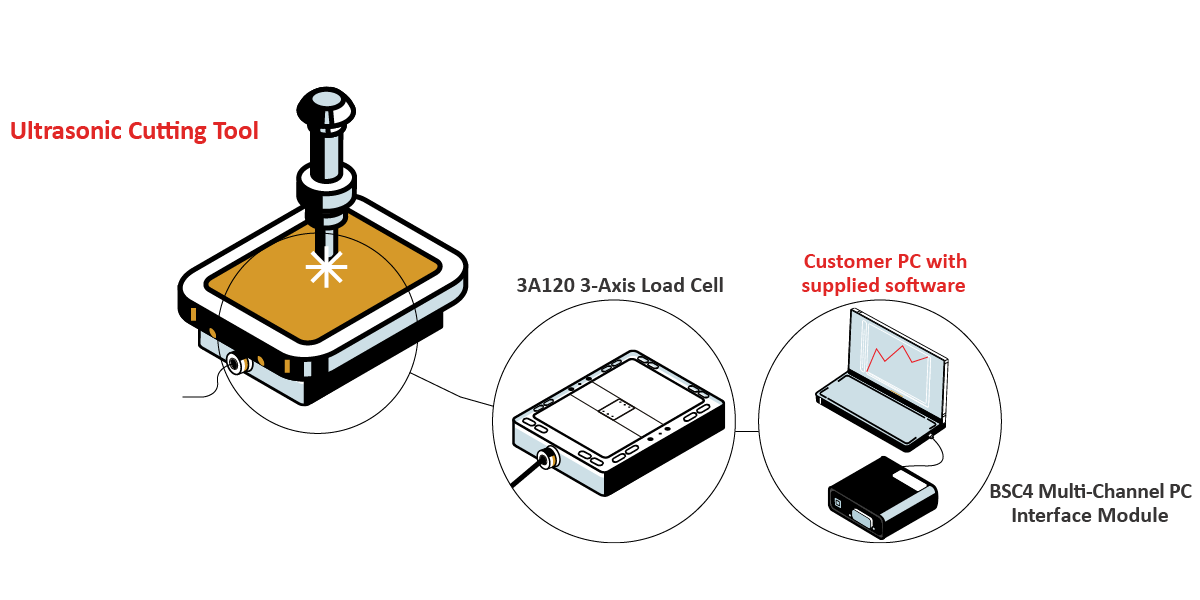
    Interface’s 3A120 3-Axis load cell is installed in the rotary ultrasonic machine to measure the forces being applied to a sample part. With clear signals and minimal crosstalk, the applied forces are recorded and stored using an the BSC4D Multi-Channel PC Interface Module.

  • Results

    The 3-Axis load cell provides excellent data helping uncover the relationship between machine cutting parameters and the forces applied on the component. Using this knowledge the machining process can be reliably optimized for new materials and operations.

Materials


  • 3A120 3-Axis Load Cell
  • BSC4D Multi-Channel PC Interface Module
  • Appropriate Cabling

How it Works


  1. A 3A120 3-Axis load cell is installed on the cross slide of the machine.
  2. The test material is fixed to the load cell.
  3. The load machine runs its program on the part.
  4. The load cell reacts to the forces on the part during machining.
  5. The signals are logged and stored using the BSC4D Multi-Channel PC Interface Module, and the customer’s laptop.
  6. The data is studied to better understand the rotary ultrasonic machining process.

Download PDF